At the table of a state dinner, nothing is left to chance, and especially not what seems incidental. The guest sees a dish; the protocol sees a message. Because an official meal is not primarily a gastronomic demonstration: it is an exercise in high precision, where hospitality must deal with geopolitics, religion, public health and the image of the host country. The question that haunts palace kitchens is simple to formulate, formidable to resolve: how to feed a distinguished guest when each ingredient can become a signal?
The menu, an invisible diplomatic document
An official menu is conceived as an archive piece even before being a meal. At the US State Department, the composition of a state dinner begins about six months in advance, and the dishes deliberately refer to the country of the guest of honor. At Buckingham Palace, banquet cards are written in French, a tradition inherited from classical diplomacy, and invitations go out two months before the evening. None of this is decorative. The choice of a local product, a grape variety or a dessert affirms an identity and shows deference. The presidential kitchen thus becomes a showcase: at the Élysée, chef Guillaume Gomez, in the palace’s kitchen since 1997, claims to present the best of French gastronomy as one presents his credentials.
Five constraints for a single table
1/ Religious constraints
This is the most visible fault line. Palaces commonly adapt their menus to dietary restrictions: no pork or alcoholic preparations for certain guests. But custom also dictates that the rules of the host country apply during an official visit, recalls diplomat and academic Jean-Paul Pancracio. Hence the famous standoffs over wine. In 1999, the visit of Iranian President Mohammad Khatami was postponed after a disagreement over alcohol at the Élysée table; in 2015, a lunch planned for Hassan Rouhani was canceled altogether, Paris deeming the wine “non-negotiable”. In Rome, the same year, Italy chose another path: serving wine by the glass, on demand, rather than placing it on the tablecloth.
2/ Health constraints and allergies
Before being an art, a state dinner is a health operation. The protocol services transmit in advance the likes, dislikes and medical restrictions of each delegation. A former British royal chef, Darren McGrady, describes obsessive quality control: to obtain 96 perfect pears, kitchens have 250 delivered and inspect them one by one. Allergies, diets, food safety: the slightest flaw would result in diplomatic incidents as well as discomfort.
3/ Political and geopolitical constraints
The menu can also replay, implicitly, the state of bilateral relations. Serving a wine from a vineyard owned by the diaspora of the guest country, highlighting a cereal that this country promotes on the international scene: so many calculated winks. In 2023, the White House offered Indian Prime Minister Narendra Modi his first all-vegetarian state dinner, respecting his diet while celebrating millet, which India was then promoting globally. Attention becomes a political argument.
4/ Protocol and precedence constraints
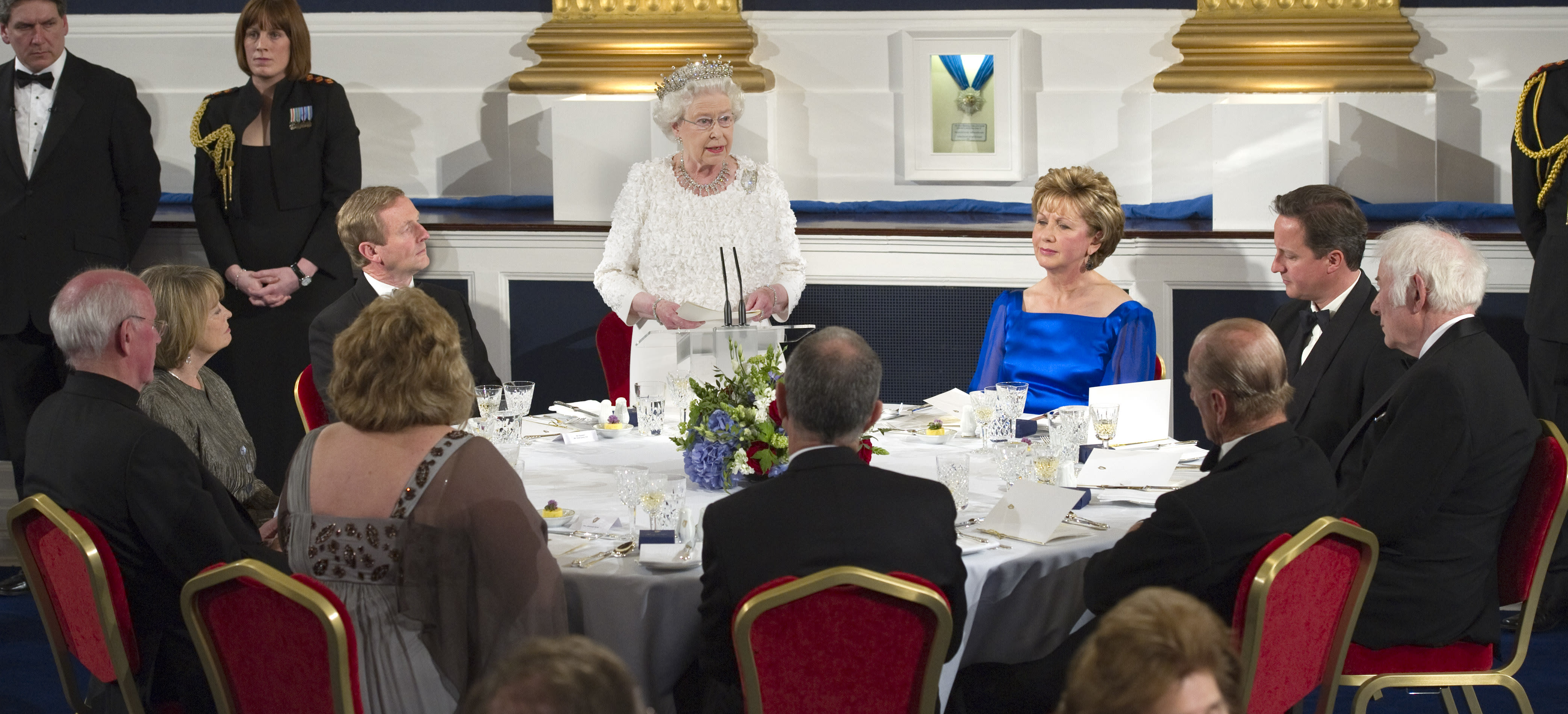
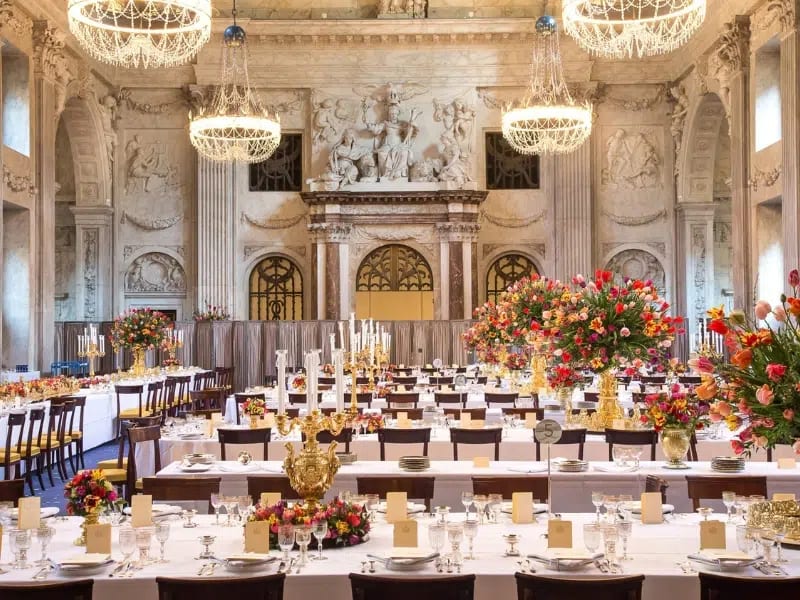
The order matters as much as the map. At Buckingham, the guests - around 170 - sit around a horseshoe table, the sovereign and the foreign head of state at the top. The service itself mobilizes a heritage: the ceremonial tableware, comprising several thousand pieces, requires eight people three weeks of preparation. Each place, each glass, each turn of duty obeys a grammar of precedence.
5/ Constraints linked to the image of the host country
Finally, the plate speaks of the receiving country. The palaces house a national story: terroirs, know-how, season. It’s the most assertive part of diplomatic gastronomy - the one that transforms an official meal into a self-portrait.
An invisible human chain
None of this would hold without a discreet chain. The diplomatic services identify food constraints; the protocol sets precedence and unfolds; kitchens translate these imperatives into dishes; the butlers orchestrate a meticulous service.
A successful state dinner is not judged by the number of stars of its cuisine, but by everything that did not happen: the odd thing avoided, the forbidden circumvented, the allergy anticipated, the susceptibility taken care of.
Gastronomy is only one surface. Below works a precision mechanism where religion, health, politics and protocol are played out, in silence. The great art of palaces consists of passing off this tension as simple hospitality - and ensuring that the guest, sated, never suspects the number of messages he has just swallowed.