Couscous could have become a jealously contested national trophy. It has become a shared heritage: the delicious story of a thousand-year-old tradition which, for the duration of a UNESCO file, brought together Algeria, Morocco, Tunisia and Mauritania around the same table.
There are dishes that divide nations. This one did the opposite.
On December 16, 2020, a decision adopted by UNESCO went almost unnoticed. Yet it is a diplomatic miracle. Algeria, Morocco, Tunisia and Mauritania jointly obtain the inscription of “knowledge, know-how and practices linked to the production and consumption of couscous” on the Representative List of the Intangible Cultural Heritage of Humanity.
Together. In a Maghreb affected by political tensions, where the land border between Algeria and Morocco has been closed since 1994, four states have agreed to include their names on the same file. Not to defend a territory or negotiate a treaty, but to gain recognition for gestures, customs and traditions gathered around a few grains of semolina.
Diplomacy often fails where cooking sometimes succeeds.
A heritage made of gestures
Couscous is first and foremost a gesture. That of the hand that patiently works the semolina, moistens it and rolls it in circular movements until it forms thousands of regular grains.
This gesture, transmitted within families and long learned through observation, constitutes the true heart of the heritage recognized by UNESCO. Because the 2020 inscription does not establish either an official recipe or the property of a country. It distinguishes a set of know-how, utensils, social practices and forms of transmission.
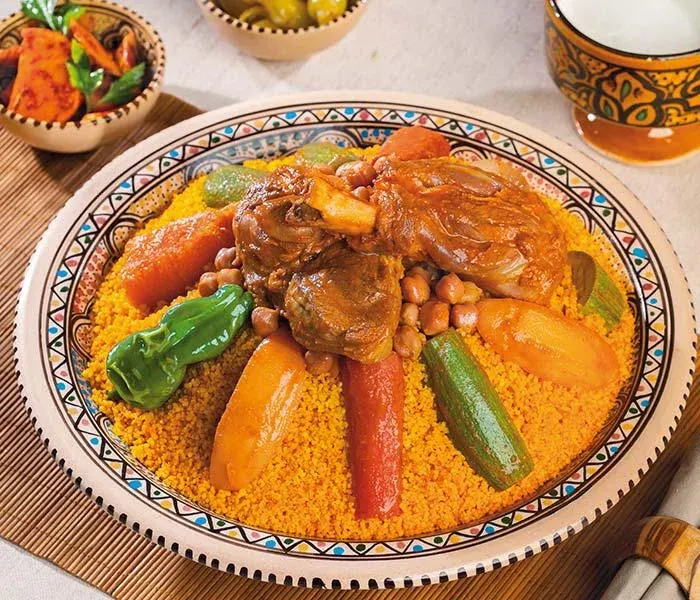
The grains are usually steamed in a couscous maker, sometimes several times, so that they expand without crushing. They can be served with vegetables, chickpeas, meat or fish, depending on the regions, seasons and circumstances. The cereals themselves, the broths, the garnishes and the ways of presenting the dish vary considerably from one territory to another.
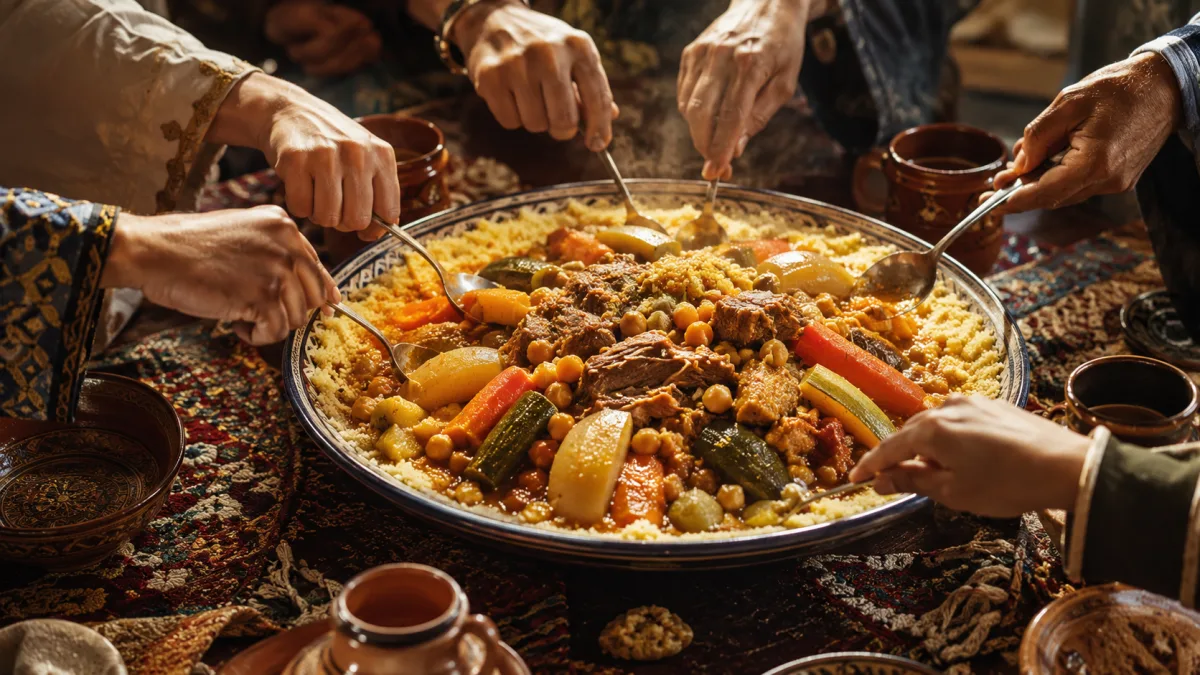
Served during family meals, parties, weddings or ceremonies, couscous is less a fixed recipe than a way of receiving and sharing. In Amazigh, it is notably called seksu. In many families, however, everyone remains convinced that the version prepared at home remains the only real one.
The grain of discord
Before becoming the symbol of a common heritage, couscous was also an object of rivalry.
As traditional cuisines acquired diplomatic, tourist and commercial value, each Maghreb country began to defend its own uses. In the press and public debate, the culinary dispute has sometimes married political tensions, notably between Algeria and Morocco.
Who owned the couscous? Who could present it as their national dish? Which version should be considered the oldest or most authentic?
However, these questions were based on a misunderstanding. Intangible cultural heritage does not function as a property title. Its inscription by UNESCO does not grant any patent, monopoly or certificate of exclusive origin. It recognizes living practices carried out by communities and transmitted from generation to generation.
By wanting to designate a single owner, States therefore risked enclosing within their modern borders a tradition that had preceded them.
Four flags, one file
The idea of a joint candidacy eventually took hold. Rather than deciding between the contenders, it was a matter of recognizing what they shared.
The four countries constituted a multinational file devoted not to couscous as a simple food product, but to the knowledge and practices surrounding its preparation and consumption. Behind the recipe thus appeared the manufacturing gestures, the utensils, the social occasions, the forms of conviviality and the essential role of family transmission.
On December 16, 2020, the Intergovernmental Committee for the Safeguarding of Intangible Cultural Heritage approved this joint application.
No country has been declared the inventor of couscous. No recipe was set up as a model. On the contrary, the inscription recognized a community of traditions large enough to accommodate regional differences.
For once, there was neither winner nor loser. Only four States recognized in the same movement and invited to take responsibility together for the protection of a shared heritage.
Older than borders
This common recognition is also historically obvious. Couscous has never followed the contours of a single state, because its history largely precedes the formation of the contemporary borders of the Maghreb.
Its origins are generally linked to the Amazigh populations, whose cultural space today crosses several countries in North Africa. Written sources attest to its presence in the medieval cuisine of the Maghreb, but its diffusion was built over a much longer period, over the course of migrations, commercial exchanges and family transmissions.
From Kabylia to the Moroccan plains, from southern Tunisia to the Saharan and Mauritanian areas, couscous has adapted to available resources and local habits. It can be prepared with fish on certain coasts, accompanied by several vegetables, seasoned with spices, enriched with raisins or taken in sweet forms during festivals.
This diversity does not contradict its unity. It precisely constitutes its nature. Couscous is not an immobile monument whose original form must be restored, but a living heritage, continually reinterpreted by those who prepare it.
What semolina teaches the nations
The story of this inscription therefore does not only tell that of a dish. It shows how heritage can become a space for cooperation without erasing differences or artificially resolving political disagreements.
The 2020 issue did not sustainably reconcile the Maghreb chancelleries. It has not reopened any borders and has not eliminated any disputes. Talking about peace would be excessive. But, in a region where common heritages can easily become instruments of national competition, he has created a rare form of cultural harmony.
Its strength lies in the renunciation of exclusivity. By submitting a joint candidacy, the four States have not abandoned their particular traditions. They recognized that the same heritage could have several expressions, several memories and several legitimate stories.
Couscous thus reminds us that shared heritage is not property without an owner. It becomes a common responsibility.
Where borders close, gestures still circulate. Recipes travel, families pass them on and the steam continues to rise above the couscous makers. In a history where dishes often serve as battlefields of identity, this has become, during the time of an inscription, a table of concord.
We don’t fight forever over a dish we like. We end up sharing it.
Sources
UNESCO (primary source)
“Knowledge, know-how and practices linked to the production and consumption of couscous”, registration of December 16, 2020, decision 15.COM 8.B.14 : ich.unesco.org; UNESCO article on cooperation: unesco.org
- Algeria TSA, “Common Maghreb project to have couscous included in the heritage of humanity”: tsa-algerie.com
- Morocco TelQuel, “Maghreb couscous becomes UNESCO intangible heritage”: telquel.ma; on the previous rivalry, le360: fr.le360.ma
- Tunisia La Presse de Tunisie, “Couscous inscribed on the list of intangible cultural heritage”: lapresse.tn
- Mauritania Cridem, “Maghreb couscous becomes UNESCO intangible heritage”: cridem.org
- Context - Jeune Afrique, “Unesco: the couscous of concorde”: jeuneafrique.com ; NPR, “Couscous, a symbol of harmony in northwest Africa”: npr.org
Iconographic credits: original images composed for “Gastronomic Conflicts”. These are visual interpretations, not documentary photographs.