
The invention of porcelain constitutes one of the greatest technological and cultural breakthroughs in history.
With it, ceramics ceased to be only utilitarian: it became an object of global prestige, sought after by emperors, merchants and soon European courts.
China laid the foundations for this revolution as early as the Han dynasty. The artisans gradually mastered firings exceeding 1,250°C and discovered the properties of kaolin, this white clay capable of producing a fine, dense and translucent material.
Under the Tang, porcelain reached its first golden age: in the north, the Xing kilns perfected the whiteness of the pieces; in the south, Yue’s cecidons fascinate with their jade green glazes.
The Song dynasty then took this art to an unparalleled level. The famous Five Grands Fours develop textures, cracks and nuances that have become legendary.
In Jingdezhen, the future global heart of porcelain, the imperial workshops perfect production with exceptional precision. Then, under the Yuan and the Ming, the true aesthetic revolution appeared: the “blue and white” decor, obtained thanks to cobalt imported from the Persian world. This porcelain conquered maritime routes and became the first globalized luxury in modern history.
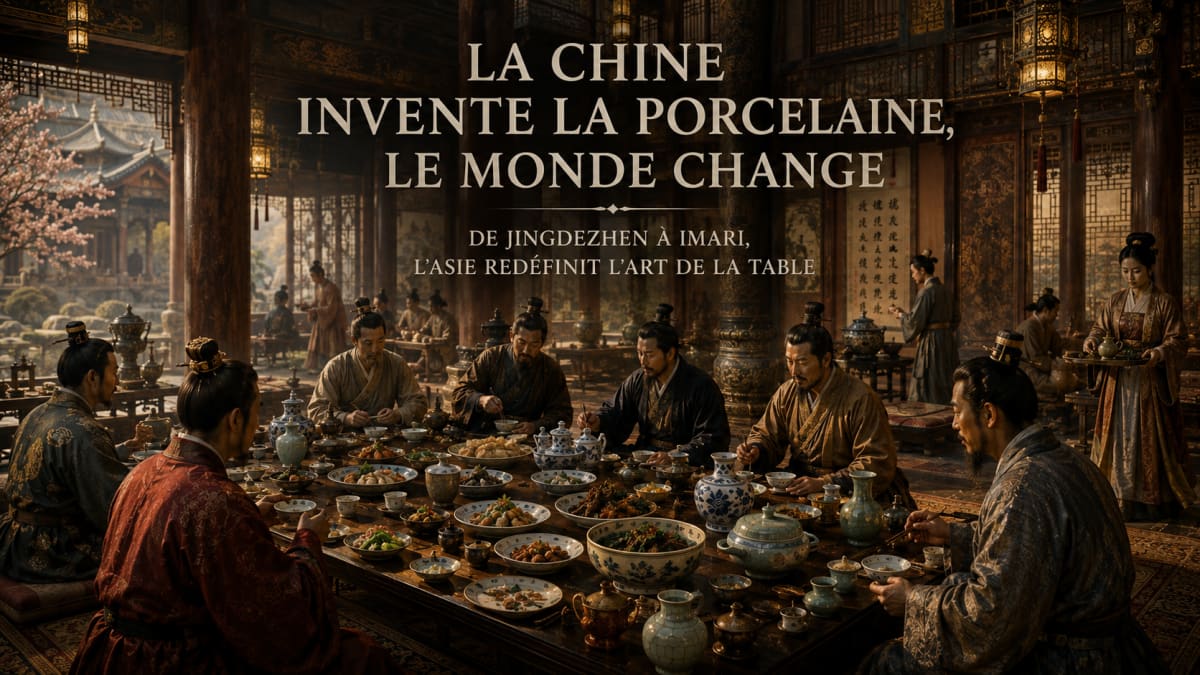
Korea is also developing its Goryeo Celadons, famous for the sanggam inlay technique of remarkable sophistication. Finally, in Japan, the potters of Arita, heirs of Korean knowledge, created porcelain exported from the port of Imari in the 17th century. The Kakiemon and Imari styles quickly won over the whole of Europe.
From that moment on, the world changed profoundly: porcelain became a global commercial, diplomatic and artistic issue.
The West would spend the next two centuries trying to unravel the secret of this “white gold” from Asia.