A Work Without an Author, but Full of Knowledge
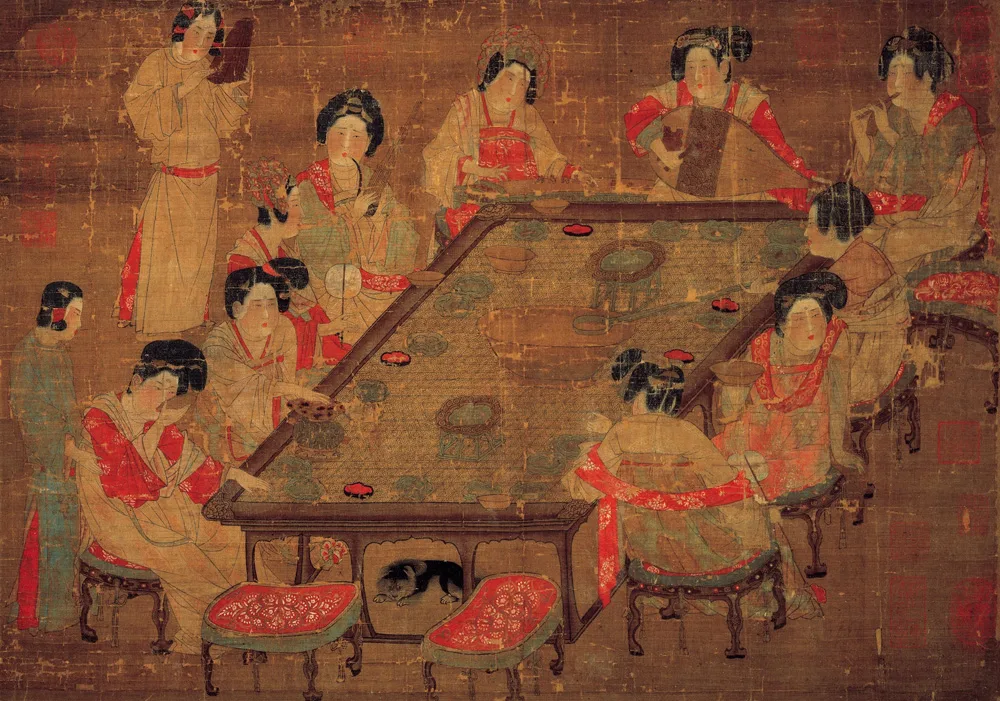
The Gongyue tu is a painting on silk attributed to the late Tang dynasty, around the beginning of the tenth century. Neither its author nor its exact date of execution is known. Specialists tie it to the late Tang by precise signs: the women’s elaborate coiffures, the cut of the garments, the harmony of the colours. This scroll of modest format, held at the National Palace Museum in Taipei, owes its value not to its size but to its precision: few ancient images yield so many details about the manner of receiving guests in a palace.
The scene is that of the inner apartments, a private space, not an official embassy. That is what makes it precious: one grasps in it a court sociability as it was ordered day to day. And yet, even in intimacy, nothing is left to chance.
The Table as an Instrument of Hierarchy
Ten ladies are gathered around a great rectangular table, seated on low stools, while two serving women remain standing. The arrangement is not a simple friendly circle: it organises the space into zones, the guests on one side, the musicians at the end, the service set back. Each woman knows where to place herself, and that place speaks her rank.
The most telling detail is read in the adornment. The museum notes that one of the women wears a crown of flowers, a sign of higher rank. Precedence, then, passes not only through position around the table: it is read on the head as well. Status is worn as much as it is placed. Here is a lesson every steward recognises: at a reception, rank must be seen before it is spoken. The rectangular table, with its ends and its sides, is never a neutral piece of furniture. To compose the table is already to compose the hierarchy.
To Drink Is Not a Simple Pleasure
Around the table, the gestures differ. Several women are served tea, while one drinks wine. This coexistence of two refined beverages, at the same table, is part of the language of reception. The museum also notes winged wine cups, whose handles evoke wings: the vessel from which one drinks contributes to the aesthetics of the scene as much as the drink itself. Here, as in the great houses of today, tableware is never a mere container; it dresses the gesture and signals the care taken over the guest.
Let us remain honest, however: the image does not deliver a menu, but the existence of a culture of drinking and of the table, made of fine distinctions. It shows a way of receiving, not a book of recipes.
The Music Holds Its Place, in the Literal Sense
At the end of the table, four women play: a pipa, that lute with a rounded body, a guqin zither laid flat, and wind instruments, among them a reed pipe close to the oboe. A serving woman marks the rhythm with clappers. The music, then, is no floating background sound: it occupies a precise pole from which the sound is directed toward the guests, and the rhythm itself is the object of a dedicated service. The performance is organised with the same rigour as the seating. To receive, at this court, is to orchestrate together the table, the drink, and the sound.
A Lesson in Stewardship from Far Away
The Gongyue tu lays out a system: a table conceived as a plan, ranks legible in the adornment, beverages that distinguish, a music placed rather than merely endured.
A thousand years before our precedence cards, an East Asian court already knew that to receive is an art of arrangement.
To seat the guests, to choose the objects, to order the sound: these gestures said who mattered, and how much. Therein lies its most enduring lesson. The splendour of a table is measured not by its abundance, but by the precision with which each place has been thought out.
Main sources: National Palace Museum (Taipei) and Google Arts & Culture, catalogue notice of the work A Palace Concert (宮樂圖); documentary file “Banquets of the chiefdoms and kingdoms of Asia before the year 1000.”