Born of a State’s Will
The ambition goes back to Peter the Great, dazzled by the Meissen porcelain he glimpsed at the court of Dresden in 1718. When his daughter, the Empress Elizabeth I (Elizabeth Petrovna), orders the creation of the manufactory in 1744, the stakes go beyond courtly refinement. It is a matter of asserting that Russia can make, on its own, what Europe jealously guards: hard-paste porcelain, that “white gold” whose secret Meissen protects. The scholar Dmitri Vinogradov takes up the challenge and develops, from exclusively Russian materials, a paste comparable to the finest in the West. The first imperial service is completed in 1756. The feat is not only technical, it is political: a nation that masters porcelain raises itself to the rank of the civilised powers.
The Sovereign’s Cipher
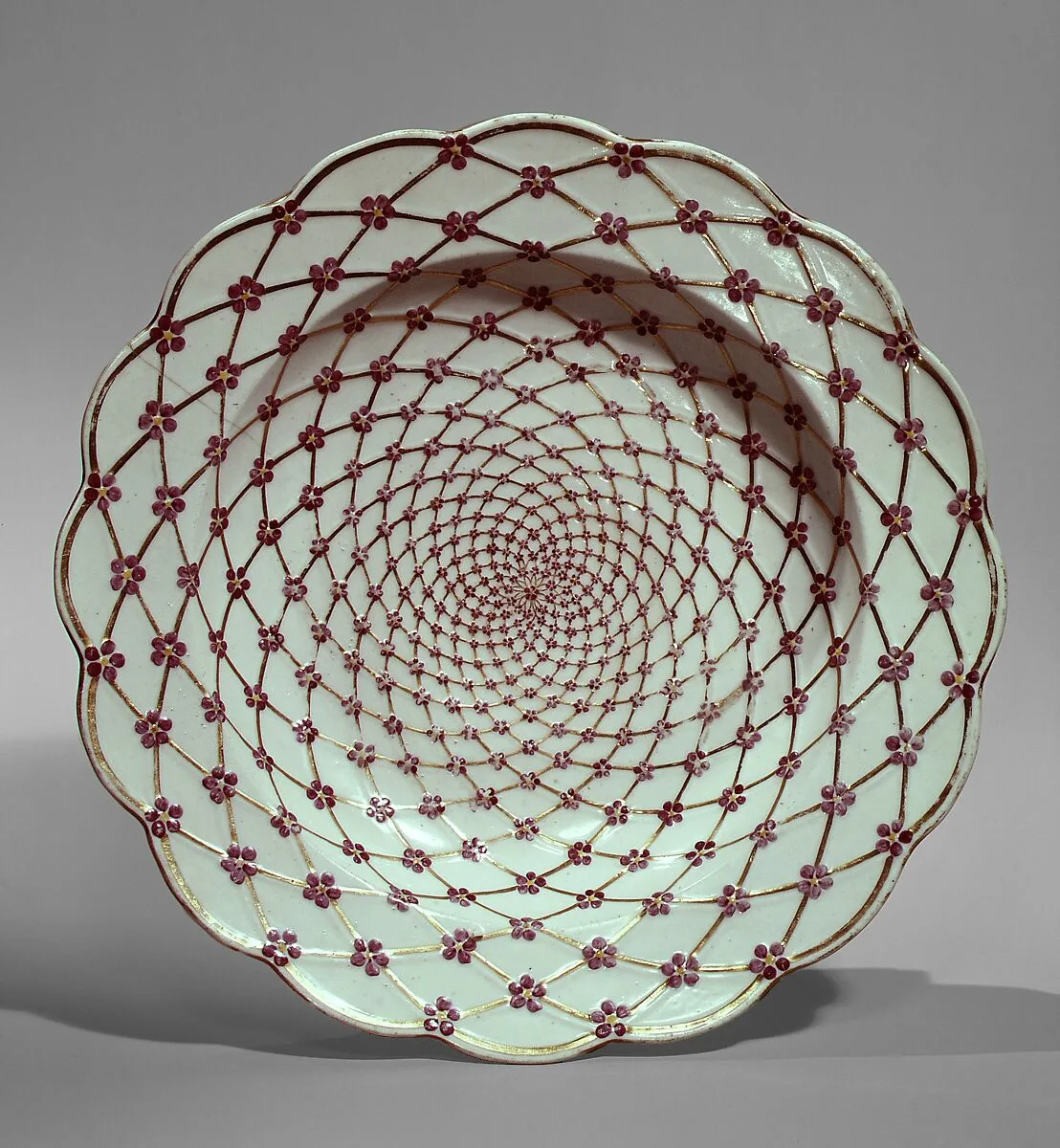
From Catherine II onward and until the fall of the dynasty, each piece bears, underneath, the monogram of the reigning monarch. The gesture seems trivial; it is foundational. Repeated to infinity on the tables of palaces, imperial yachts, and residences, this cipher turns a set of tableware into an instrument of the power’s presence. One dines not merely at the tsar’s table, one dines under his sign. The maker’s mark becomes a mark of authority, and the double-headed eagle that accompanies it recalls, down into the hollow of a saucer, the order of the world according to the Empire.

Catherine II: The Table as Manifesto
Under Catherine, the manufactory enters its golden age and becomes the court’s near-exclusive supplier for more than a century and a half. The Empress, who thinks like a strategist of the image, commissions sets in which the decoration delivers a discourse. The Arabesque Service (1784) unfolds allegories to the glory of her reign; the Cabinet Service runs through views of Roman antiquity, a way of inscribing the young capital of the North in the lineage of the great empires. The gilding, it is said, was prepared from gold coins of the Imperial Treasury. Nothing is gratuitous: at this table, every dish asserts an idea of Russia.
Rewarding, Ranking: The Banquets of the Orders
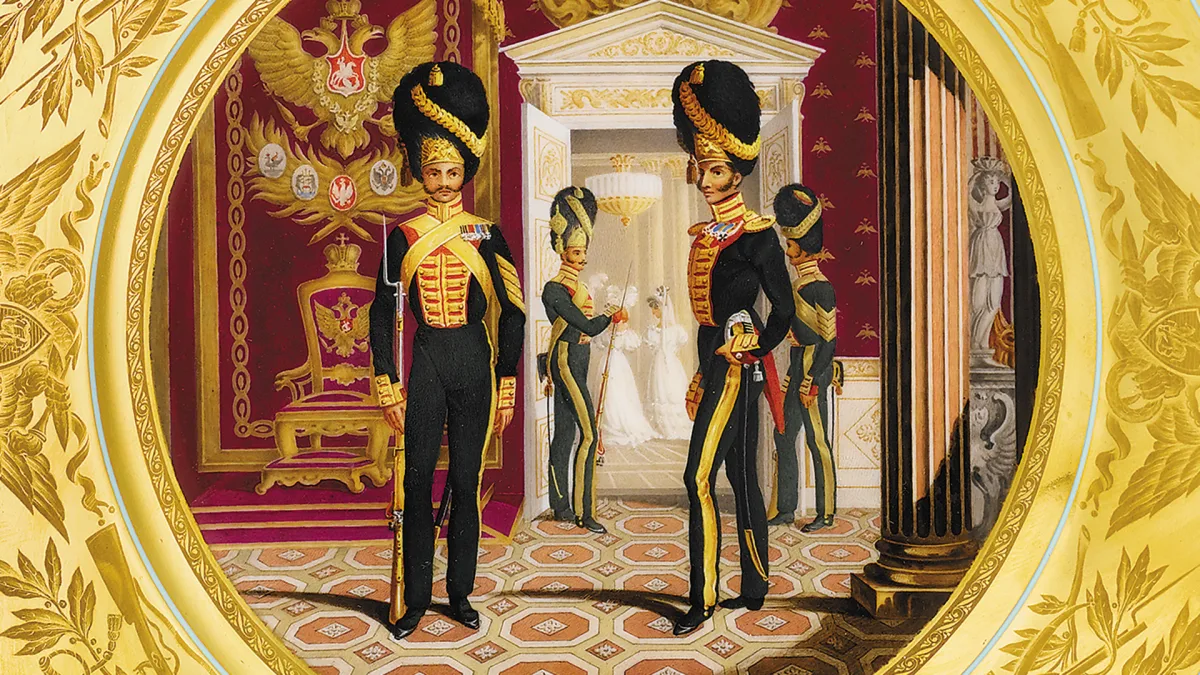
The table also serves to distinguish the faithful. For the annual banquets of the knights of the great orders, held at the Winter Palace on the feast day of each order’s patron saint, Catherine II commissions sumptuous dedicated services. A detail often forgotten: these Order services were entrusted not to the Imperial Manufactory, but to the private factory of Francis Gardner. Ribbons in the colours of the order, stars, painted mottoes (“For Service and Bravery” for Saint George): the tableware makes the hierarchy of honours visible. To eat from the plate of one’s order was to see one’s loyalty rewarded, made material, staged before the entire court.

The Gift That Speaks for the Empire
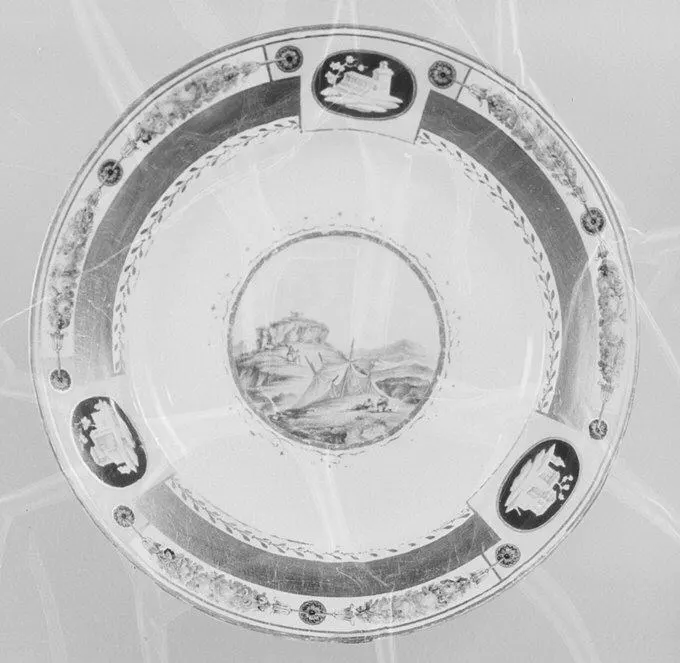
Beyond the palace walls, imperial porcelain becomes a diplomatic weapon. Dowry services for princely marriages, gifts destined for foreign courts: to present a piece from Saint Petersburg is to display a state’s refinement and the power of its industry against Sèvres or Meissen. Thus the tsar Alexander I has a service adorned with views of Italy made to give to his sister Catherine on the occasion of her marriage, in 1816, to the King of Württemberg. The gift seals an alliance, and the beauty of the object is its signature.
The Empire and Its Peoples
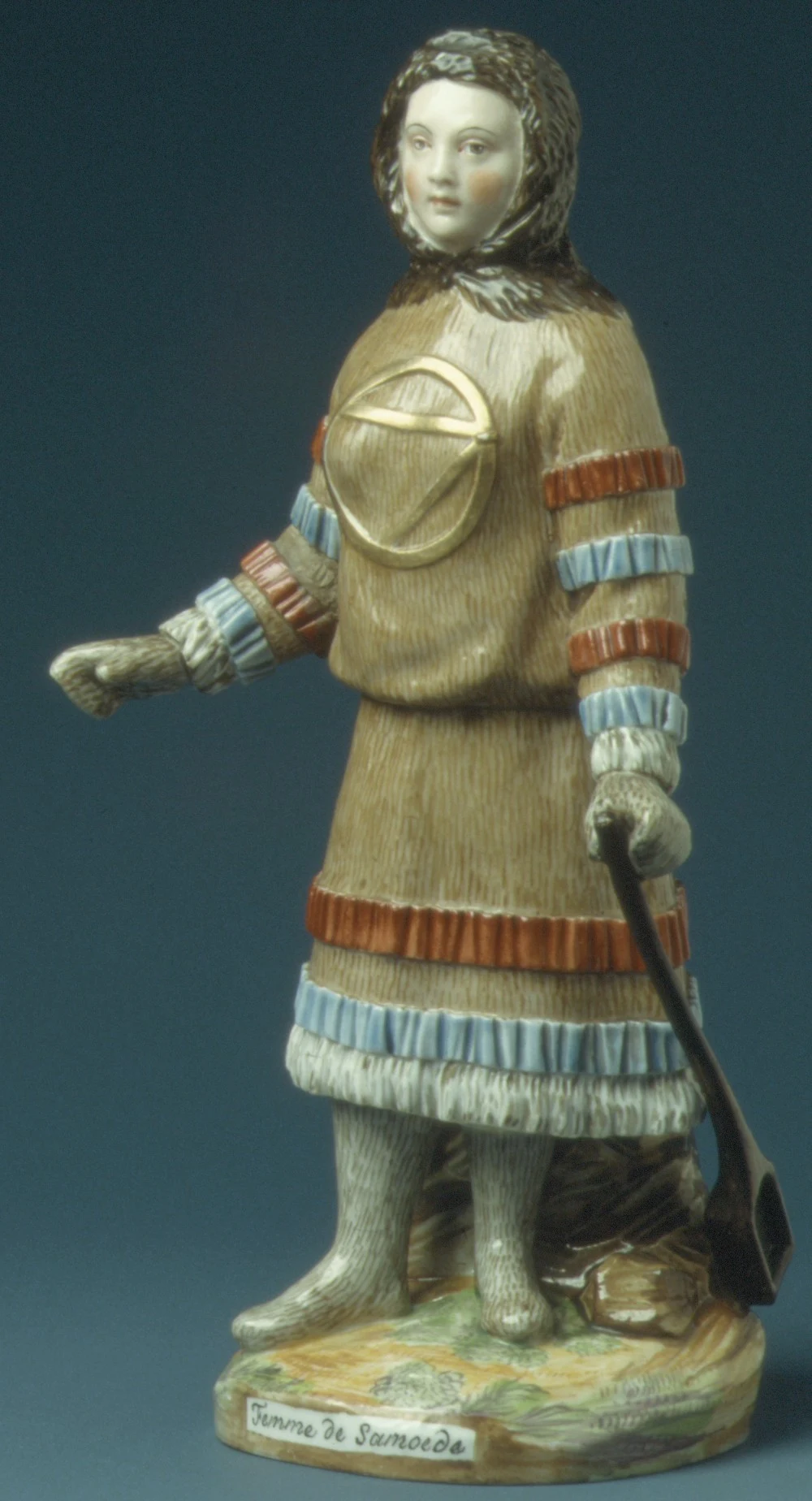
From the 1780s, the manufactory issues a celebrated series of figurines depicting the peoples of the Empire: merchants, fishermen, peasants, populations of the Arctic and the borderlands. Where Europe peopled its tables with shepherds and figures from the commedia dell’arte, Russia puts its own subjects on display. The gesture is doubly political: it celebrates the immensity of the Empire and its diversity, while cataloguing that diversity, at table height, like an inventory of the imperial domain.
Under the Tsar’s Eye
In the nineteenth century, the demand for excellence remains a matter of state. Nicholas I personally supervises the models, approves the designs submitted to him, has kaolin brought from Limoges and perfects a fire-gilding whose secret would later be lost. The manufactory’s museum is founded in 1844. Later, when the enterprise is deemed “useless and unprofitable,” Alexander III refuses to close it: on the contrary, he demands that it attain excellence, precisely to hold its rank and set the tone for the private factories. Striking proof that its value was political before it was commercial.
Power Changes, the Porcelain Remains
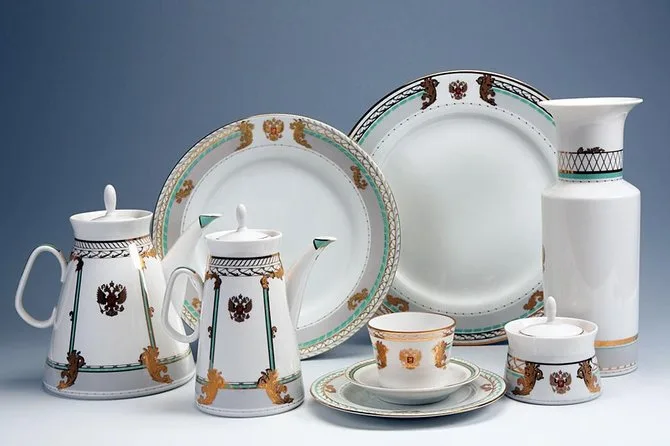
A final paradox: the manufactory outlived the dynasty it served. After 1917 it becomes the State Factory, then, in 1925, the Lomonosov factory (LFZ). The tsar’s cipher gives way to the hammer and sickle: this is the famous “agitation porcelain,” which puts the same craftsmanship at the service of a new power. The greatest names of the avant-garde, Sergei Chekhonin as artistic director and the Suprematists around Kazimir Malevich, draw slogans and abstract forms upon pieces inherited from the imperial stock, decorated over the tsar’s effaced monogram. In 2005, the circle closes: the enterprise takes back the name Imperial Manufactory and once again places the double-headed eagle beneath its pieces.

Epilogue: The Table of the Tsars, Still Alive
Three centuries after Elizabeth, the porcelain of Saint Petersburg is nothing like a relic. The manufactory, still in operation, continues to draw on its palatial heritage: in the spring of 2026 it launched, one after another, the “Monplaisir” collection, a marriage of French charm and Asian refinement, and a series inspired by the fountains of Peterhof, while the factory’s historical museum, today attached to the Hermitage Museum, continues to welcome visitors. From one regime to the next, the lesson endures: in Saint Petersburg, the table always says who governs.