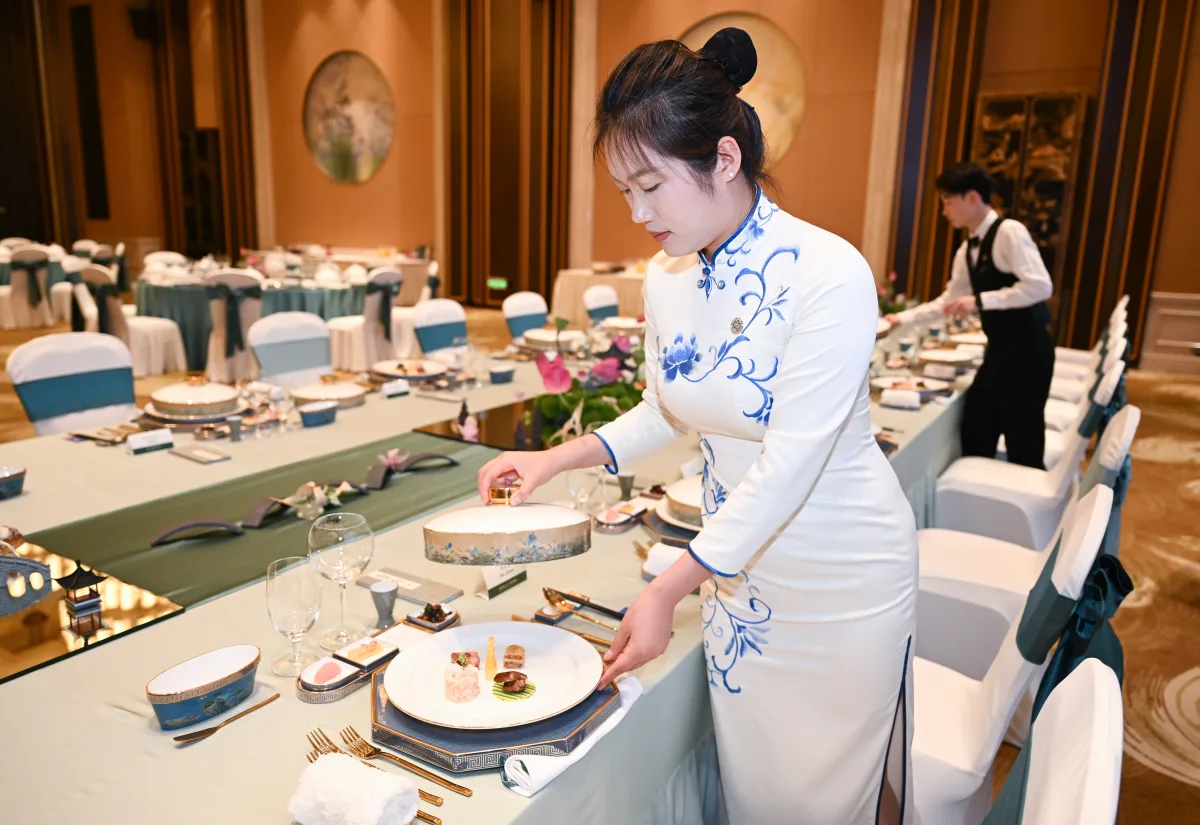
An empty room, a woman in a qipao, a plate she sets down to the millimetre: this photograph, taken in Hangzhou on 18 June 2026, does not show a state banquet, and that is precisely what makes it so dizzying.
For this level of execution is not the summit of Chinese protocol. It is its everyday floor.
The Hour When Nobody Is Watching
The picture is dated 18 June 2026. It was taken at the Huajia Shanzhuang, in Hangzhou, by Wang Gang for China News Service. No head of state appears in it. No guest. The room still belongs to itself.
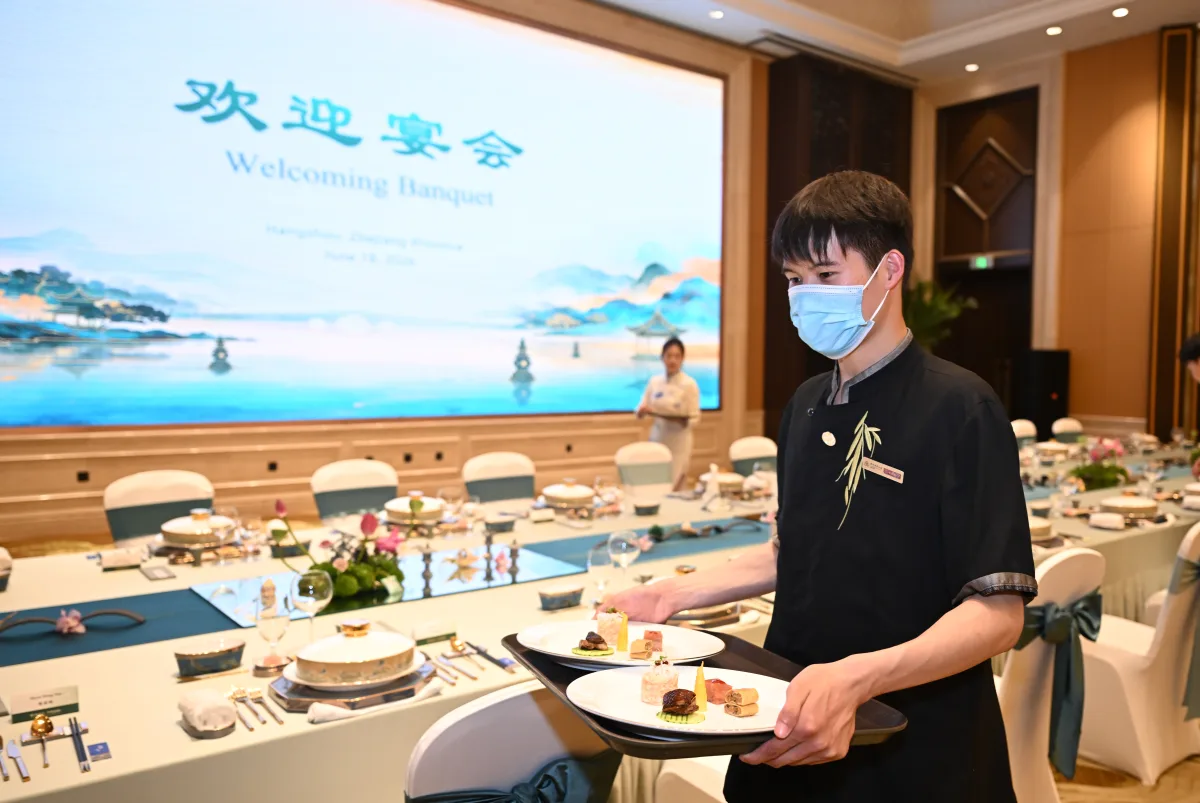
This is the hour a steward recognises at once: the one when everything is decided and when, as a rule, nobody is filming. A head waitress in a white qipao with a blue pattern sets down a presentation plate and closes a porcelain cloche. At the far end of the same line of settings, a maître d’hôtel in a black waistcoat and bow tie works in mirror image. Both gestures are calibrated, controlled, unhurried.
In the background, the round tables are already laid: white chair covers, blue-green bows, charger plates in position, cloches in place. Nothing is waiting to be finished. Everything is waiting to be checked.
A Lake Laid on Three Metres of Tablecloth
The first professional reflex is to read the tabletop. It does not tell the story of China in general. It tells the story of one city and one particular body of water.
A strip of mirror runs down the centre of the table along its whole length. This is not a decorative effect: it is water. A miniature pavilion stands on it to be reflected, the Jixian Pavilion, one of the viewpoints of West Lake. Further along, the Three Pools Mirroring the Moon are reproduced in miniature. Pink lotus flowers and fresh lotus seed heads close the composition. The tablecloth is a very pale blue, the runner a celadon green: the two exact shades of the lake seen from the hills of Hangzhou.
This reading is not a journalist’s conceit. When it inscribed West Lake on the World Heritage List in 2011, UNESCO described a Chinese tradition of composing the landscape as a succession of pictures, an idealised fusion of man and nature. The Hangzhou table applies that method to three metres of tablecloth.
The plate follows suit. Four cold bites, named by the Chinese agency: braised duck, dressed pomelo, lotus root stuffed with glutinous rice, vegetarian goose. The lotus thus links the flowers, the mirror and the dish. As for the vegetarian goose, rolled in tofu skin, it comes from the kitchens of Hangzhou’s Buddhist temples, where soy has been used to imitate meat for centuries. It is served to the leader of a Theravāda Buddhist country.
Then there is the date. The dinner falls on 18 June, the very eve of the Dragon Boat Festival, inscribed as intangible cultural heritage of humanity in 2009. Hence the miniature boats and the scented sachets set out along the runner. The Duanwu sachet is a protective object: the fifth lunar month is held to be the month of fevers, and aromatic plants are worn to ward off harm. To offer one to a guest is to wish him good health according to an almanac two thousand years old.
This Is Not a State Banquet
Here is the point most of the coverage misses. The state banquet of this visit took place in Beijing on 16 June, hosted by Xi Jinping. What the photograph shows is something else: a welcome dinner given two days later in Hangzhou, at provincial level, on the margins of the trip.
In other words, this porcelain, this staging, this mise en place do not represent the ceiling of Chinese protocol. They are its middle floor.
A steward sees in this a lesson in management before a lesson in style. The standard for the official Chinese banquet was locked in under Zhou Enlai around the rule of four dishes and one soup, together with a ban on ostentatious ingredients and a timed service. It was later cut back to three dishes and one soup. The constraint has never been lifted.
The spending, for its part, has not disappeared. It has moved. It has left the number of courses and gone into the object and the gesture. The precedent is documented: for the 2016 G20 summit, the Shanghai house Magolong produced the service known as the West Lake Feast, under the direction of Zhao Chunyang. Soft-paste porcelain with forty-five per cent bone ash, sixteen design proposals, four months of prototypes, ten months of manufacture, eighty-one operations at the very least. Its domed cloche already quoted the Three Pools Mirroring the Moon, the cups took the shape of the lotus and the cup holders that of a bridge.
The 2026 service is not that one: the G20 was on an emerald green ground, the table of 18 June is in blue and white picked out with gold. Lineage, then, not identity. But the method is the same. Save on the number of courses and invest in what is still in hand ten years later.
February 1972, the Same Lake
The setting is not new, and this is where the image becomes truly instructive.
On 26 February 1972, Richard Nixon is lodged at the West Lake guesthouse. In the afternoon he visits Huagang Park and the lake in the company of Zhou Enlai, then crosses by boat to the island of the Three Pools Mirroring the Moon. At half past seven in the evening he is received at a banquet given by the provincial revolutionary committee.
Fifty-four years later: same city, same provincial level, same Three Pools. Only now they are no longer reached by boat. They sit in miniature on a mirror, in the centre of the table.
The system is continuous down to the detail, moreover. On 2 June 2026, sixteen days before the Burmese dinner, the West Lake State Guesthouse received the Laotian president with a menu built entirely on the seasonal produce of Jiangnan, including a lotus root with glutinous rice chosen because glutinous rice is the staple food of Laos.
The kitchens of Hangzhou call this 应时应景:
- the right season,
- the right place,
- the right guest.
Three constraints, never just one.
Sources and Credits
Primary source
- China News Service, photo report on the Hangzhou dinner, 19 June 2026:
. Identification of the venue, the four cold dishes and the decorative elements.
Institutional sources
- UNESCO, World Heritage Centre,
West Lake Cultural Landscape of Hangzhou, inscribed in 2011 * UNESCO,
The Dragon Boat Festival, intangible cultural heritage of humanity, 2009 * Ministry of Foreign Affairs of the People’s Republic of China,
announcement of the state visit of 15 to 19 June 2026 * Ministry of Foreign Affairs of Myanmar,
China-Myanmar joint statement of 17 June 2026 * Zhejiang Provincial Government,
王浩会见缅甸总统敏昂莱一行, 19 June 2026 * Richard Nixon Presidential Library and Museum,
. Stay at the West Lake guesthouse, visit to the Three Pools, banquet of the provincial revolutionary committee.
Protocol and porcelain
- China News Service,
周总理亲定国宴标准四菜一汤,主导礼宾革命, 31 December 2008 * China News Service,
国宴改革菜谱越来越简化, 27 August 2009 * Yicai,
扒一扒G20国宴餐瓷:设计取自西湖,历经81道工序, September 2016 * People’s Daily Online,
Tableware for the G20 state banquet, 6 September 2016 * China News Service, 东西问·知味东方 series,
dinner given for the Laotian president, 3 June 2026 * Hangzhou.com.cn,
monastic origin of vegetarian goose
Political context
- Human Rights Watch,
Myanmar: ICC Prosecutor Requests Arrest Warrant, 27 November 2024 * Amnesty International,
Myanmar: Presidency must not shield Min Aung Hlaing from being held accountable, April 2026
Image credit:
Hangzhou, 18 June 2026. Mise en place for the welcome dinner given for Myanmar’s president Min Aung Hlaing, at the Huajia Shanzhuang. Photograph: Wang Gang / China News Service / VCG via Getty Images.