A diplomatic timepiece
Comparing a state banquet to a piece of haute horology is not coquetry.
In both cases, the value lies in the assembly. Each complication serves a function. Each cog is part of an overall mechanism. Beauty comes from accuracy.
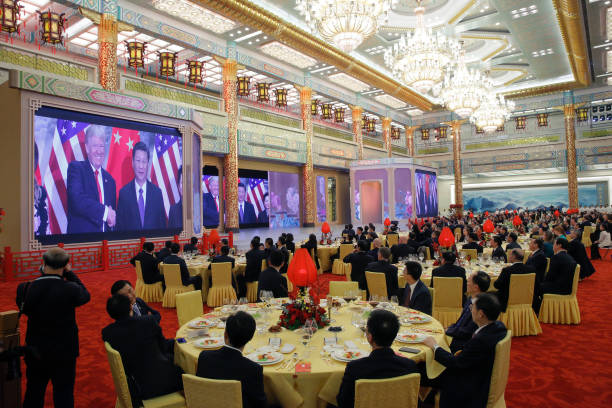
The works brought together in the university program Table and Diplomacy from the Middle Ages to the Present Day establish that this logic crosses civilizations and eras. From medieval courts to G20 summits, from the Caribbean, from the Commonwealth to the Asia-Pacific, states use the composition of the table as an instrument of representation.
The central question is that of control.
How does a material device manage to formulate what the official discourse does not say? How do the arrangement of a place setting, the choice of a service, the position of a guest contribute to communication between States?
The answer lies in the work of the steward, orchestrator of an ensemble where each profession, financier, butler, florist, contributes to the final coherence.
Long-term expertise
Transmission as filiation
The great sovereign houses perpetuate their codes through objects and uses passed down from generation to generation.
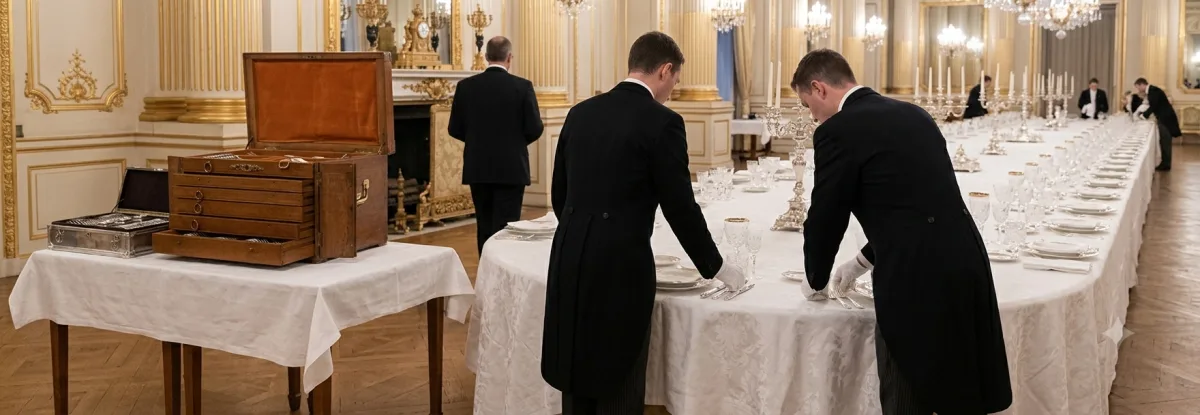
In Windsor, the Grand Service in silver-gilt, created under George IV at the beginning of the 19th century, remains the reference repertoire for British state banquets. Its conservation, preparation and disposal are the responsibility of the financier. Its integration into an overall system, consistent with the table plan validated by the protocol and the expectations of the communications service, is the responsibility of the manager.
The glassware is aligned and polished for several days before each reception.
The sovereign and the guest of honor occupy the center of the table.
These constants are not habitual. They come from a conscious, documented transmission taught within stewardship teams.
In Ireland, the state banquets introduced at Dublin Castle in 1934 were part of a different logic, that of appropriation. The young Free State adopts formats inspired by French and Swedish practices to fit into the European diplomatic order.
The chosen location, the throne room formerly associated with the British Crown, is not insignificant. The old scene of colonial power becomes the theater of reconquered sovereignty.
The table here participates in the construction of state legitimacy. The steward is the architect.
Learning to calibrate
The required precision is the subject of explicit training in several contemporary administrations.
The Nepalese diplomatic training manual details the rules for seating, the number of services depending on the degree of formality, and the order in which guests are served. These prescriptions, once validated by the protocol, are implemented by the steward and executed by the maître d’hôtel and his team.
A five-course dinner does not send the same message as a twelve-course dinner.
A meal of up to eighteen courses signals exceptional solemnity.
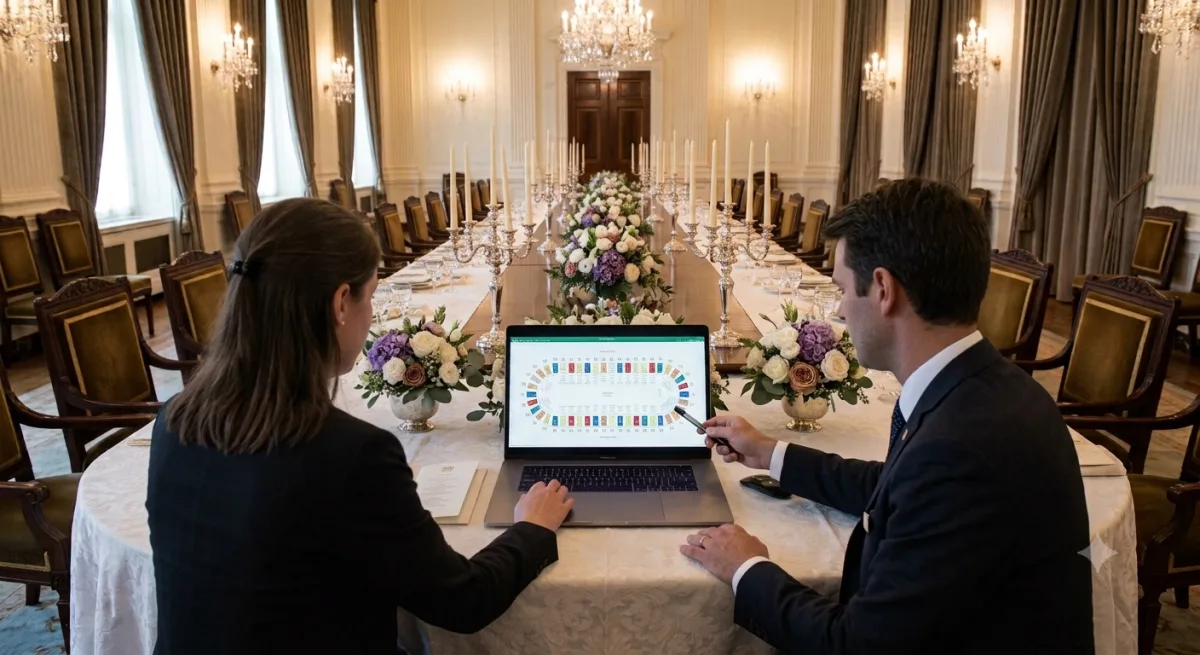
In Saint Kitts and Nevis, a Commonwealth Caribbean micro-state rarely cited in stewardship studies, the Ministry of Foreign Affairs publishes table plan diagrams as an annex to its official protocols. The position of the governor general, that of the official guest to his right, the proximity of the aide-de-camp: each element is the subject of a written prescription that the intendant translates into material provision.
This documentation is not the prerogative of the great powers.
It supports the exercise of sovereignty at all latitudes.
The signature as a constant
Each sovereign house develops a recognizable script.
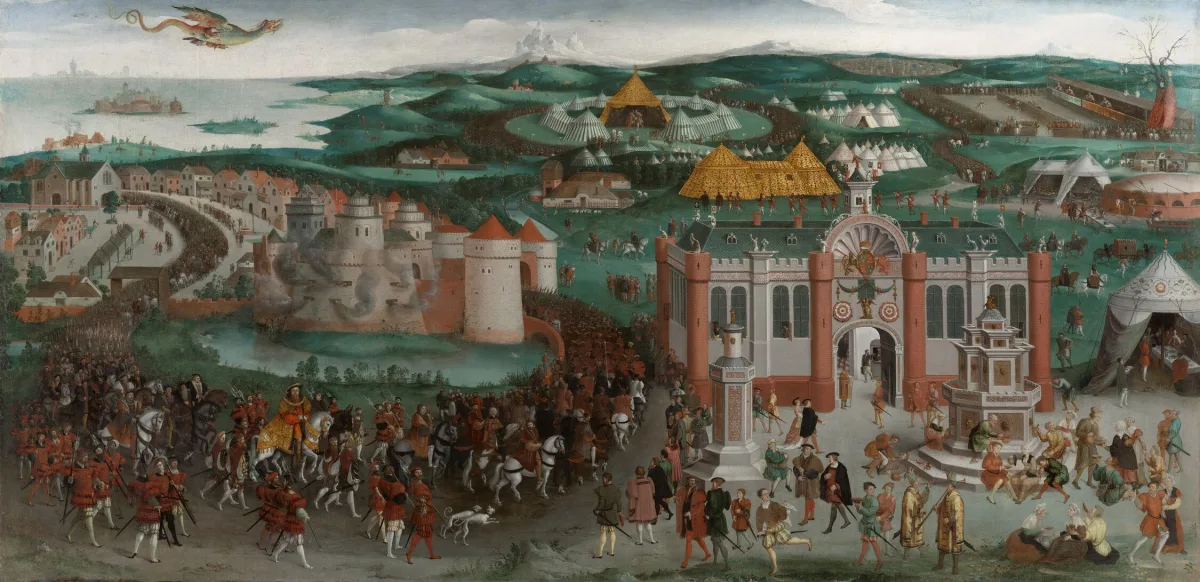
The call for papers Oaths, gifts and etiquette, devoted to medieval and Renaissance diplomatic practices, shows that European courts were already using precious tableware and sophisticated decorations to assert their rank. Service choices functioned as a peer-to-peer recognition system.
This logic continues.
The Coral Triangle Initiative guide, intended for multilateral meetings in the Asia-Pacific, codifies a standardized formal dinner place setting including named place cards and precise sequence of place settings. The signature here is not national but regional. It signals membership in a common diplomatic framework.
Contemporary African and Middle Eastern protocols remain less accessible in the sources consulted. This documentary gap does not mean lack of codification. It calls for caution in any claim to exhaustiveness.
The components of writing
The spatial partition
The geometry of the table structures the relationship before any words.
In Windsor, state banquets use a single table of approximately fifty meters. The sovereign and the guest of honor occupy the center. This provision makes visible a double assertion.
The hierarchy first: all eyes converge towards the center.
Parity then: the host and the main guest share the top position.
In Saint Kitts and Nevis, the Governor General sits at the top table, with the official guest to his right. The Nepalese manual confirms this constant: the place to the right of the host constitutes the position of honor.
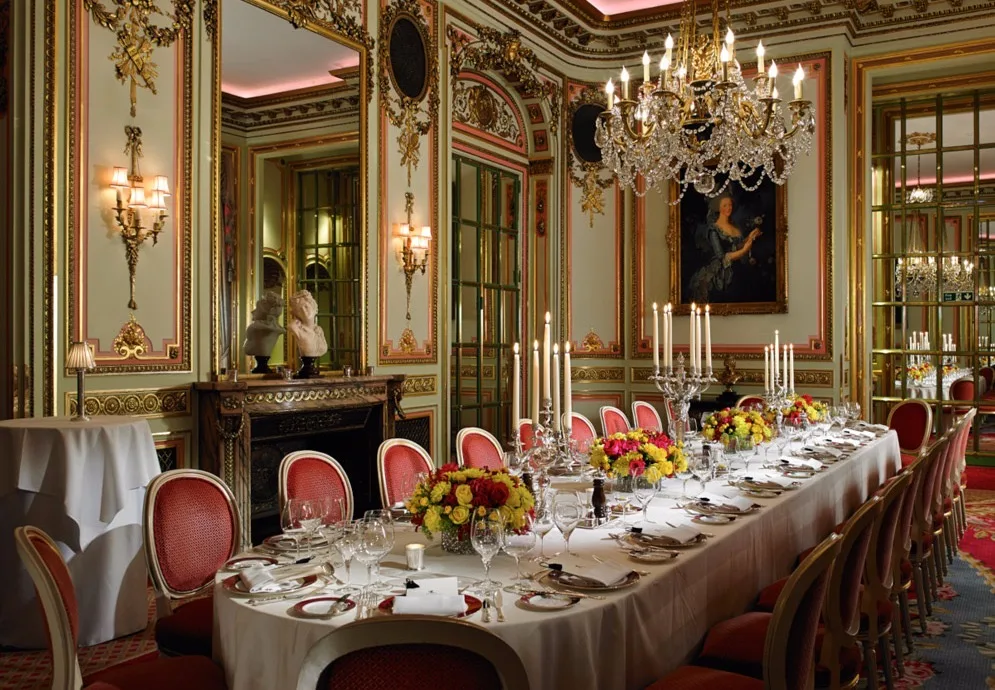
The shape of the table, single line, horseshoe or multiple round tables, functions as a reading key. It immediately indicates how to interpret the positions included therein.
The protocol prescribes the placements. The intendant designs the geometry that makes them possible and readable.
A change in geometry is never trivial.
It reconfigures the entire system.
The furniture directory
The objects used are not interchangeable.
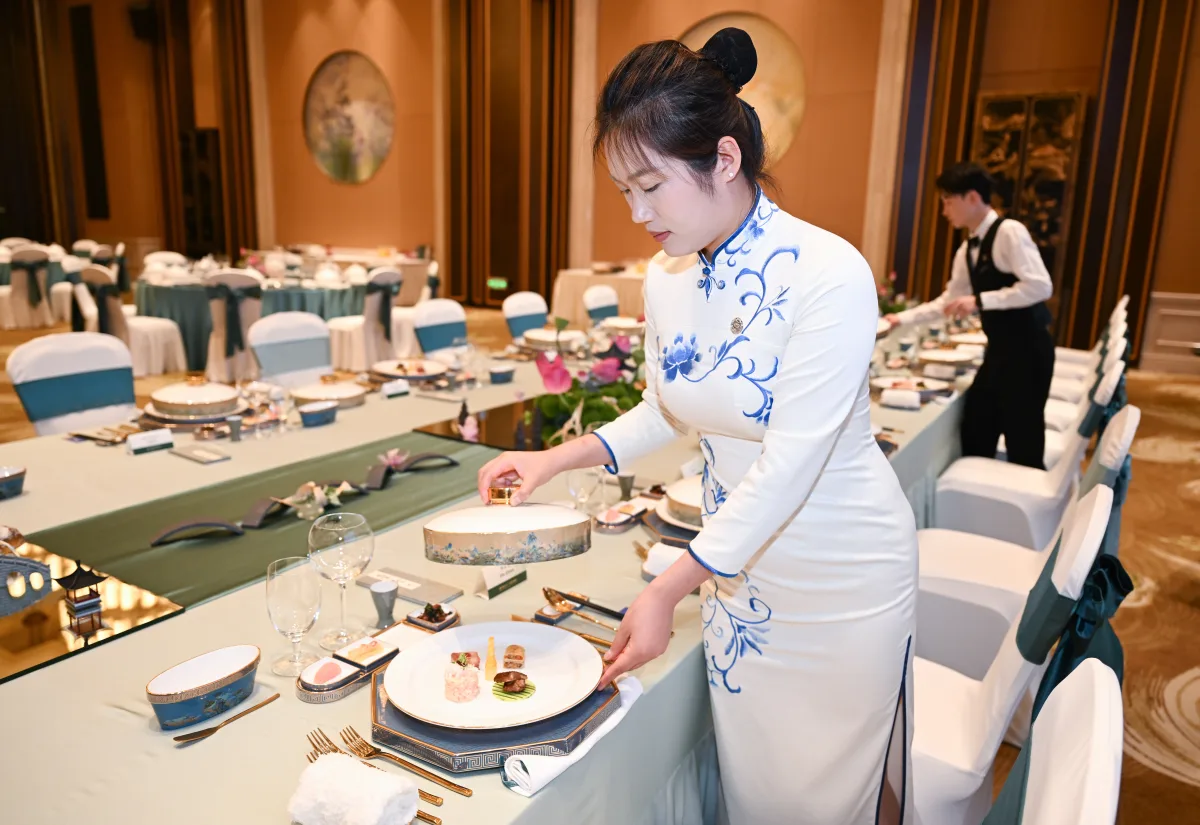
The use of an identified historical service places the banquet in the continuity of the institution. Porcelain, silverware, glassware constitute a material vocabulary of which each piece carries a symbolic charge.
This heritage is preserved and prepared by the financier. Its staging, its integration into the overall system, is the vision of the manager.
Work on medieval and Renaissance banquets highlights that precious table settings were explicitly used to demonstrate power and wealth. This function has not disappeared. It has become institutionalized.
The choice of service is an editorial decision.
It affects the image of the State in the same way as an official press release.
[Suggested image location: detail of a historic service, vermeil, emblazoned porcelain or sovereign house crystal]
Punctuation of the service
The number of beats and their sequence constitute explicit markers.
The Nepali manual states that dishes are served from the head table. The guests only start eating after the host and the main guest. This sequence is not an organizational convenience. It materializes precedence.
The execution of this tempo is the responsibility of the maître d’hôtel and his team. Its design, consistent with the desired degree of solemnity, belongs to the steward.
Fast service does not send the same signal as slow, ceremonial service. The total duration, the rhythm of the sequences, the breaks between services: so many elements which modulate the overall message.
Identification marks
Emblazoned menus, place cards, national emblems are among the requirements of several protocols consulted.
In Nepal, the state emblem must appear at the top of the menu placed at the table. This rule transforms a functional document into an institutional identification medium. The guest does not simply consult what he is going to eat. He reads the sovereignty of his host.
The Coral Triangle guide includes the nominative maps in the codified system. Their presence is not optional. It contributes to the readability of the whole.
These elements are not decoration.
They constitute markers of membership and rank, validated by the protocol and the communication service, integrated by the steward into the final composition.
What the discerning eye perceives
Consistency as a criterion of control
A successful composition can be recognized by its coherence.
Academic sources show that the device functions as a system. Geometry of the table, furniture heritage, precedence, sequence of service, significant elements of the decor: these levels interact. An inconsistency between them confuses the message or produces an uncontrolled effect.
The framework text of the Table and Diplomacy program describes the table as “a material and symbolic place for diplomatic negotiation”. This formulation assumes a global, non-fragmented reading.
The seasoned steward sees at a glance what works and what stands out. It is his responsibility to ensure the unity of the whole.
Intentional variations
Adapting without deviating is one of the most delicate exercises in the role.
British state banquets illustrate this tension. The shape of the table, U or line, and the detail of the floral decorations change according to the visits. On the other hand, the use of the Great Service and the centering of the sovereign remain constant.
The variation must remain readable as variation.
It assumes a stable norm in relation to which adaptation makes sense. Modifying an element without awareness of the rule you are breaking exposes you to misunderstandings. This awareness is at the heart of the job of steward.
Peer reading
Stewardship professionals immediately identify what is the rule, custom and deviation.
At the court of Portugal, at the end of the 15th century, contemporary testimony notes that different drinks were served to imperial ambassadors depending on their rank. This detail, noted by contemporary historians, shows that material distinctions were perceived and interpreted by the delegations of the time.
The distinctive function is attested.
The exact meanings of each element sometimes remain debated. This uncertainty does not invalidate the analysis. It calls for interpretive caution.

The contemporary requirement
Document to transmit
The formalized protocols studied, whether from Nepal, Saint Kitts and Nevis or the Coral Triangle Initiative, show the importance of written documentation.
This practice does three things.
Transmission first: uses pass from one stewardship team to another without loss.
Control then: compliance can be checked during execution by the butler.
Finally, adaptation: when circumstances require it, the manager knows what he is changing and why.
Formalizing in an internal document the composition rules, standard diagrams and significant elements specific to the institution constitutes a good practice attested in several administrations.
Train to read
The steward does not just execute. He designs and he interprets.
This skill requires training in reading codes, one’s own and those of other houses. Understand what the guest will perceive. Anticipate possible interpretations. Identify the risks of misunderstanding.
These dimensions exceed technical mastery alone.
They are part of a professional culture which is transmitted through observation, exchange between peers and the study of precedents. The steward dialogues with the protocol, consults the communications department, coordinates the financier and the butler. It is the point of convergence.
Maintain good stewardship in constrained formats
Reception formats are evolving.
The working lunch, the buffet, the informal meeting are gaining ground on the seated banquet. Constraints of time, security and budgetary restraint weigh on choices.
These transformations do not remove the composition requirement.
They move it. Each format has its own codes, its own markers, its own risks of inconsistency. A poorly designed buffet can send a signal of disorganization. A working lunch without a visible hierarchy can blur the lines.
The question remains open for stewards: how to transpose the rigor of the classic banquet into formats that seem to free themselves from it?

Precision as an institutional skill
The composition of a state banquet is a discipline of precision.
The sources used, covering several centuries and four documented continents, converge towards one observation. The implementation constitutes an institutional writing whose components, space, objects, sequence, signs, form a coherent system.
Forms vary according to cultures and diets.
The function remains.
Formulate rank, recognition and sovereignty through material means. Place the present moment in historical continuity. Demonstrate, through visible mastery of the system, that the institution deserves the consideration it claims.
This skill is not incidental.
She participates fully in the representation of the State. Its transmission, documentation and reasoned adaptation constitute professional challenges of the highest order.
The steward coordinates. \ The financier preserves and disposes. \ The butler executes. \ The protocol validates precedence. \ The communications department ensures the consistency of the message.
For those who work in this profession, the table is not a decoration.
It is an instrument of sovereignty.
Sources: Table and Diplomacy from the Middle Ages to the Present Day (university program, 2014-2016) • Diplomatic training manual, Nepal • Ministry of Foreign Affairs, Saint Kitts and Nevis • Regal ceremonies and diplomatic practices (2019) • Oaths, gifts and etiquette (call for papers, 2024) • Irish Diplomatic Dining, archives of the Department of External Affairs (2018) • Rules of British royal banquets, institutional description (2025) • Diplomatic Guide, Coral Triangle Initiative