
At the Élysée, we sometimes take out a measuring tape to set the table. The financier checks the spacing of the plates, which must not exceed 34 centimeters according to the Presidency’s instructions.
Behind this almost ordinary gesture hides a little-known profession, that of the men and women who prepare the presidential tables and watch over their collections.
Silverware, Sèvres porcelain, tablecloths and floral arrangements: every detail passes into expert hands, well before the guests arrive.
A rolling meter on the presidential table
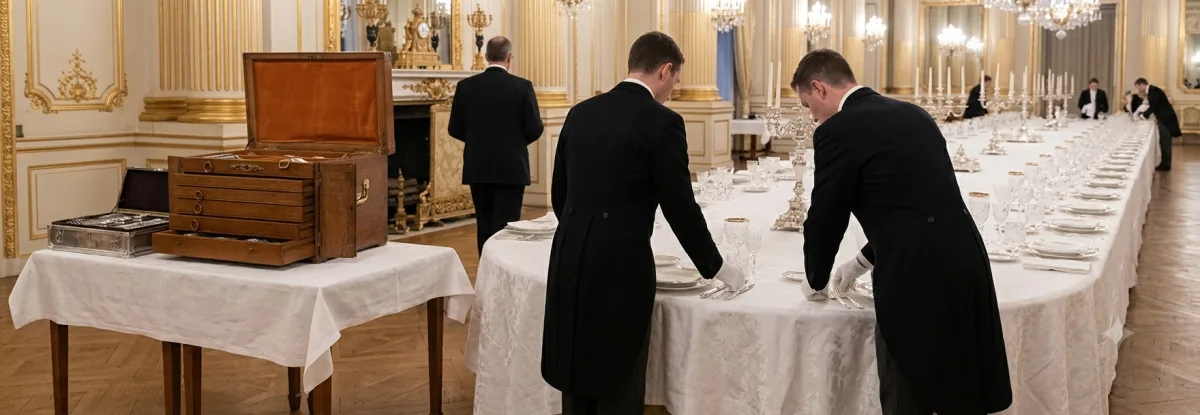
In a publication dedicated to the art of hosting, the Presidency of the Republic reveals that the financier uses a rolling meter to control the spacing of the plates. The maximum distance indicated is 34 centimeters.
One could have imagined that after years of practice, the eye would be enough. Obviously, at the Élysée, we also prefer to check.
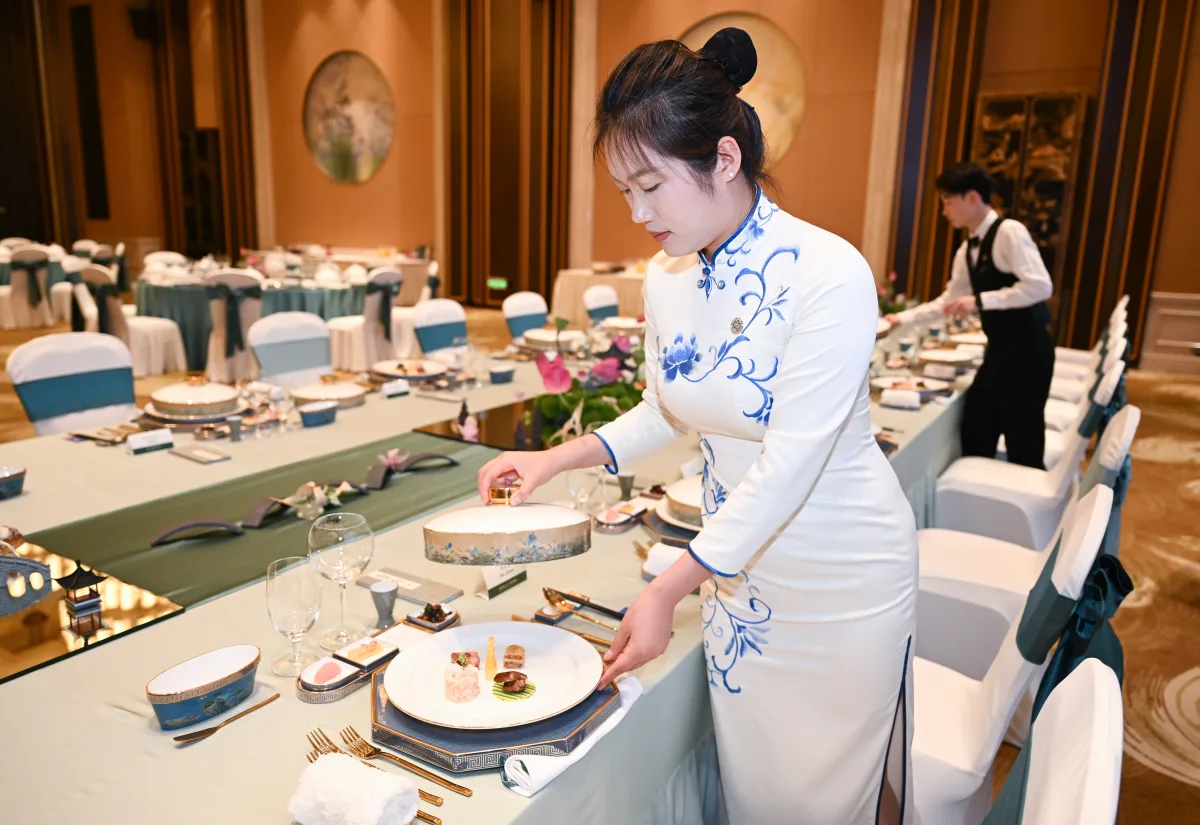
Precision matters. On a long table, the slightest difference ends up being noticed. The plates must follow a regular line, the cutlery must be arranged in an identical manner and each place must naturally find its own.
White gloves and coats of arms
At the Élysée, the financier does not only take care of the silverware.
He also watches over the porcelain, participates in their presentation and ensures that the pieces intended for receptions are handled with care.
White gloves are part of his equipment. In particular, they avoid leaving fingerprints on the metal. A practical detail, before being an image of the ceremonial.
The position of the cutlery also follows a specific usage. The Élysée indicates that the forks and spoons are turned downwards, in order to reveal the coat of arms.
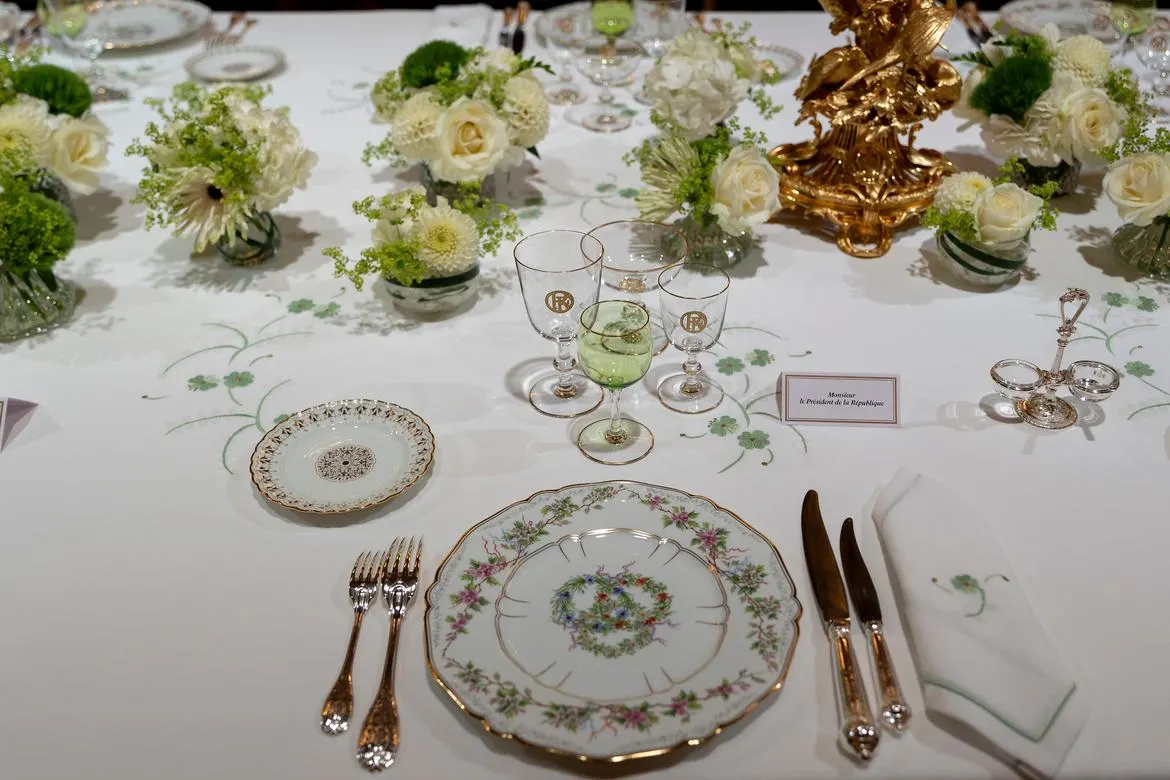
These pieces were designed to be used, but also to be seen. Their decor belongs to the material history of the Presidency.
You need to know the services, their particularities, the parts that make them up. Know what can be presented together and how to handle sometimes old objects.
The job continues well after the guests have left. Collections must be stored, items checked and kept in good condition.
A filmed archive allows you to discover part of it.
In The table of the Élysée, a national heritage, a documentary made for Michelin, Stéphane Guénaud, then silversmith of the palace, presents the Sèvres porcelain services and the room where the silverware collections are kept.
In particular, we discover large wooden chests, far from the set tables that the public is familiar with.
These images tell a rarely shown aspect of the Élysée. Between two receptions, the objects return to their reserves. There they wait for their next release, sometimes after several decades of use.
“The Élysée table, a national heritage”. Bernard Vaussion and Stéphane Guénaud present the kitchens and collections of the presidential table. Production: Gérard Jumel, for Michelin.
Sèvres, from 1872 to the present day
One of the particularities of the Élysée tables is the diversity of their porcelain.
The Manufacture nationale de Sèvres has long maintained links with French institutions. Some presidential services date back to the 19th century, others are much more contemporary.
The Duplessis “Aux oiseaux”, presented by the Maison Élysée, is dated 1872. It belongs to this long history of official porcelain.
But the Presidency also preserves creations that speak of other eras: the Poliakoff service from 1969, that of Étienne Hajdu from 1970, “Bouquet of flowers” from 1989 or even “Richer-bleu Élysée” from 2018.
From one service to another, the decorations change, the shapes evolve and the artists bring their perspective.
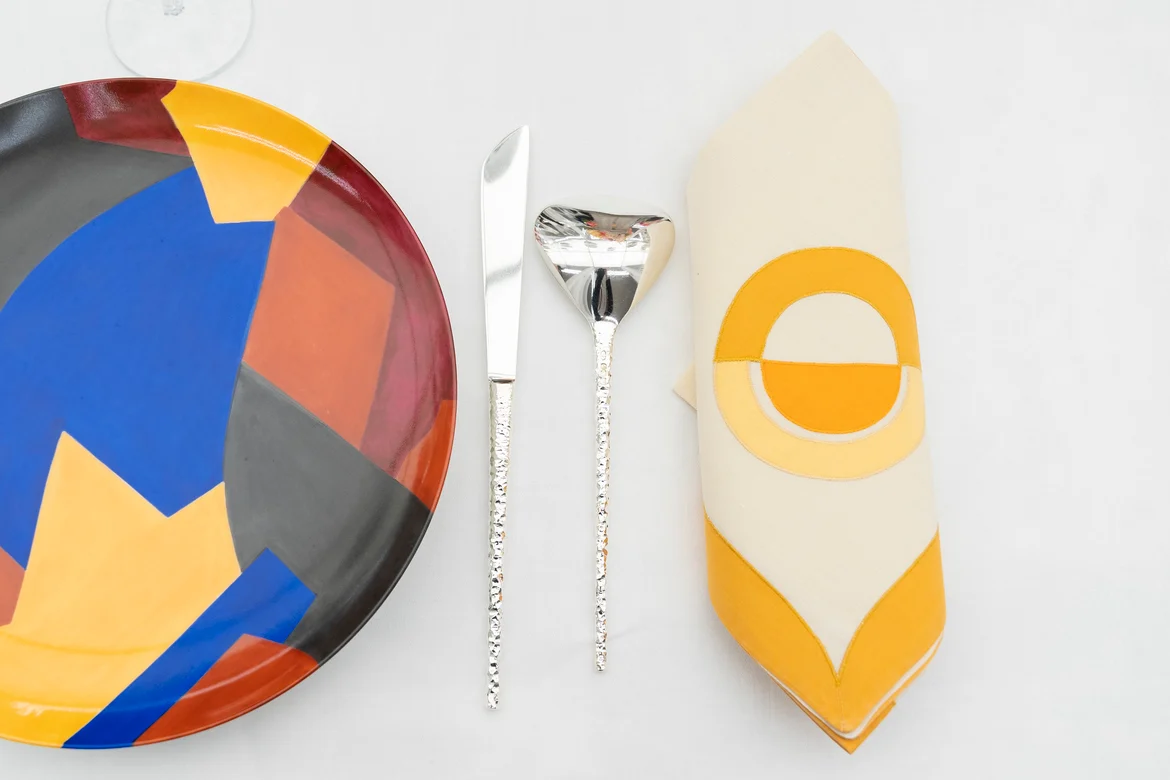
In February 2026, a new presentation of tableware at the Maison Élysée, a space open to the public facing the palace, brought together several of these ensembles.
Porcelains rubbed shoulders with Lalique and Baccarat glasses, as well as pieces of Puiforcat goldwork.
This proximity gives an idea of the compositional work necessary around a presidential table. You don’t just choose a plate because it’s beautiful. We must consider the service to which it belongs and the other objects that accompany it.
These collections also offer an interesting freedom: the table of a state dinner can borrow from different periods of French history without losing its official character.
At each reception, professionals have a heritage whose resources they know.
The tablecloth, then the flowers
Before the plates and cutlery, there is the tablecloth.
The Élysée indicates that the linen chosen for a reception is ironed directly on the table. An operation which may seem tedious, but which allows you to obtain a regular surface before starting dressing.
The creases disappear. The fabric takes its place. The teams can then install the dishes.
A few steps from this world of porcelain and metal, other professionals prepare floral arrangements.
The florists have their workshop at the palace. They work according to the theme of the reception and the table service chosen.
Their role is not limited to decorating a room with bouquets.
A composition must find its place among the plates, glasses and pieces of goldwork. Its color is related to that of linen and porcelain. Its volume modifies the appearance of the table.
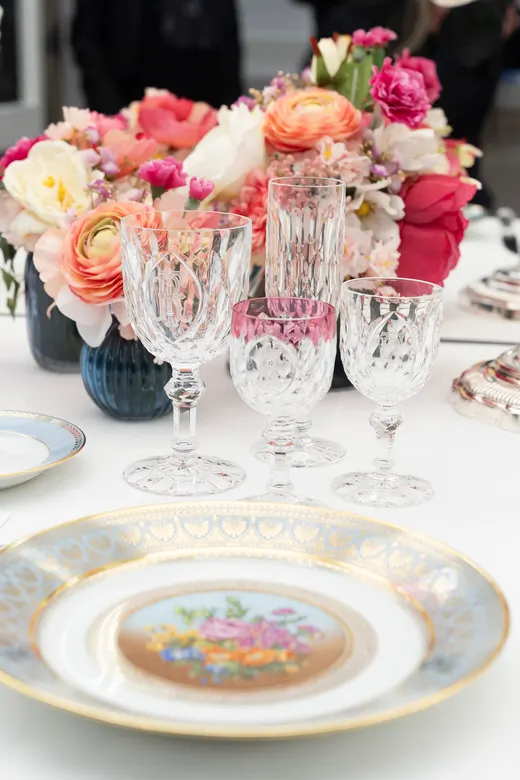
The precise constraints adopted for each dinner are not all public. But the documentation from the Presidency shows how these professions overlap.
In February 2026, the new tableware scenography of the Maison Élysée had also been prepared with the participation of the silversmiths, florists and laundry workers of the Presidency.
A collaboration interesting enough to be noticed: those who maintain the objects are also among the best placed to present them.
In kitchens, another matter of precision
While the room is getting ready, the kitchens have their own constraints.
Here again, the archives allow us to understand realities that the photographs of official dinners do not tell.
Bernard Vaussion, who directed the kitchens of the Élysée after spending a large part of his career there, kept numerous photographs of his work. Part of this fund joined the collections of the Bibliothèque nationale de France in 2023.

There we find culinary preparations carried out under several presidencies, from daily meals to large receptions.
The BnF notes in particular a difficulty which will speak to all catering professionals: the distance between the kitchens and the lounges where guests are served.
For a long time, dishes were transported in polystyrene containers to retain their heat. Under the presidency of Nicolas Sarkozy, Bernard Vaussion obtained the installation of relay ovens.
It wasn’t a question of prestige. A very concrete problem of temperature and routing had to be resolved.
The success of a reception also depends on these arrangements that no one notices at the table.
Bernard Vaussion’s archives also show the time spent on certain preparations. Decorative pieces required several days of work, particularly to respect their drying times.
These testimonies belong to the history of presidential kitchens. They do not allow us to describe in detail the current functioning of the Élysée facilities, but they remind us of a constant in the profession: the service is prepared long before the first guest is seated.
A know-how that the Élysée is beginning to show
For a long time, the public mainly discovered the presidential tables through official photographs.
There you could see the guests, the flowers, the china and the general order of the reception. More rarely the people responsible for preparing this set.
The Maison Élysée has begun to lift some of this discretion by presenting the collections and the professions associated with them.
During the European Heritage Days in September 2026, the Presidency also announced the reconstitution of a head table: that of the dinner given on July 13 to the members of the coalition of volunteers.
A way of allowing visitors to get closer to what they usually only discover from a distance.
This attention to the table joins a broader French tradition. In 2010, UNESCO listed the French gastronomic meal as an intangible cultural heritage of humanity. Among the recognized elements are the decoration of the table and the gestures that accompany the meal.
Elysée dinners naturally have their own diplomatic customs. They nevertheless call on some of this know-how, in an institutional framework where each reception is prepared for particular circumstances.
Then comes the moment when the doors open.
The guests discover the porcelain, the flowers, the shine of the silverware. Everything seems to have found its place naturally.
The drop-down ruler is long gone. White gloves too.
All that remains is the pleasure of a beautiful table and this very particular elegance of things whose work we do not suspect.
Sources and credits
- Presidency of the Republic, “The art of hosting: a tradition of excellence”, October 10, 2024.
- Maison Élysée, “A new showcase for the presentation of table arts”, February 19, 2026.
- National Library of France, Marion Tayart de Borms, “At the table of the Élysée”, 2024.
- Presidency of the Republic, European Heritage Days 2026.
- UNESCO, The gastronomic meal of the French, inscription from 2010.
- Gérard Jumel, for Michelin, “The Élysée table, a national heritage”, video archive.