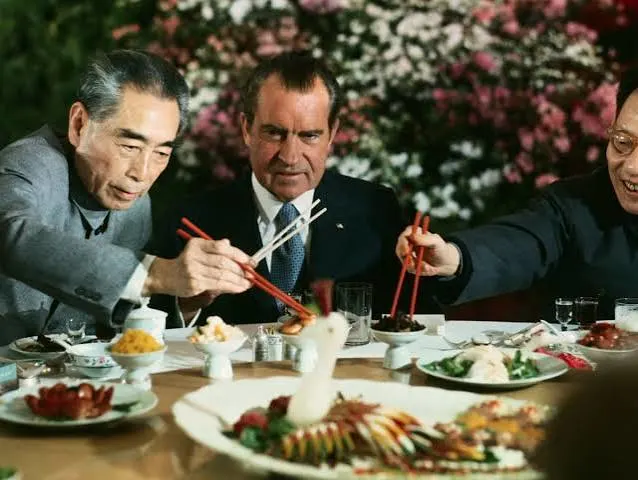
In February 1972, American President Richard Nixon visited communist China after more than twenty years of total rupture. Everything, or almost everything, is played out around a table, at the Grand Palais du Peuple, in front of hundreds of millions of television viewers. To avoid making any mistakes, Nixon secretly trained himself to use chopsticks.
Story of a meal that reopened a continent.
There are images that are worth all the talk. In February 1972, the whole world saw on television a President of the United States clumsily picking up a bite with chopsticks at the Chinese leader’s table. The scene seems innocuous. It is in reality one of the turning points of the 20th century.
To measure its scope, we must remember the situation. Since the victory of the communists in China in 1949, the United States and Beijing have no longer spoken to each other. Twenty-two years of complete silence, without embassy, without trade, without official contact. The two countries are enemies. But Nixon had one idea in mind: getting closer to China to weaken the Soviet Union, the other great communist power. This plan was prepared in the greatest secrecy by his advisor Henry Kissinger. Nixon’s trip should publicly seal this rapprochement. And he will seal himself at the table.
A dinner in front of the whole world
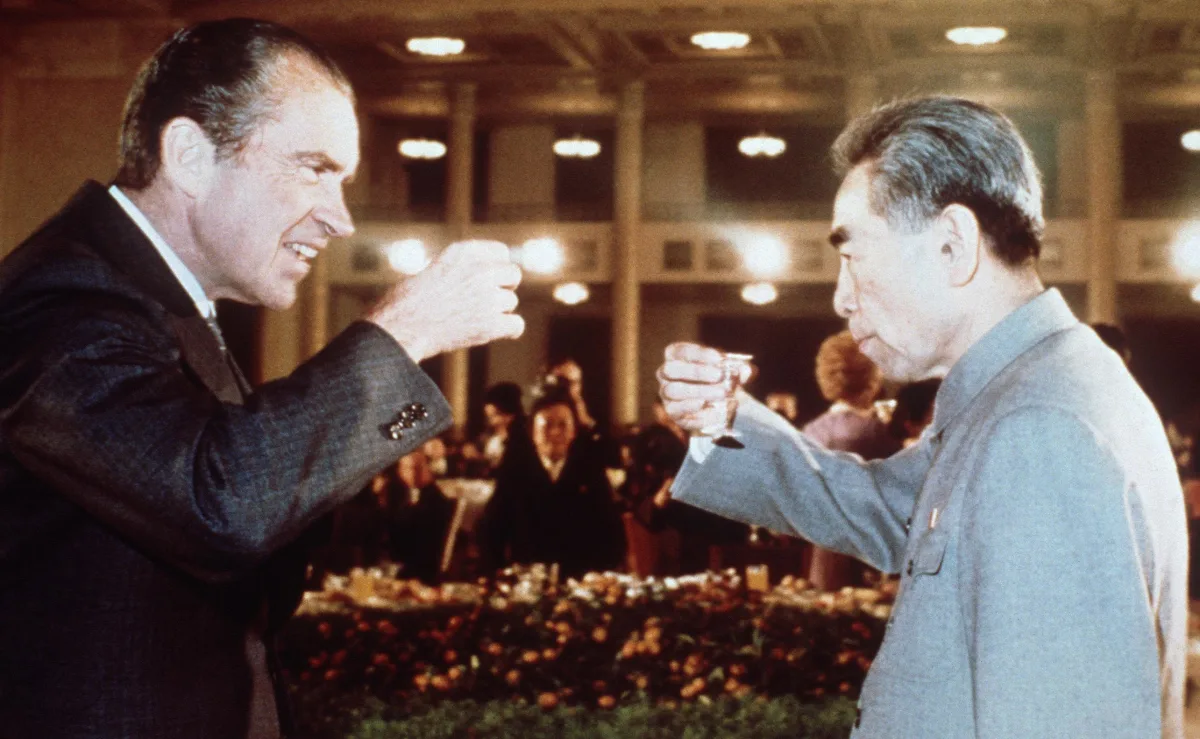
On the first evening, Chinese Premier Zhou Enlai offered Nixon a grand state banquet at the Great Hall of the People in Beijing. Rarely for the time, the evening was broadcast live on television around the world. Hundreds of millions of people are watching. Every gesture counts, because every gesture is a message.
The menu combines traditional Chinese dishes, adapted to the tastes of American guests: Chinese sausages, shrimp, and especially the famous Peking duck. We toast with maotai, a very strong Chinese alcohol. Nothing is left to chance. The White House had even prepared a confidential memo for Nixon on table manners, likely dishes and the use of chopsticks. The president had trained before departure, so as not to make a fool of himself in front of the cameras. This detail says it all: in this dinner, the slightest awkwardness could become an incident, and the slightest success, a symbol of friendship.
The table, neutral ground between enemies
Why so much importance given to a meal? Because, between two countries that do not trust each other, the table offers ground that the negotiating room cannot offer. We sit side by side, we share the same food, we raise a glass together. These simple gestures create the beginnings of trust, essential before signing anything.
An anecdote sums up this idea well. During the nightly discussions leading up to the final agreement, known as the Shanghai Communiqué, Kissinger reportedly said, after a dinner of Peking duck and maotai: “After a dinner of Peking duck, I would sign anything.” » The phrase may be too good to be accurate, and its source cannot be verified with certainty. But she speaks a truth: a good meal puts people in a better mood. Banquets did not make the deal for diplomats. They created the atmosphere in which this agreement became possible. Nixon himself later recognized the role of these meals.
The other face of the table: trickery
The story also keeps a more secret side, and just as tasty. Seven months earlier, in July 1971, it was another meal that made everything else possible. Kissinger then prepared Nixon’s trip, but in great secrecy. On an official visit to Pakistan, he pretends to be unwell, a victim of the heat. His hosts escort him to a high-altitude residence so that he can rest. In reality, a car secretly takes him to a military airport. Wearing a large hat and sunglasses, he flies to Beijing at four in the morning.
The official dinner in Islamabad served only one purpose: to cover this escapade. Here, the table does not build trust, it hides a maneuver. This is a rarely told aspect of diplomatic cuisine: the meal can be a decoration, a cover, as much as a tool for rapprochement.

A week that changed the world
Nixon’s trip to China is often described as “the week that changed the world.” In a few days, two sworn enemies reopen the door to each other, and the global balance is changed for decades. It would be wrong to say that Peking duck reconciled Beijing and Washington. The real work was done in the discussions, the strategy and the shared interests vis-à-vis Moscow.
But, as in Vienna with Talleyrand, as in Bangkok with Thai cuisine, the table played a role that nothing else could play. It offered both camps a space to look each other in the face without threatening each other, to share a human gesture before sharing a signature. Between two countries that no longer had anything in common, a meal recreated the minimum of trust without which no peace can hold. This is perhaps the greatest lesson of this 1972 banquet: when the official word is blocked, there remains the tablecloth to renew the dialogue.

Sources
- National Archives of the United States and Nixon Presidential Library: archives of the menu and the visit (DocsTeach platform).
- Los Angeles Times, June 1994: declassified CIA report quoting the phrase attributed to Kissinger (take with caution).
- Nixon Foundation and The Guardian: testimonies on the role of banquets in the 1972 visit.
- The China Project and AP News: account of Kissinger’s secret trip to Beijing, July 1971.
- Reference report “Diplomatic Gastronomy” (June 2026), basic document of the series.
📸Official photographs from 1972: United States National Archives and Nixon Presidential Library. All photos by the official White House photographer are in the public domain.