How a beetroot soup entered UNESCO’s most fragile list and turned its cooks into ambassadors.
On 1 July 2022, a UNESCO committee meeting in extraordinary session turns its attention not to a treaty but to a soup.
Within minutes, the “culture of Ukrainian borscht cooking” joins the List of Intangible Cultural Heritage in Need of Urgent Safeguarding, the register a state turns to when a living tradition is at risk of dying out in the near term.
The urgency is not rhetorical: the war has scattered the very families who pass the recipe from one kitchen to the next.
Welcome to one of diplomacy’s most discreet frontiers: the table.
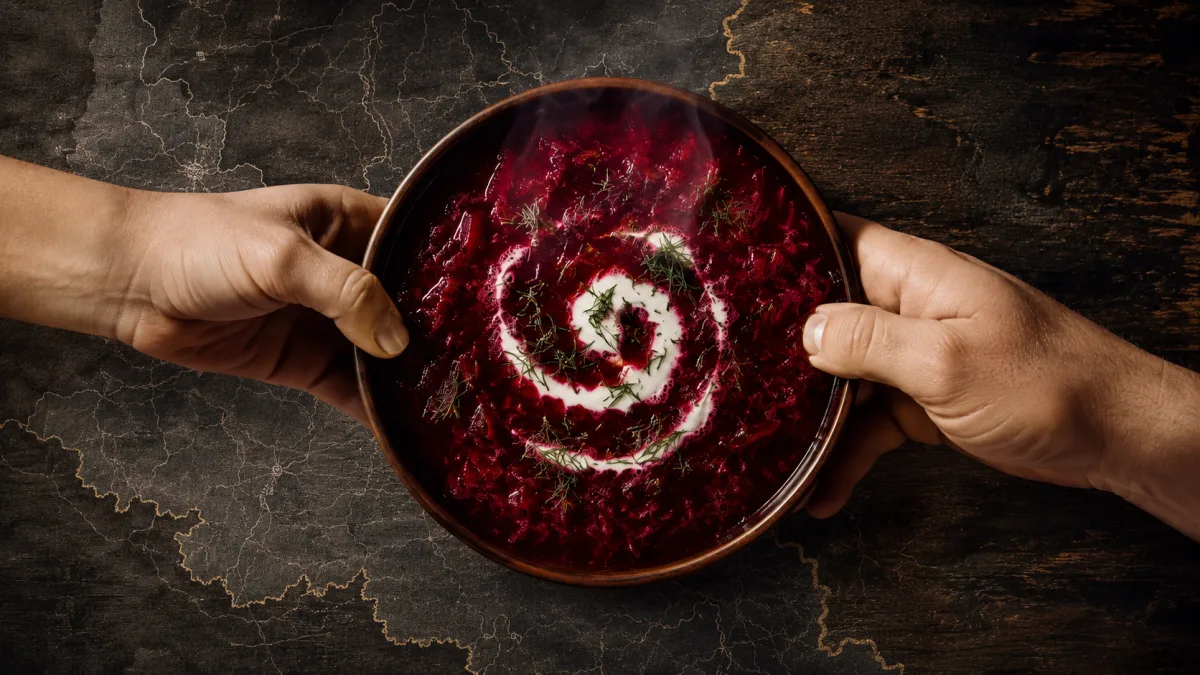
Picture a deep red, almost garnet, that stains the tablecloth and makes no apology for it. Borshch (which English usually spells borscht) is first of all beetroot (sweet, earthy), but also cabbage, carrot, sometimes beans, simmered until the broth turns to velvet. At serving time, a spoonful of smetana, the sour cream, melts in a spiral across the surface, and a shower of dill cuts through the sweetness with a fresh, peppery note. It is eaten scalding hot in winter, cool at the height of summer: rustic, generous, domestic, the kind of dish one associates with a grandmother’s kitchen, not with a diplomatic communiqué.
And yet, that summer, it became both at once.
To safeguard a way of cooking is to safeguard those who cook.
A Place on the World’s Most Fragile List
The list borshch joins is not the famous Representative List, that great inventory of humanity’s living traditions. It is the other one, the List of Intangible Cultural Heritage in Need of Urgent Safeguarding, reserved for practices threatened with disappearance. The Ukrainian file is examined under an accelerated procedure that UNESCO keeps, in its own words, for “a case of extreme urgency”.
The committee’s reasoning is remarkably concrete. The armed conflict, it notes, “has threatened the viability of the element”: with populations displaced, families can no longer grow the vegetables, cook the dish, or (the phrase stays in the mind) “gather to practise” the tradition. What is at risk is not a recipe. Recipes survive in books. What is at risk is the practice: the handing down, the gathering, the ordinary evening around a pot.
UNESCO also takes care to spell out what the honour does not mean. The inscription, the decision says, “does not imply exclusivity or ownership of the heritage concerned”; borshch “is also prepared in communities across the wider region”. The soup is cooked and loved across a vast arc of Eastern Europe, and no committee has claimed otherwise. What is recognised is narrower and more human: the Ukrainian way of preparing it, and the urgency of protecting those who keep it alive.
The Cook as Ambassador
If a nation’s cuisine is a language, someone has to speak it abroad. In Ukraine, that voice has often belonged to its cooks. Long before the UNESCO file was opened, a young chef, Ievgen Klopotenko, had made borshch a cause, reinventing it, filming it, teaching it, putting it into school canteens and onto menus abroad. His campaign, launched in 2019, carried an everyday dish to the centre of a national conversation about who Ukrainians are and what they put on the table.
That conversation has since become policy. Since 2021, and even more so since the invasion, promoting and protecting Ukrainian food culture has been an avowed strand of its foreign policy, a way of asserting, in the midst of war, that its identity is its own.
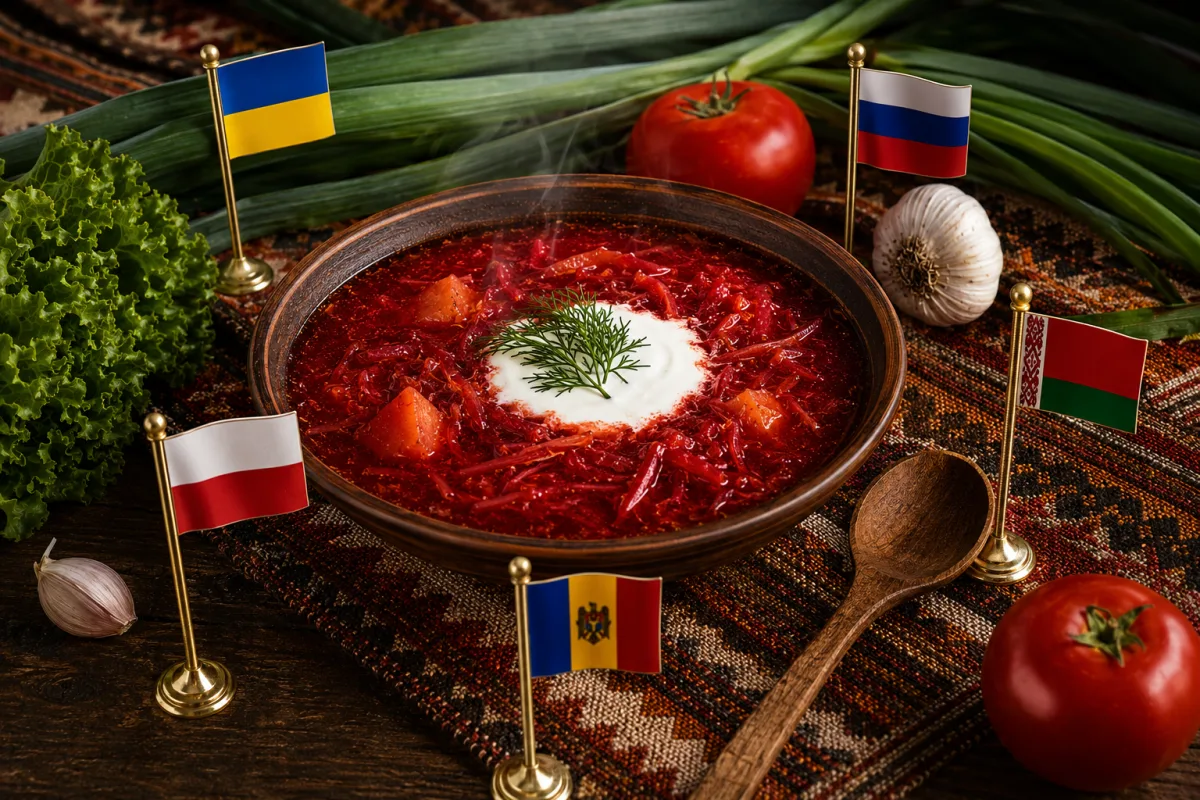
The Ukrainian way of preparing and sharing borshch, the living practice UNESCO set out to protect.
This is gastrodiplomacy in its most disarming form: the idea that a country can make itself known, and loved, through what it offers a guest. A bowl of borshch pleads no case and signs no agreement, and yet it does the slow, patient work that diplomacy is made of: it makes a culture legible, memorable, dear to strangers. In wartime, that work takes on an extra charge: a way of asserting that a people, and the small rituals that make up its days, are holding firm.
A bowl of soup can do the slow, patient work of diplomacy.
In the end, this story is not about beetroot. It is about what a cuisine holds on to when everything else is shaking: memory, belonging, the shape of an ordinary evening, the certainty of a familiar taste. That is why a simple soup could find itself, one July morning, in the hands of an international committee: because borshch does not only feed those who eat it. It feeds the idea they have of themselves.
Recognised, safeguarded, carried across the world by its cooks, borshch has become what great cooking always is, quietly: an ambassador who needs no title, and asks only for a place at the table.
Sources
- UNESCO, primary source: “Culture of Ukrainian borscht cooking”, inscribed on the “List of Intangible Cultural Heritage in Need of Urgent Safeguarding”, decision 5.EXT.COM 5, 1 July 2022. (ich.unesco.org)
- Academic foundation: Johanna Mendelson Forman and Yevheniia Yemshenetska, their co-written work on Ukrainian borshch and culinary diplomacy, presented at the Dublin Gastronomy Symposium, the documentary basis of this article. Johanna Mendelson Forman, “Ukraine’s Borsch Diplomacy” and “The Borsch War is Over”, Inkstick Media.
- A chef’s campaign: on chef Ievgen Klopotenko and the movement to have borshch recognised as Ukrainian cultural heritage, since 2019. CBC; NPR; klopotenko.com.
- Heritage and identity: Mariya Lesiv, “Not All Quiet on the Culinary Front: The Battle Over Borshch in Ukraine”, Folklorica. Smithsonian Folklife, on the etymology and regional spread of borshch.
About this article. This text was written by the editors of Intendance Palace in collaboration with Johanna Mendelson Forman (Conflict Cuisine Project, School of International Service, American University) and Yevheniia Yemshenetska, drawing on their co-written work.
Picture credits: visual interpretations, original images composed by artificial intelligence for “Gastronomic Conflicts”.