Secret anatomy of a state dinner under Raymond Poincaré
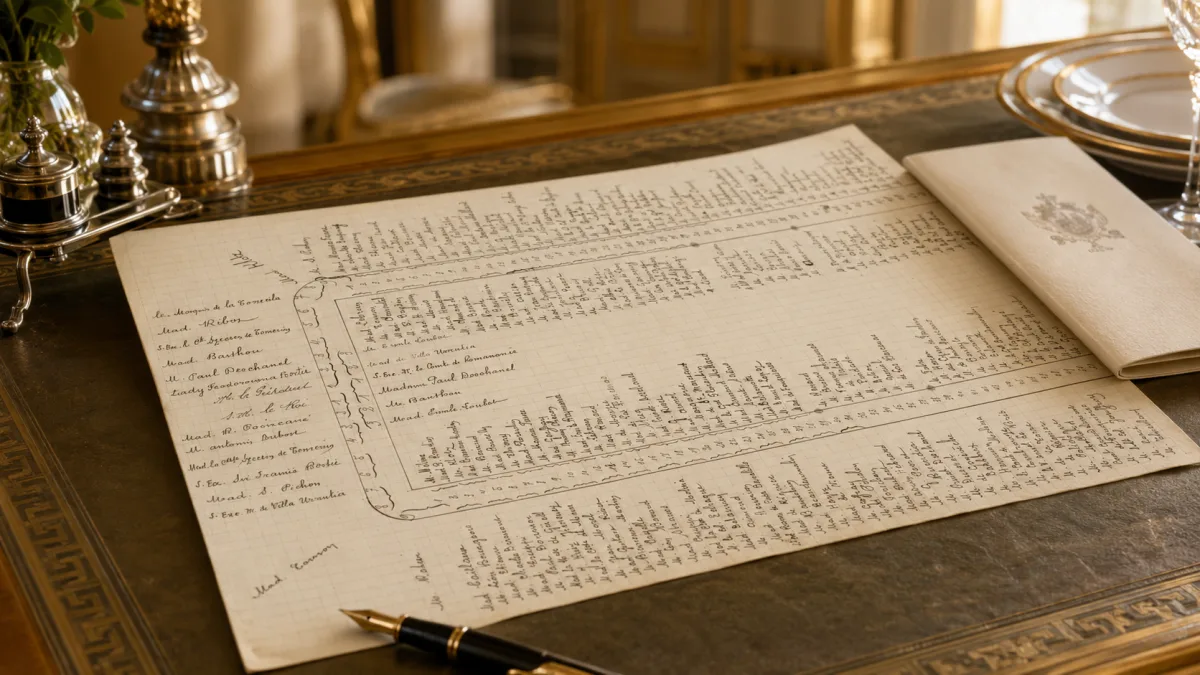
More than two hundred chairs. A king that the document never names. And a numerical scale which descends, without a break, from the sovereign to the captain. The table plan of May 7, 1913 is not a souvenir of a dinner: it is a government document, drawn up in pencil on graph paper.
Two functions, no name
In the center of the short side, two words order everything else: “H.M. the King” and, immediately next to it, “Mr. President”. Neither Alphonse XIII nor Raymond Poincaré are written. The protocol does not place men, it places charges. The king is the king, the president is the president, and the leaf only knows them.
This is the first lesson of the document, and it is dry. Poincaré, elected in January, installed at the Élysée since February, exists here only through his function. The day he leaves, the position will remain and his name will be erased from these papers.
The dinner took place on May 7, 1913. It opened the official visit of the Spanish sovereign to Paris, which lasted three days, until the reception at the Palais des Beaux-Arts.

The unnamed king
The name is missing, but the court designates it. Around the center crowd the Count of Romanones, head of the Spanish government, the ambassador Wenceslao Ramírez de Villaurrutia, and the Marquis de la Torrecilla, who heads the King’s Household. Three men who only move behind a sovereign, and only one sovereign is then in Paris: Alphonse XIII.
The provision then says the main thing in one line. The king and the president sit side by side, in the two places numbered 1, in the exact middle of the head table. This is the only place in the shot where two men touch. Everywhere else, the alternation of the sexes is maintained without fail; here it gives way, because no rule takes priority over the one which requires that the two heads of state speak to each other without an intermediary. Proximity is not a courtesy: it inscribes in space the Franco-Spanish rapprochement that France is cultivating a few months before the war.
The science of neighborhoods
A state table plan is not a guest list: it is a reduced order of the world. And this order cannot be improvised the same morning. It is calculated.
In 1913, French precedence was not a matter of tact or worldly memory: it was a matter of law. The decree of June 16, 1907 relating to public ceremonies, precedences, civil and military honors had just, six years earlier, replaced the imperial decree of 24 Messidor Year XII, which had governed the matter since Napoleon, in order to take into account the separation of Churches and State. The man who sets this table is working on a regulatory text in front of him. He does not seat guests: he applies a standard, and he is responsible for it.
Superimposed on this national corpus is a second, older and international one. The Vienna regulations of March 19, 1815, annexed to the final act of the congress, had classified diplomatic agents into classes and fixed that within each class the rank is taken on the date of official notification of arrival. An ambassador therefore does not take priority by the power of his country, nor by his current favor: he takes precedence by his seniority in Paris. The rule is blind, and that is precisely what makes it governable.
There remains the third floor, the heaviest, the one which is not written anywhere. It is necessary to verify, name by name, the function actually performed on the said day, and not that of the previous week. You must know the exact title, French and foreign, down to the title which has just been conferred or which has not yet been conferred. We need to know who speaks what language, who cannot be seated next to whom, what mourning is underway, what estrangement is fresh. You have to arbitrate two hundred times in a row, knowing that a single mistake will produce a letter of protest from the embassy the next morning.
You don’t set a table for two hundred seats. We calculate it, at length, alone, in an office, on graphed paper, in successive erasures.
This job had one department and one man. At the Ministry of Foreign Affairs, the protocol passed in 1913 under the direction of Richard William Martin, who retained it until 1920 and who had been, five years earlier, first secretary of the French embassy in Madrid. No one was better placed to establish the court of Alfonso XIII. His name appears on the map, in the fourth line, in the forty-sixth place. The man who knows the table better than anyone sits forty-six chairs away from the king. This is the signature of the profession: the success of a table plan is measured by the fact that, when the evening comes, no one has to think about it.
Count from center
The document does not state the hierarchy: it quantifies it. Above the head table, the numbering is read in mirror, “8 7 6 5 4 3 2 1” on one side, “1 2 3 4 5 6 7 8” on the other, on either side of the royal couple. Everyone’s rank is not an impression, it is a distance, and this distance is written.
The diplomatic scale is verified to the letter. Sir Francis Bertie, British ambassador to Paris since 1905, and Count Szécsen de Temerin, Austrian-Hungarian ambassador since 1911, occupy the two row five places, one on each wing. Villaurrutia, appointed Spanish ambassador in March 1913, sits in row seven. In other words: the ambassador of the sovereign who we are celebrating this evening goes behind two colleagues, for the sole reason that they arrived in Paris before him. The rule of Vienna prevails over the event. This is where you recognize a State that sticks to its protocol.
The same logic governs the two long branches. Each has fifty-one guests on each side, and each is opened by former presidents of the Council: Jules Méline, Léon Bourgeois, Aristide Briand. Briand is in fifth place in a branch. Seven weeks earlier, he was still presiding over the Council and his chair would have been completely different; Louis Barthou, who succeeded him on March 22, is seated at the head table. A seating plan does not reward a career, it records a state of power on a date.
It does not reward glory any more. Camille Saint-Saëns, then the most famous living French musician, occupies twenty-fifth place. Ernest Lavisse is in thirty-third, Maurice Barrès in thirty-sixth, Edmond Rostand in forty-second. The branches end in generals, colonels, lieutenant-colonels and captains. From the king to the captain, the ladder descends without a missing step.
One last detail finally betrays the hand: the alternation of guests and wives is strictly maintained, place after place, until the ladies run out. After this point, the lines end in rows of single men. The protocol only renounces its rule at the exact moment when it becomes materially impossible.
A chair without a warrant
There remains a place that nothing in the organization chart justifies. Émile Loubet is there, with his wife, on the inside of the head table. Former President of the Republic from 1899 to 1906, he no longer held any office in 1913. The decree of 1907 owes him nothing.
His presence is not due to power, it is due to a story. It was Loubet who welcomed the young Alphonse XIII to Paris in 1905. And it was at his side, on the night of May 31 to June 1 of that year, at the corner of Rue de Rohan and Rue de Rivoli, that an explosive device was launched against the king’s procession. Both emerged unscathed.
Eight years later, the man without office sits a few steps from the sovereign. The table plan does not only record the power relations of the moment: it keeps the memory of what States owe each other outside of any mandate.
What the pen doesn’t say
We would be tempted to read a code in the writing itself. On the sheet, most of the names are drawn vertically, only a few horizontally, and it is believed that there is a secret hierarchy.
This is not the case, and the truth is more beautiful. The table is a hollow rectangle, where you sit on both sides of each long branch. The names of the branches are written perpendicular to the edge, due to lack of space to place them; those on the short side, where the king and the president sit, are read horizontally because the short side is short. The orientation of the pen says nothing about the rank. She says the shape of the furniture.
The rank is elsewhere, in an obvious fact that the century has not denied: in the center of the short side, then at the distance that we take from it, chair by chair. To be seen at a state table is not to be written straight. It’s sitting next to the king.
A square of squared paper, under the crystal and the silverware that other hands were polishing at the same moment in the office. Before speeches, before treaties, before official photographs, power begins with a chair.