The line does not lie
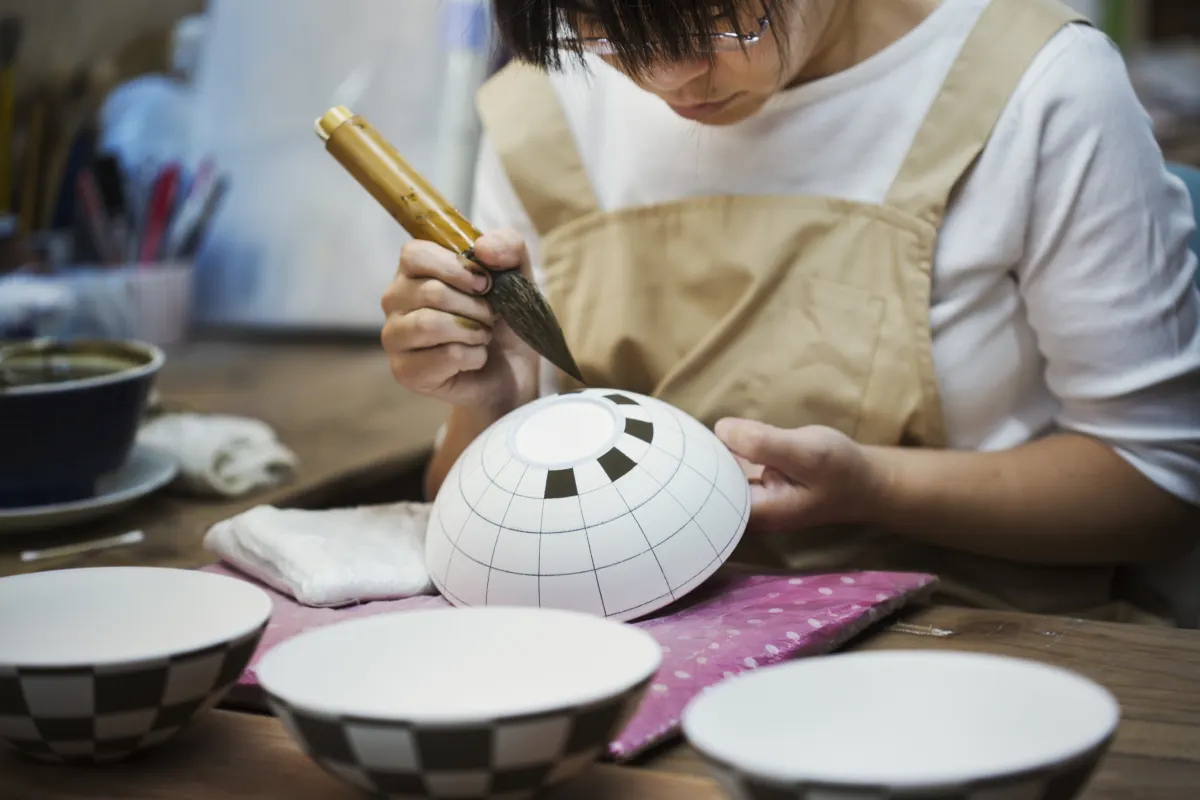
On July 27, 2012, Arita Porcelain Lab published a short workshop story on its site. A young painter draws lines. She tries so hard that she stiffens and ends up not breathing at all. The author of the post, who watches her do it, notices that she is holding her breath, too.
Professor Hideshima intervenes with a single sentence, translated from Japanese:
“Draw the line to the rhythm of your own breathing. »
His explanation is common sense. A brush does not leave the same trace depending on whether it runs or drags: the speed changes the intensity of the line. The breath regulates the speed. As long as the painter breathes calmly, her hand maintains its appearance, and so does the line. When she blocks her breathing, she loses this inner metronome, and it is the line that bears the trace.
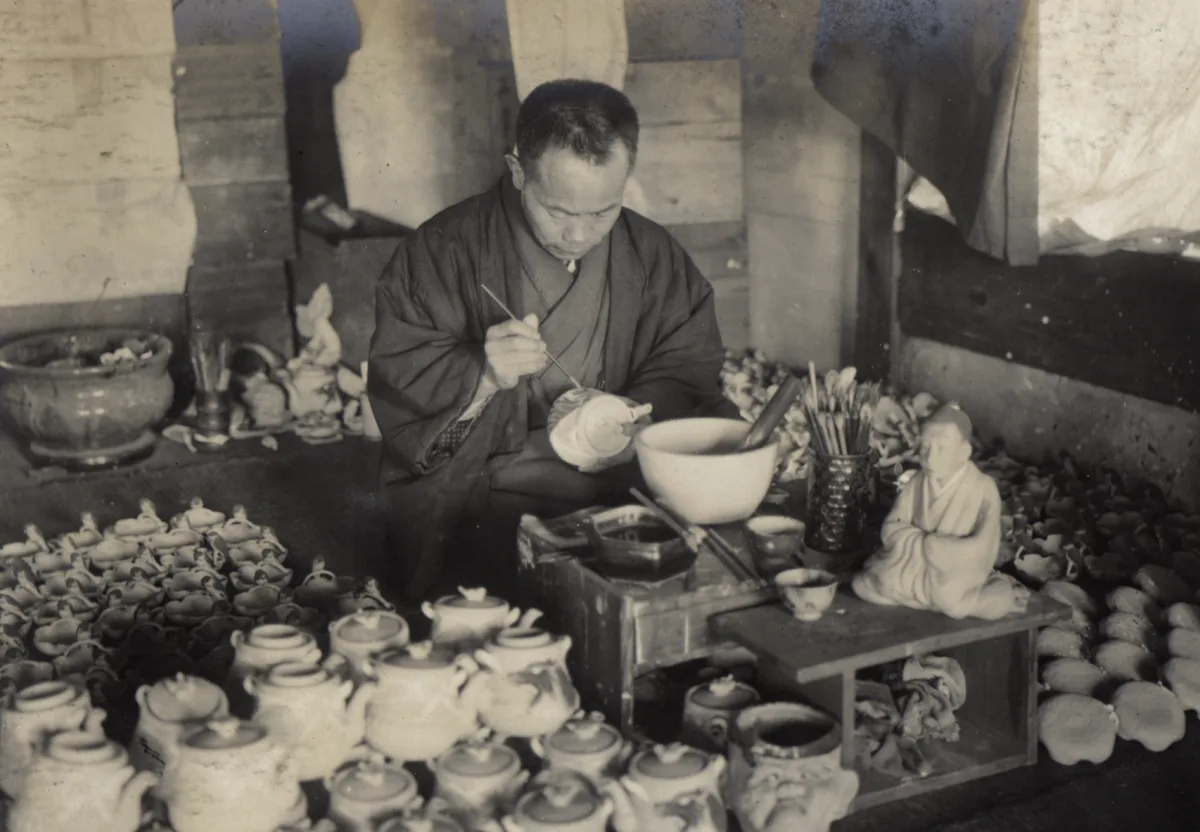
The following exercise is nothing spectacular. Breathe normally, then draw longer lines, again and again, until you find the position where the hand works best. Before touching the porcelain, you learn to hold yourself and breathe.
The blue that only reveals itself in fire
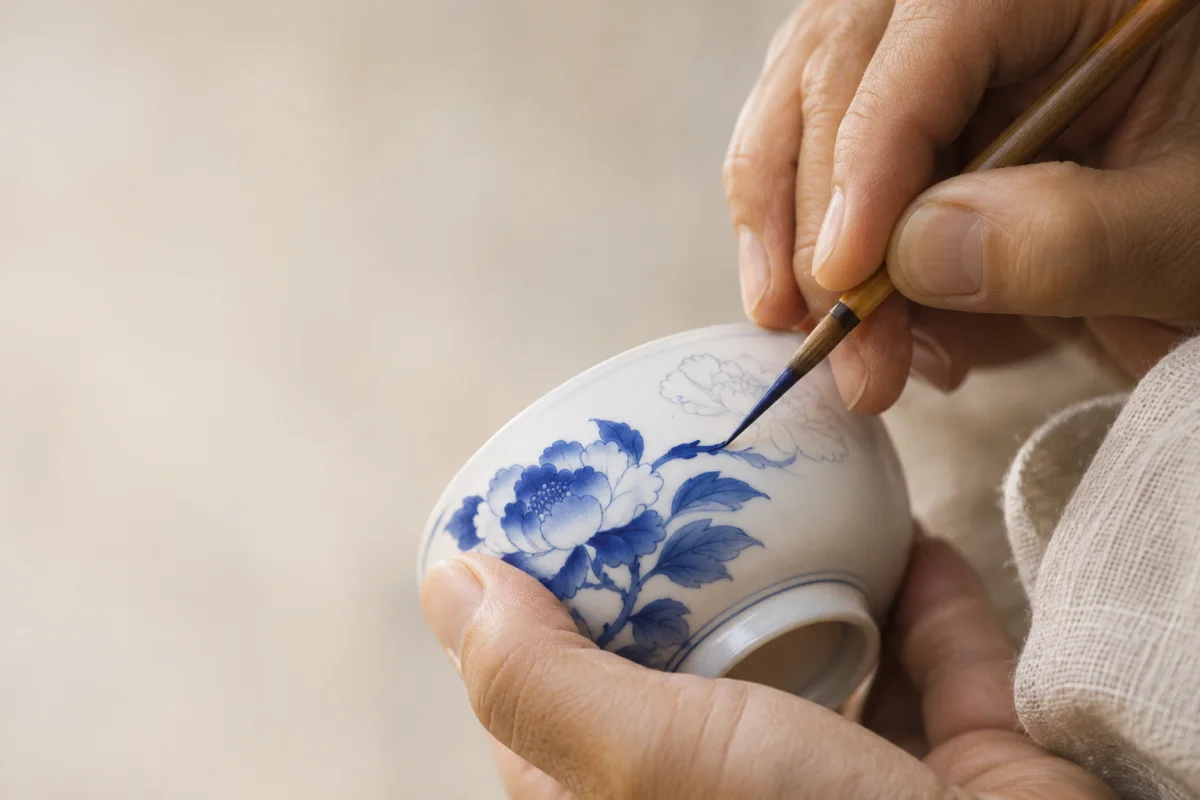
It must be said that porcelain hardly leaves time to think. Before being painted, the piece is put in the oven for the first time, around 900°C. It comes out more solid, but above all very absorbent: the earth drinks the water from the brush. According to Arita Porcelain Lab, drawing a clean outline on this surface requires a very steady hand.
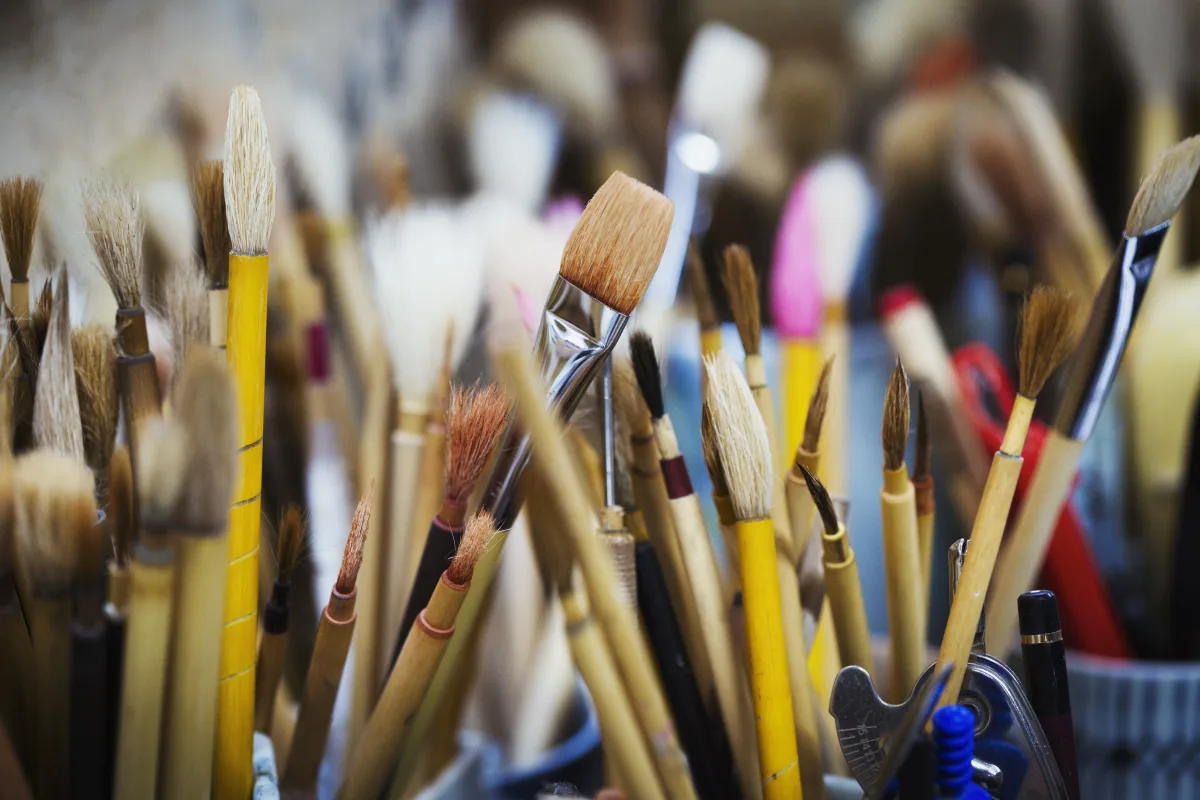
This outline is drawn with gosu, a cobalt-based pigment which will only turn blue when cooked. Then, the painter takes the dami, a funny brush with a thick body and a very fine tip. He uses it to fill in the drawing, moving from light blue to more intense areas. The house presents this technique as specific to Arita underglaze painting, and it takes years to master it.
The piece is then immersed in the glaze, the layer of glaze, and the decoration disappears. It only returns after a second firing, around 1,300°C, under a transparent and shiny varnish. The painter then discovers what his hand has really done.

Six hundred colors and an oven at 1,350°C
At Fukagawa-Seiji, whiteness begins well before the painting studio. The house, founded in Arita in 1894 by Fukagawa Chūji, prepares its dough with porcelain stone from Amakusa, in the neighboring prefecture of Kumamoto. She does everything herself, from the clay to the colors, and shapes even the models for her molds by hand.
She then fires her porcelain at around 1,350°C, 50 to 100 degrees higher than usual firing, for thirteen to fourteen hours. She draws a white so fine that it lets light pass through, and a bright blue that she calls “Fukagawa blue”.
In this house, color is a profession in its own right. There are around six hundred shades there, almost all mixed on site. Every day, specialists adjust the preparations according to temperature and humidity, because the same formula does not give the same tone from one season to the next. For the covered decor, the palette brings together red, black, yellow, green, gold and silver. The painter therefore works with colors whose final result he will only see when they come out of the oven.

The emperor among painters
In 1910, Fukagawa-Seiji became a supplier to the Ministry of the Imperial Household. A year later, the Saga prefecture album already mentions it in its notice on the company.
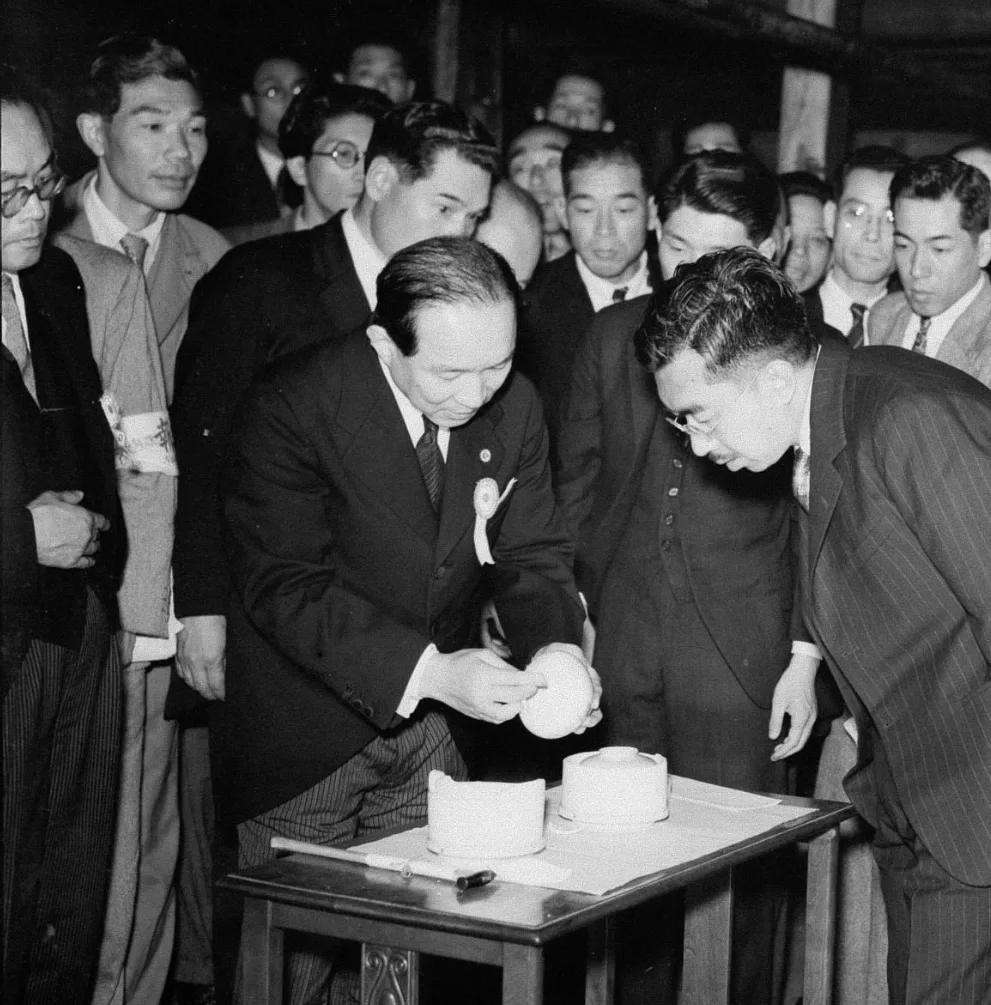
Connections with the court are not limited to deliveries. On May 23, 1949, Emperor Hirohito came to visit the factory. Twenty years later, on November 11, 1969, it was Crown Prince Akihito who came to watch the artisans work there.
Palmettes from a king of France
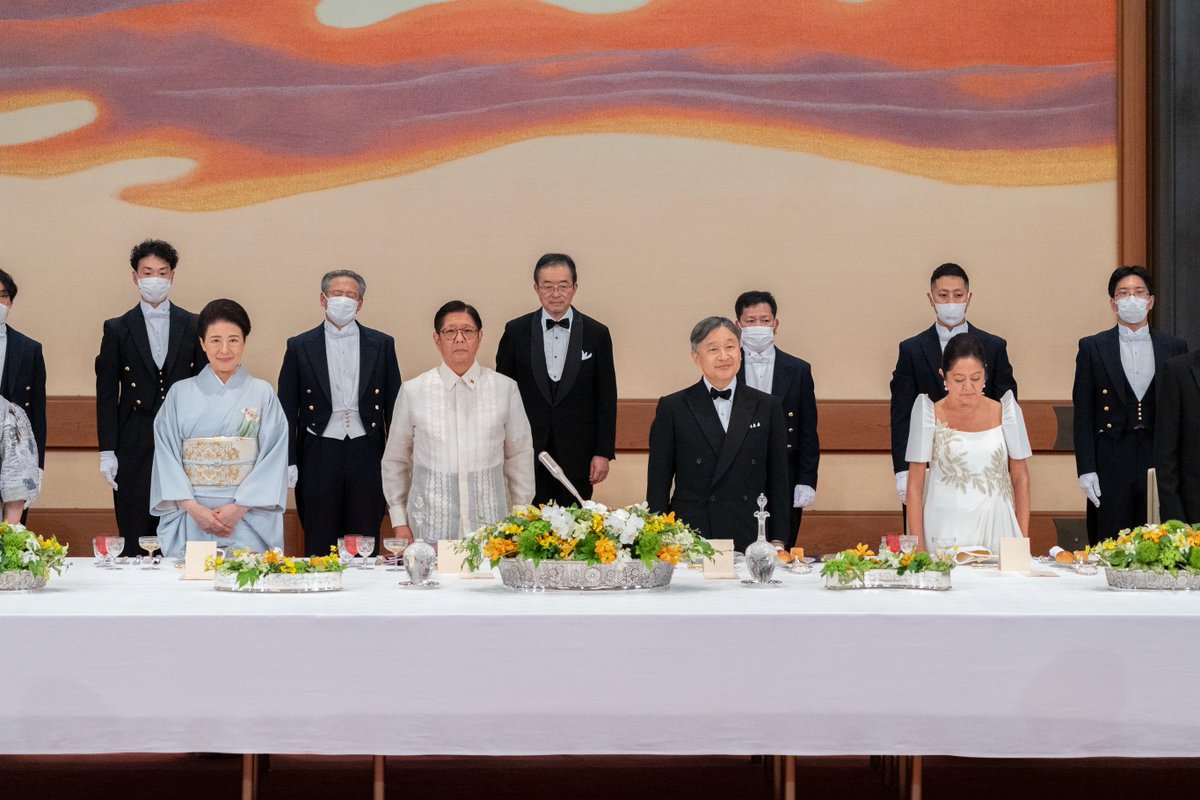
In Tokyo, the Kasumi Kaikan Memorial Museum in Gakushūin is currently devoting an exhibition to court banquets. In an interview published on October 1, 2026, its commissioner, Minako Nagasako, looks back on the year 1882: the first banquet services manufactured in Japan were then delivered to the Ministry of the Imperial Household, at the cost of great effort.
Among the pieces on display is a service with palmettes and paulownias accented with gold. It is attributed to Seiji Kaisha, an Arita factory, and dated from 1882 to 1897. The palmette is a stylized palm leaf, which is considered one of the ancestors of the arabesque.
According to Minako Nagasako, this service was inspired by a decor used by a king of France.
Each leaf was hand painted.
Today, the plates of imperial banquets have replaced the paulownia with the chrysanthemum, the emblem of the Imperial House. The palmette frieze has not changed.

Remaking a plate from the Meiji era
The archives tell the rest. In her thesis on the tableware of Emperor Meiji, historian Mary Redfern notes that in June 1889 an order was completed for the gold-decorated porcelain for the Hōmeiden banquets. This is then the hall of the Meiji Palace, not the one of today. She also notes that Seiji Kaisha, founded in 1879, declined in the 1890s, and that other Arita houses, including Tsuji, Kōransha and Fukagawa-Seiji, then resumed manufacturing the same models. The service has outlived its maker.
He continues to live. Fukagawa-Seiji explains that certain orders from the Imperial Household Agency still concern pieces intended to complete the tableware delivered under Meiji, and that remaking them requires rediscovering techniques from the period. The Japanese Tourism Agency specifies the requirement: find the exact shape, decoration, color and weight of old pieces, using, when possible, the original molds and techniques.
Allowed tolerances are not published. But for a palmette painted this year to join those of more than a century ago, the line must be the same.
It is therefore necessary, first of all, for the painter to breathe.

SOURCES AND CREDITS
Sources and credits. Sources: Fukagawa-Seiji, “Ayumi”, “Creative” and “深川の手» (11/11/2026); Saga Prefecture, Saga-ken shashinchō (1911, National Diet Library); Arita Porcelain Lab, “OJT » (07/27/2012) and “Manufacturing”; Mary Redfern, Crafting Identities: Tableware for the Meiji Emperor (University of East Anglia, 2015); Nihon Bunka Kōryū Zaidan, interview with Minako Nagasako (01/10/2026); Japan Tourism Agency, “Fukagawa-Seiji History and Vision”; The Asahi Shimbun, legends of the visits of 1949 and 1969. Photos: 1. Mint Images / Getty Images, ref. 910585950; 2. Elstner Hilton / A. Davey album, circa 1914-1918, CC BY 2.0; 3. The Asahi Shimbun / Getty Images, ref. 494077272; 4. Mint Images/Getty Images, ref. 910585856; 5. The Asahi Shimbun / Getty Images, ref. 494077284; 6. Saga Prefecture / National Diet Library, 1911, public domain; 7. The Asahi Shimbun / Getty Images, ref. 2178834879; 8. Ricardo Stuckert / Presidency of the Republic of Brazil, CC BY-ND 2.0, without modification.