
June 2013. Fire breaks out in the roofs of Riga Castle. In the morning, the village hall is streaming. The ceiling paintings are soaked, blackened with soot. None are destroyed. The palace has just escaped the worst, and with it a certain idea of Latvia.
Because behind its clear facade, this castle hides a manifesto. Its first stone was laid in 1330. Centuries of destruction, reconstruction and expansion followed. It became a presidential residence in 1922, losing this function under the Soviet occupation, regaining it in 1995 with the return of the head of state. Its salons keep traces of each era. And they are still used: we receive there, we accredit there, we dine there.
A room to recognize yourself
In 1923, President Jānis Čakste launched a competition.
Purpose: the room where the ambassadors will present their letters of credence. The ambition is cultural. Offer foreign representatives a setting where the country recognizes itself. Ansis Cīrulis wins with a project entitled Atdzimšana, “Renaissance”. The whole was completed in 1929.
Cīrulis is not satisfied with walls. He designs everything: lights, seats, carpets, curtains, upholstery. The furniture is robust, sculpted or inlaid with motifs drawn from Latvian traditions, reinterpreted in the spirit of Art Deco. The result is so coherent that the room is today included in the Latvian Cultural Canon, the national selection of the country’s major works.
Enter. The green of the walls is obvious. Then come the golden patterns, the openwork backs, the colorful figures on the ceiling in a world of flowers and signs. A large rug brings it all together. The room has an almost domestic density. We would recognize her among a thousand.
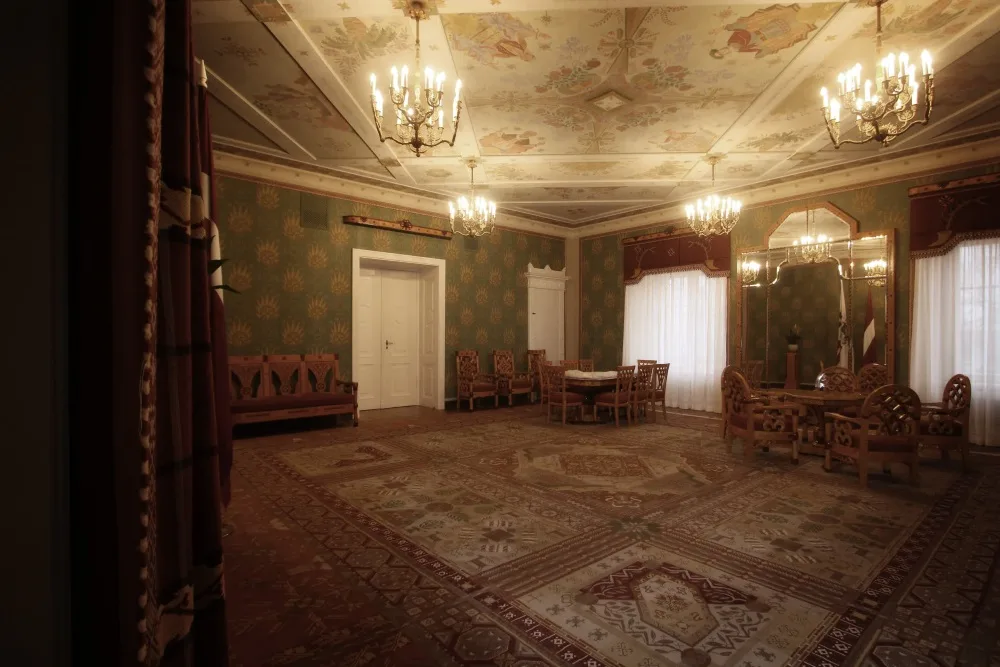
The man knows Paris. Between 1908 and 1914, he spent several winters there and attended the Académie Julian. Painter, ceramist, textile and furniture designer, he moves from one profession to another effortlessly. At the castle, its strong green, its mythological figures and its ornaments give a face in search of a Latvian style. He will also design the gates of the palace, forged at the end of the 1930s.
The curtain, a matter of state
It is in the fabrics that this requirement is best seen. During the restoration, the original hangings had disappeared. It was necessary to investigate. Old photographs provided the motifs. A sample kept at the Museum of Decorative Arts and Design revealed the structure of the fabric.
Set designers Ināra Cine and Guntars Jansons restored designs and colors. Textile artist Māris Maniņš reconstructed the patterns. Together with Kristīne Vēja, head of KATE’s textile department, they had to be adjusted to the historic rods and proportions of the room. The fabrics were woven by hand, carefully lined, edged with decorative bands made separately.
Every steward knows these decisions. The width of a curtain. Its fallen. The rhythm of a pattern. The way it frames a door. A few centimeters are enough to change the perception of a living room. Here, these choices made it possible to rediscover the accuracy of an ensemble designed almost a century earlier.
“A great painting”
The village hall changes scale. In 1938, for the twenty years of the Latvian state, the architect Eižens Laube gave it its scale. Wood, national ornaments, cycle of paintings dedicated to the history of the country. On the final drawing, he notes two words: Liela glezna, “a large painting”.
The oak paneling and balcony warm up the space. Seven large bronze chandeliers take over. Their 4,300 crystal pendants give the room its reception shine. The materials remain present even when the tables occupy the entire floor.
The first paintings of the ceiling were completed at the beginning of 1939. After the fire of 2013, they were removed, restored, then put back in place. Furniture follows the same path. In August 2016, the presidency announced the return of the set designed by Laube. In the green room, the Biedermeier mahogany furniture, seriously damaged by the fire, finds its place. Five Latvian museums are lending works for the development. Saving a palace means mobilizing an entire network of know-how.

On the ceiling, history continues to be written. In 2021, two new paintings join the decor. Aleksejs Naumovs represents a popular demonstration on the banks of the Daugava. Andris Eglītis painted the proclamation of the Republic on November 18, 1918.
For this scene, Eglītis had models pose at the National Theater and read testimonies from the time. Naumovs mixed his personal memories, his research and his exchanges with participants. Two contemporary views in a historic setting, with a rare constraint: a painting made to be seen over the shoulders of the guests.
A dinner, a reunion
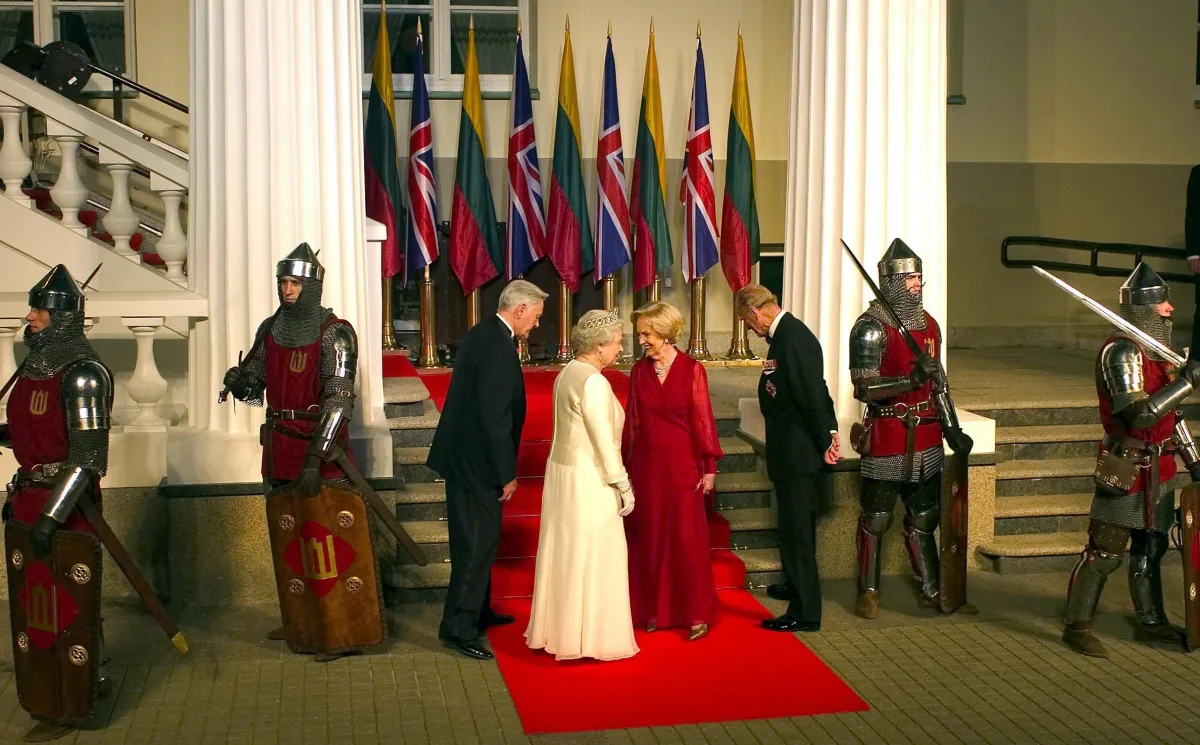
On October 28, 2025, President Edgars Rinkēvičs hosted a state dinner for Frederik X and Queen Mary. Before the banquet, the royal couple and their host greet the guests in the white room. Evening outfits, decorations, line of greetings: the palace regains its reception movement.
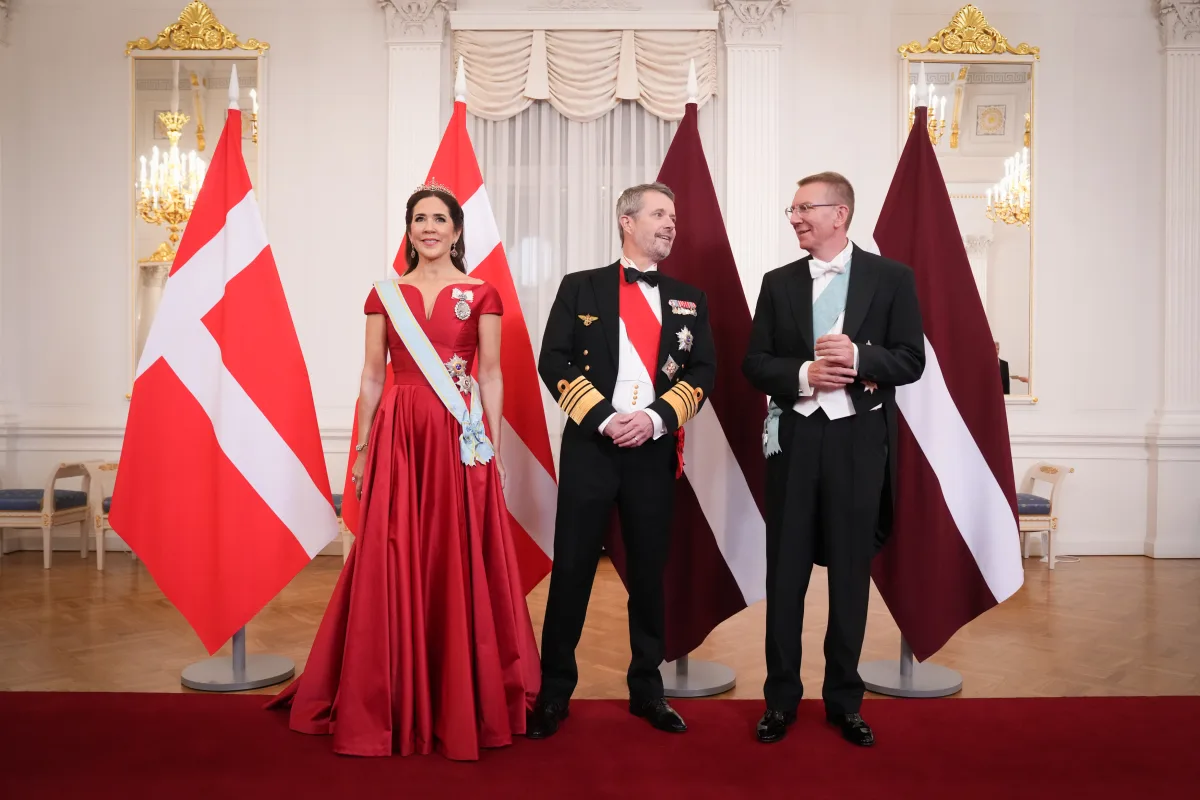
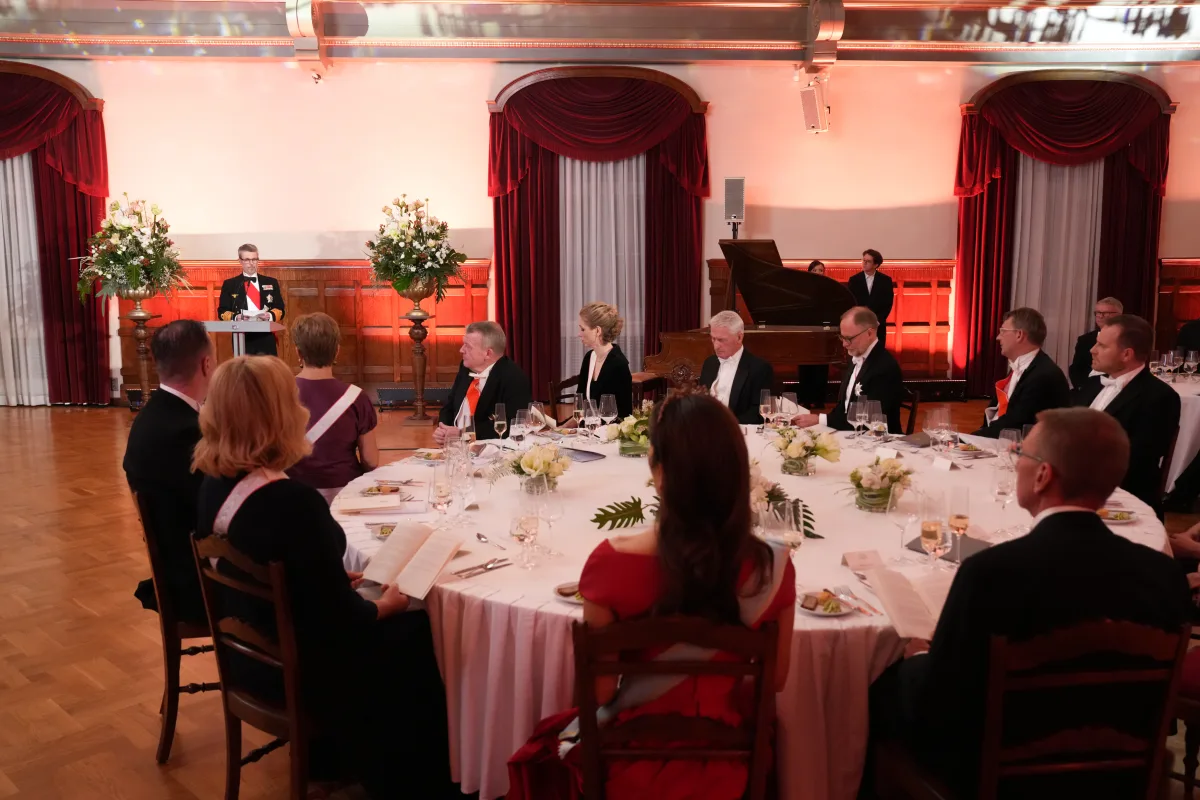
Then the ceremony opens with a smile. In his speech, the president recalled that the king discovered Latvia as crown prince in the early 1990s. More than thirty years earlier, he followed an exchange program at the University of Latvia. The books he donated founded the political science library. Students of the time especially remember the informal discussions, sometimes over a beer. That evening, several of them are at the table. The president speaks of “small reunions”. The host slipped friendship into the protocol.
Under the chandeliers, round tables and white tablecloths. The floral arrangements are low. It’s not a detail. They let the gaze pass freely towards the paintings on the ceiling and the conversation flow from one guest to another. We go from a face to a canvas, from a bouquet to the oak balcony. The Laube decor remains the master of the place.
The castle has not stopped entertaining since. In March 2026, he welcomed Petr Pavel for the first state visit by a Czech president since that of Václav Havel, thirty years earlier. The rooms change guests. They don’t change language.
In Riga, works do not sit in windows. They work. An armchair designed to welcome an ambassador. A fabric found to dress a door. A fresco that we discover by looking up between two dishes. Latvia presents itself through its artists, and it is through them that the guest remembers it.

Sources
- Presidency of Latvia: history of Riga Castle and reinstallation of furniture and works, August 3, 2016.
- Latvian cultural canon: the hall of ambassadors of Ansis Cīrulis; Dace Lamberga, notice “Ansis Cīrulis”, Latvian National Encyclopedia.
- KATE: reconstruction of the textiles of the Ambassadors’ Hall, with an extract from the article by Marta Šuste published in Latvijas Architektūra, February-March 2017.
- Maira Sudrabiņa, LSM: the village hall of Eižens Laube, December 2, 2021.
- Presidency of Latvia: presentation of the new paintings, September 17, 2021.
- Danish Royal House: State visit to Latvia, October 28, 2025; Latvian President’s speech at the State Dinner, October 28, 2025.
- Presidency of Latvia: speech at the state dinner in honor of Czech President Petr Pavel, March 2026; Prague Castle: State visit to Latvia, March 9-11, 2026.