When a palace becomes a database
Beijing has unveiled the digital double of the Forbidden City. Behind the museum prowess lies the control room of the palaces of tomorrow.
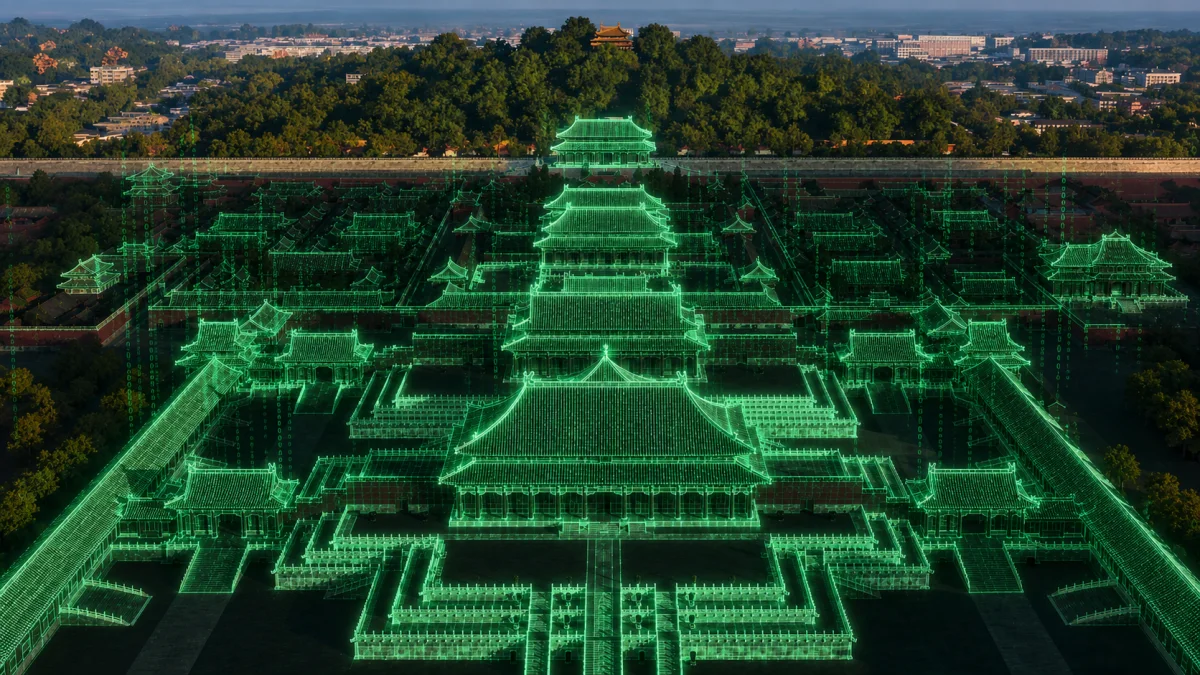
On April 29, 2026, in Fuzhou, the Beijing Palace Museum presented a platform described as a digital twin. Behind the museum display emerges a question of stewardship rarely addressed head-on: to what extent can a palace be documented, monitored, and then administered from its data replica?
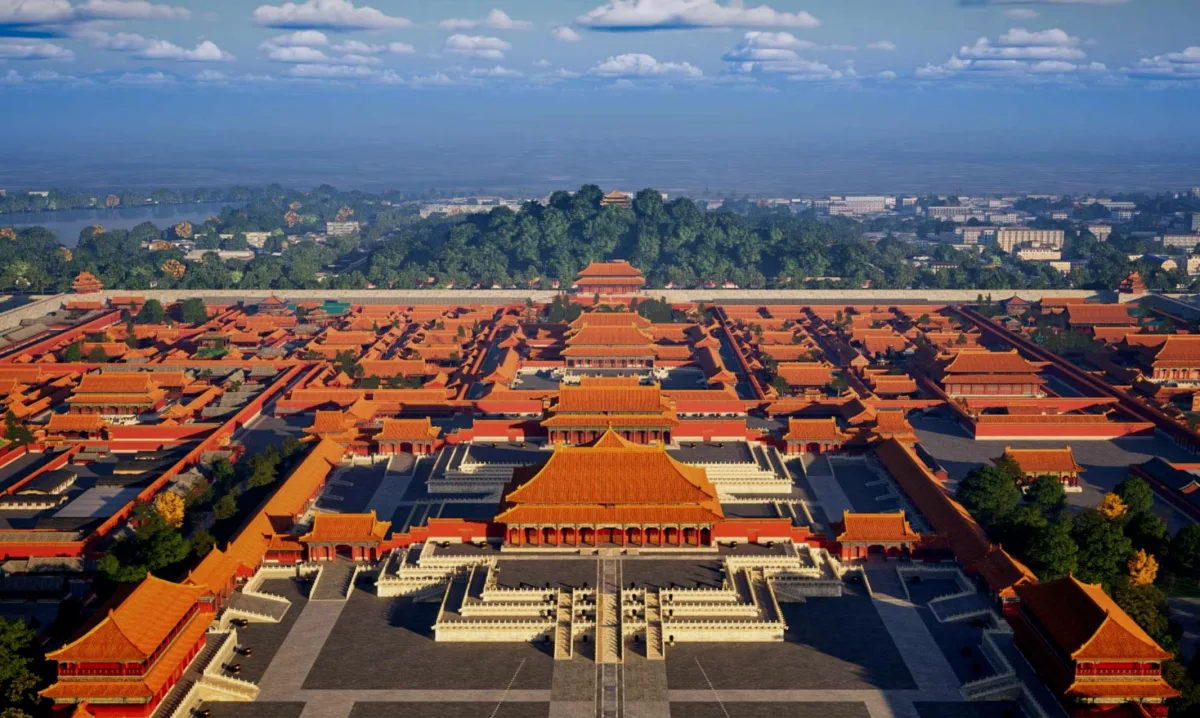
The Forbidden City already has a double, and it’s working
Seventy-two hectares, six centuries of wooden frames and varnished roofs. The Forbidden City is first and foremost a material problem: settlement, humidity, century-old trees, millions of visitors. What we know less is that a second Forbidden City has been accumulating for twenty years, made up of clouds of points and series of measurements. It is already in service.
The question is therefore not whether this double exists, but at what moment it ceases to be an archive to become an instrument of government of the building. This switch, without announcement, is the real subject. It concerns all official residences, whose stewardship still relies on plans, spreadsheets and the memory of staff.
What the Palace Museum actually built
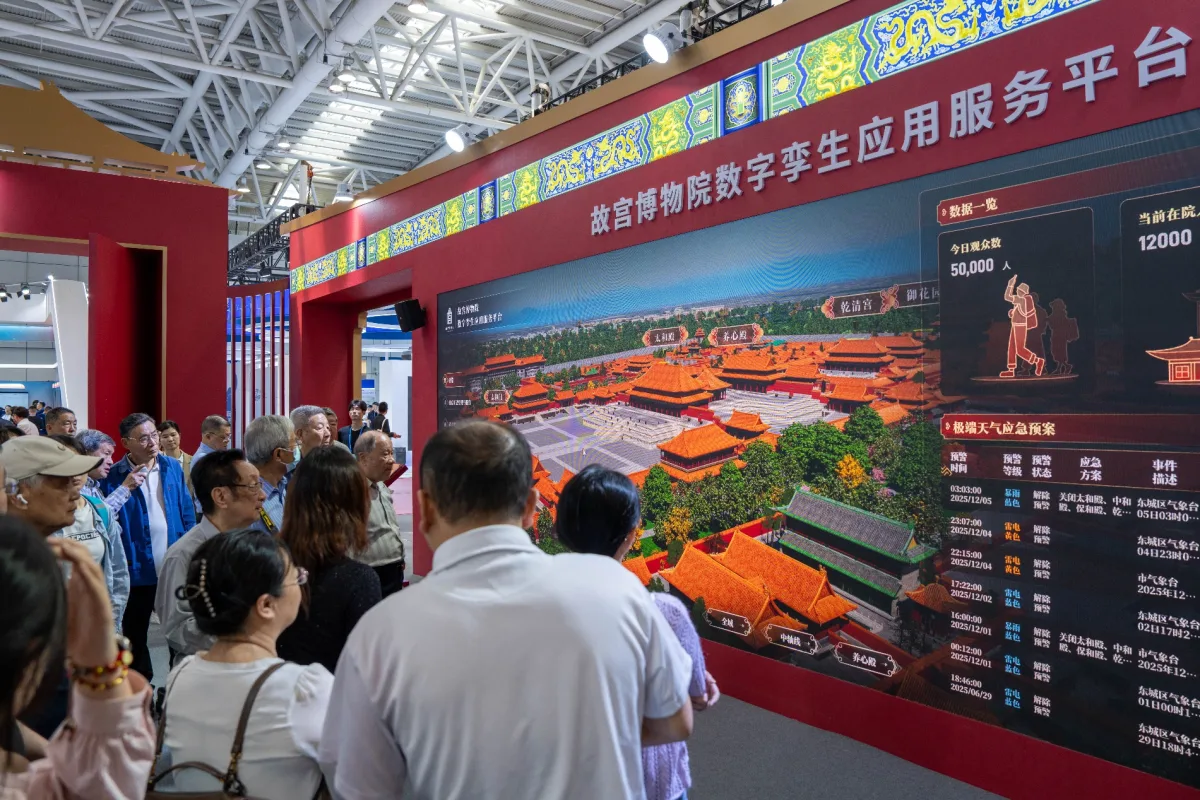
The facts are documented by the institution itself. The “Palace Museum Digital Twin Application Service Platform” (故宫数字孪生应用服务平台) was introduced on April 29, 2026 at the Ninth Digital China Construction Summit in Fuzhou. It is part of a project of the national key research and development program of the 14th Five-Year Plan, “Research on key technologies and service demonstration of digital twin for large multi-purpose museums”, led by the museum.
The platform aggregates “four categories and thirty-six elements of multisource and multimodal data” into a unified base, and aims, according to the Xinhua agency, at an interconnection of “people, objects, environment”. The spaces mentioned are the Palace of Spirit Culture (养心殿) and the central axis, equipped with intelligent navigation and physical-digital correspondence; the former imperial workshops (造办处), disappeared and restored in high fidelity 3D; the cabinet of the Three Rarities (三希堂), in virtual reality.
An earlier stage is more revealing than the museum demonstration. In September 2025, in Xi’an, the project was presented at the World Internet Conference. China Radio International named the partners, Tianjin and Wuhan universities, China Unicom and Amap, and described the integration of real-time meteorological data, the monitoring of the climate of the galleries, the monitoring of building settlement and the health of the trees, and finally operating data as prosaic as the filling of baskets. Conservation, building and logistics in the same base.
One thing, however, does not appear in any public sources: the feedback loop. There is no evidence that the model commands anything. The flow goes from the building to the copy, never the other way around. The model listens to the palate; he doesn’t speak to her yet. It is in this gap that the next decade will play out.
Stewardship, safety and climate in one system
This is where the reach of the Chinese signal is revealed. A palace today operates on deliberately compartmentalized systems: the technical management of the building; temperature and humidity sensors for preventive conservation; video surveillance and access control; protocol logistics; the inventory of collections; personnel management.
This separation is not a technical delay. It is a doctrine. We partition so that a failure, or a compromise, does not give access to the whole. The security networks of an official residence are, for this reason, kept separate from the rest.
However, a digital twin is, by construction, an integration layer. Its purpose is to bring into dialogue what does not enter into dialogue. The digital twin therefore proposes to bring together what the safety doctrine has always wanted to separate.
We can describe without much imagination what this would look like. An artificial stewardship intelligence would simultaneously read the hygrometry of a gallery, the wear of a pump, the attendance of a wing, the reception calendar and the history of restorations. It would indicate that a varnish degrades more quickly since a flow of visitors has been redirected. She would suggest staggering work so as not to encounter a state dinner. No service today has this overview, because no service is supposed to have it.
The signal from the Quirinal
Two counterpoints temper the Chinese exception. In Italy, the Quirinale 5.0 project, launched on February 16, 2024 by the Agenzia del Demanio with the General Secretariat of the Presidency of the Republic, concerns seven buildings from the presidential endowment. Its market combines BIM survey and restitution, seismic vulnerability verification and energy diagnosis, with the stated ambition of a digital twin. To date, it is a digital identity card, the possible basis of an operating twin, not a twin in service.
The detail is important. The Italian state has not ordered a digital twin. He commissioned a seismic vulnerability analysis and energy diagnosis, and modeling was the way to get them. The double was therefore not born from technological ambition, but from regulatory obligations. This is probably how he will enter most palaces.
In Indonesia, the presidential palace of Nusantara is another case. A study published in August 2024 in the Jurnal Komposit documents the use of BIM limited to the planning phase, by designer PT Yodya Karya. Design and construction tool, therefore, without a certified operating twin.
What the double does not protect
There remains the counterpart, and it is correct. What makes the twin valuable, integration, also makes him vulnerable.
A palace is protected by its mass, its walls, its distance and its guards. Its copy has none of these protections: it is transportable, identically duplicatable and modifiable without leaving a trace. You don’t rob a palace; you copy your duplicate in a few hours. The building is deteriorating before everyone’s eyes, the model is deteriorating in silence.
A residence which brings together in the same system its interior climate, its accesses, its planning and its building thus creates an object that no one, in the current organization, is mandated to protect. The palaces will have their double: the question is already settled. The only two remaining that matter are what will be entrusted to him, and who will hold the keys.
To be continued: “Who will keep double the palace? »