
On the heights above Apia, the villa Vailima was first the home of Robert Louis Stevenson. After his death, it became the residence of the colonial governors, then that of the Samoan head of state. The tale of a seat of power born under a novelist’s pen.
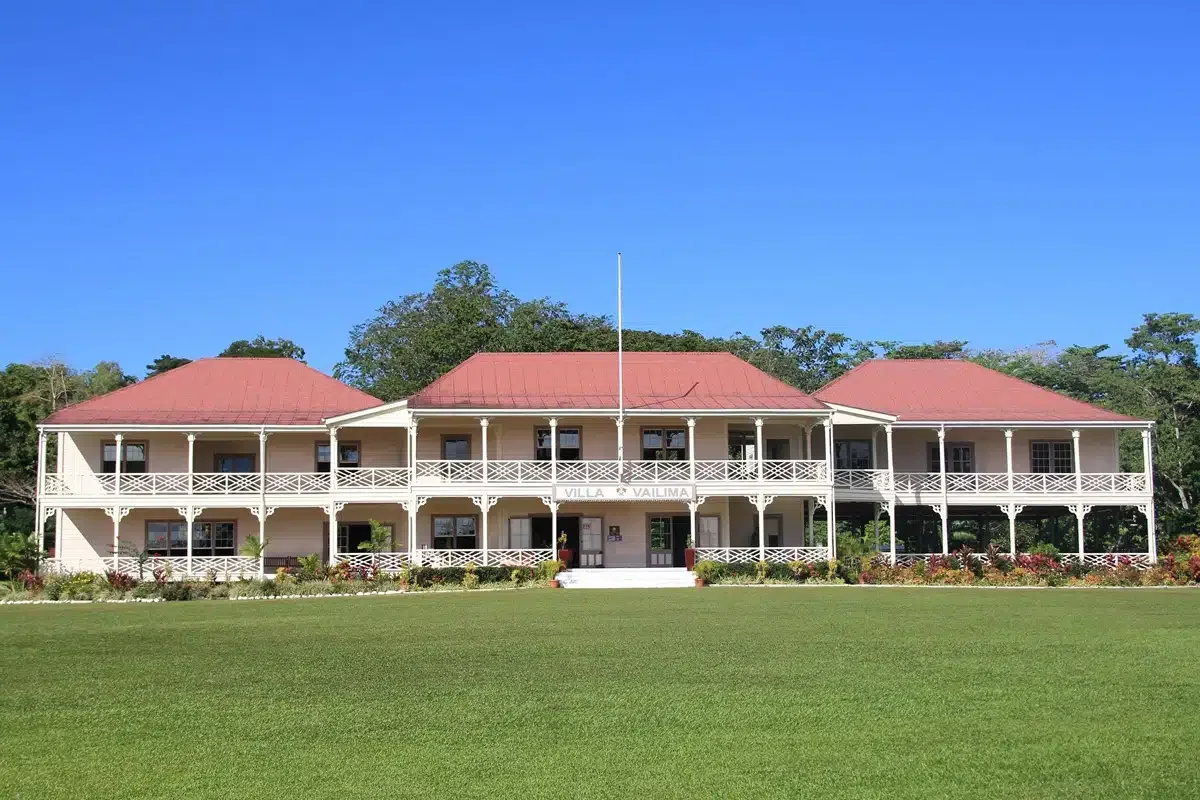
One always imagines a head of state’s residence as an edifice conceived for him. Samoa is the exception. For more than thirty years, the head of this Pacific country resided in a house conceived not for power, but for writing: the villa Vailima, home of the Scottish writer Robert Louis Stevenson, author of Treasure Island and Strange Case of Dr Jekyll and Mr Hyde. The seat of a state here was born not of a political design, but of the dream of a novelist who had come to die at the ends of the earth.
The story of a writer’s house that became a residence of state, then a museum.
Tusitala, the Writer Who Built His House at the Ends of the Earth
In 1889, ravaged by tuberculosis, Stevenson lands in Samoa in search of a gentle climate. The following year he buys an estate on the slopes of Mount Vaea, above Apia, and has a great wooden house built there, Vailima, completed in 1891. The redwood was imported from America; broad verandas, in the manner of Samoan houses, caught the shade and the breeze. There were five bedrooms, a library, and one detail that became famous: the only working fireplace in all of Samoa. The objects spoke of the host’s prestige, from a nude given by Rodin to a tablecloth that was a gift from Queen Victoria.
Stevenson was no cloistered colonial. He learned the language, bound himself to the villagers, took the side of the Samoan chiefs against the European powers, and received a name worth all the titles in the world: Tusitala, “the teller of tales.” He died at Vailima on 3 December 1894, at forty-four, and was buried at the summit of Mount Vaea, just above the house he had built.
From a Writer’s Villa to a Residence of State
At the writer’s death, the house stood unused for a few years, before beginning a second life that had nothing literary about it. In 1900, it was acquired by the German government and became the residence of the governor of German Samoa; a new wing was added to it. After the First World War, under New Zealand mandate, it housed the administrator. Then, on 1 January 1962, Samoa gained independence, and Vailima crossed a final threshold: it became the official residence of the head of state, the O le Ao o le Malo.
Three regimes will thus have succeeded one another under its wooden roof, German colonial, New Zealand mandate, Samoan national, without any of them ever having to build a residence of state. The paradox escapes no one: the man who defended the island’s chiefs had, without intending to, built the future dwelling of the colonial administration. A handsome house commanding the bay of Apia was fatefully destined to house whoever would govern. Conceived as a hearth of hospitality, the house did not change its nature in changing its master.
Beneath the Storyteller’s Tomb, Then the Museum
There remains the most singular detail of this story. As long as Vailima was a residence of state, the Samoan head of state lived literally beneath a tomb: Stevenson’s, at the summit of Mount Vaea, commanding the house and the bay. On the stone is engraved the Requiem the writer had composed, in which the sailor comes home at last from the sea. Most heads of state reside beneath a flag; that of Samoa long resided beneath the epitaph of a foreign poet who had become an adopted son of the island.
Then the elements had the last word. In the early 1990s, cyclones Ofa (1990) and Val (1991) gravely damaged the old house. Judging a full renovation too costly, the cabinet provided the head of state with another residence, today at Vailele. Restored with the support of foreign patrons, Vailima reopened on 5 December 1994, the centenary of Stevenson’s death, no longer as a residence but as a museum devoted to the writer. Contrary to what some notices still claim, this is therefore no longer where the Samoan head of state resides.
The history of palaces almost always begins with a will to power. That of Vailima begins with a cough and a manuscript: a sick writer who builds, at the ends of the earth, the house of his final books. That it became the seat of a state owes to the chance of beautiful, well-placed sites; that it then became a writer’s house once more owes to a rarer kind of justice. Three regimes succeeded one another there, but it is the storyteller’s name that stayed on the door. In Samoa, power will have been only a tenant of thirty years, before handing back the keys to the imagination that had built it.
FAQ
Where does the head of state of Samoa reside today? No longer at Vailima. Since the villa was damaged by the cyclones of the early 1990s and then turned into a museum, the official residence of the head of state has been transferred, today at Vailele.
Why did Stevenson’s house become a residence of state? After the writer’s death in 1894, his house was acquired in 1900 by the German government, served the New Zealand administrator, then, at independence in 1962, the Samoan head of state.
Can Vailima be visited? Yes. Reopened on 5 December 1994 for the centenary of Stevenson’s death, the villa is the Robert Louis Stevenson Museum, open to the public on the heights above Apia.