
In Tallinn, the residence of the Estonian president has neither high walls nor motorcade, only two guards, an open park and, on the lawn, beehives whose honey becomes a gift of state.
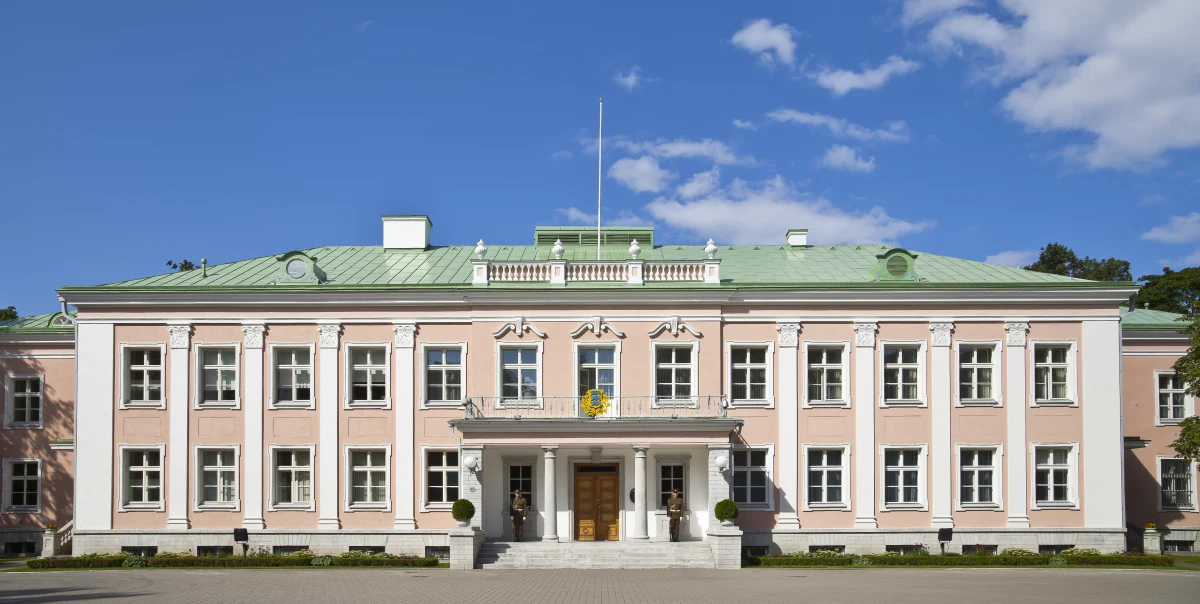
A few hundred kilometres from the Russian border, one would expect to find, around the seat of a head of state, railings, an enclosing wall, a motorcade. In Tallinn, none of that. The residence of the president of Estonia, within Kadriorg park, stands at the edge of a path crossed by strollers and by the ducks from the neighbouring pond. Two guards on duty, and that is all. This palace impresses not by what it raises between itself and the people, but by what it has renounced building: the wall.
Portrait of a power that receives without retreating behind ramparts.
The building is modest and elegant: a late-baroque edifice, completed in 1938 by the architect Alar Kotli to echo the neighbouring Kadriorg palace, that great pink palace once given by Tsar Peter the Great to his wife Catherine. The Estonian president, today Alar Karis, holds there an office that is above all ceremonial: he receives ambassadors, signs agreements, confers decorations. Nothing in the bearing of the place seeks to intimidate.

The place has not always breathed this freedom, however: from 1944 to 1990, it housed the Presidium of the Supreme Soviet of the Estonian SSR. The same building that once lodged a Soviet organ today receives the ambassadors of a democracy turned toward the West, and surrounds itself with no rampart. The absence of a fortress is a quiet message: that of a small Republic which has no need of high walls to feel sovereign.
The most telling detail, for its part, grows on the lawn. Since 2016, the palace rose garden has been home to beehives, set up together with the Estonian Beekeepers’ Union. The honey harvested there, which analysis has shown owes its flavour to the roses of the park, is put into jars and offered as a presidential gift; the head of state himself comes to lend a hand with the harvest. Where other palaces line up sentries, this one puts bees to work, and turns its lawn into a discreet instrument of diplomacy.

There is, in this absence of walls and in these beehives, more than elegance.
It is a certain idea of power: a sovereignty sure enough of itself not to barricade, and one that prefers to make itself useful rather than imposing.
The bees of the rose garden pollinate the park and yield a honey that the state offers to its guests; the care given to living things becomes there, discreetly, a diplomatic gesture.
At Kadriorg, opening one’s door to an ambassador or gathering a comb of honey spring from the same movement: that of a country unafraid of what it lets in.
*