
In Thimphu, the Tashichho Dzong shelters under one roof the king’s throne room, the ministries and the kingdom’s monastic body. Rebuilt in the 1960s without a nail or a written plan, it embodies a power that, even today, changes residence to the rhythm of the seasons.
In most countries, the palace, the government and the sanctuary are three distinct places, often three different districts. Bhutan gathers them into a single building. In Thimphu, its capital, royal power, the administration of the state and the highest religious authority cohabit behind the same white walls: those of the Tashichho Dzong, the “fortress of the glorious religion”. It is not a palace that contains a temple, nor a temple that shelters a palace: it is a place where the throne, the ministry and the monk share the same courtyard.
A journey into a fortress where state and faith dwell together.
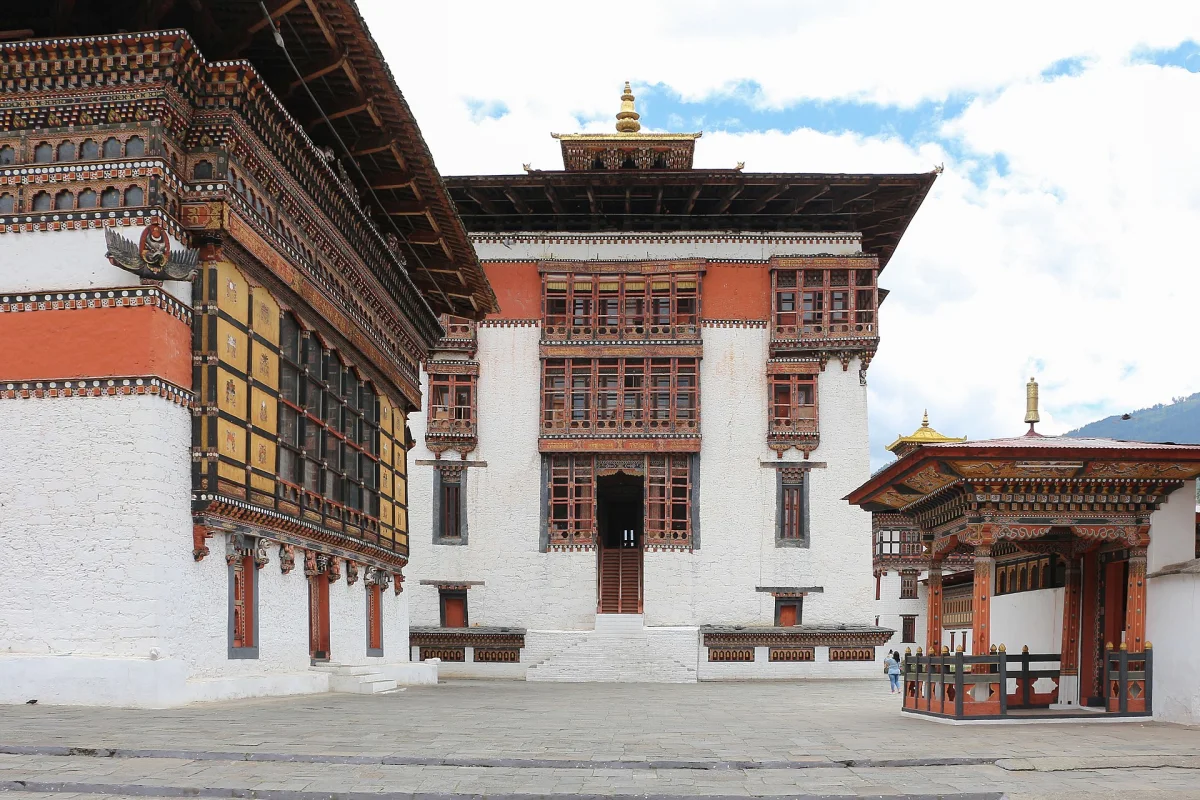
A dzong is not a castle in the sense the word carries in Europe. It is a fortress-monastery, a form of architecture particular to Bhutan, conceived to hold at once the role of citadel, of administrative seat and of convent. The Tashichho Dzong is the most solemn of them, and the beating heart of the Bhutanese state.
A fortress for a king, ministers and monks
Behind its walls are the throne room of the king, the Druk Gyalpo (“dragon king”), today Jigme Khesar Namgyel Wangchuck, along with his offices, those of the Prime Minister, of the cabinet and of key ministries such as the Interior and Finance. But the dzong also houses, in summer, the kingdom’s central monastic body, the Zhung Dratshang, led by the Je Khenpo, the supreme spiritual head of Bhutan.
This cohabitation is no accident of land use. It carries on the “dual system” instituted in the seventeenth century, which shared authority between a temporal power and a religious one. The dzong is its built translation: two wings, two worlds, one and the same enclosure and one and the same courtyard. Receiving an ambassador, signing a decree and celebrating an office all take place here within a few metres of one another.
Built without a nail or a plan
The building’s history is as astonishing as its function. A first dzong stood on the neighbouring height as early as 1216; the present edifice descends from the one built in 1641 by Zhabdrung Ngawang Namgyal, the unifier of Bhutan. Destroyed by fire on several occasions, gravely shaken by the earthquake of 1897, it was each time raised up again.
It was the third king, Jigme Dorji Wangchuck, who gave it its present monumental form. After transferring the capital from Punakha to Thimphu in 1952, he had the dzong rebuilt and enlarged between 1962 and 1968. The work was carried out according to traditional Bhutanese methods: without a single nail, and without written plans. An edifice meant to embody a state in the midst of modernising was thus raised from memory and know-how, by master carpenters who carried the architecture in their gestures rather than on paper. Only the central tower, the utse, and two temples survive from the old dzong.

A power that changes dzong with the seasons
The most singular trait remains invisible in a photograph: Bhutanese power moves to the rhythm of the seasons. Every summer, the central monastic body resides in Thimphu, at the Tashichho Dzong; every winter, it goes back down toward the mildness of Punakha, the former capital, and its dzong set at the confluence of two rivers.
Punakha is not a mere place of retreat. It was there that the first king of the present dynasty was crowned, in 1907; it was there too that the present sovereign celebrated his marriage, in 2011. Bhutan thus possesses not one seat of power, but two, between which the highest religious authority migrates as the courts once did. Power, here, is not fixed to a stone: it follows the climate.

The king governs here, but lives elsewhere
One last discretion deserves to be noted. This imposing dzong is not the king’s home. The sovereign governs from the fortress, but resides in a neighbouring palace of far more modest dimensions, the Lingkana palace, right beside the enclosure. Grandeur is reserved for the place of shared power; private life, for its part, keeps itself apart and without pomp. In a kingdom that chose, in 2008, to give itself a constitution and a democracy, this restraint is no detail: it speaks of a certain idea of the exercise of power.
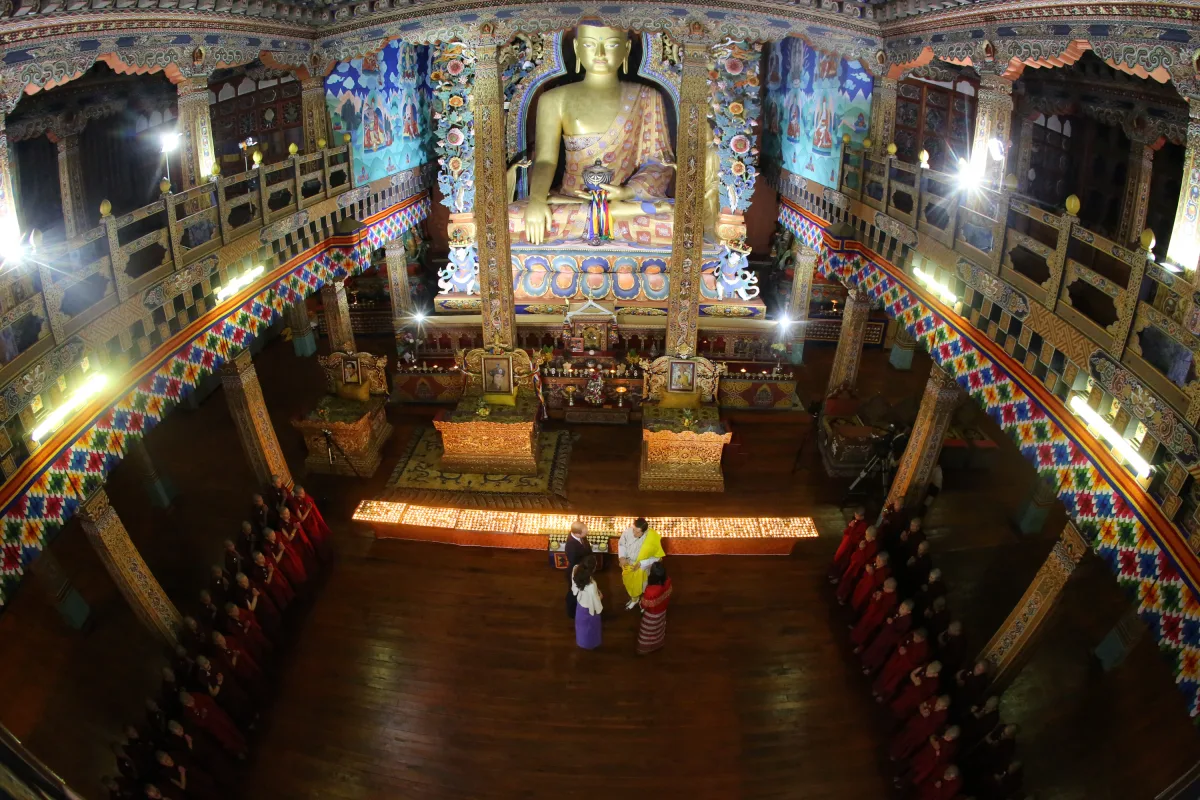
The Tashichho Dzong is not a palace one visits for its gilding, but a place one understands for what it gathers. Beneath its golden roofs, a king governs, ministers work, monks pray, and once a year a whole people comes to dance in the courtyard. It was raised up again without a nail after every fire, and the power it shelters still goes down, every winter, toward another valley. Few nations lodge, in this way, within a single enclosure, their state, their faith and their memory. Bhutan has made of its fortress the common house of all that, elsewhere, is kept apart.