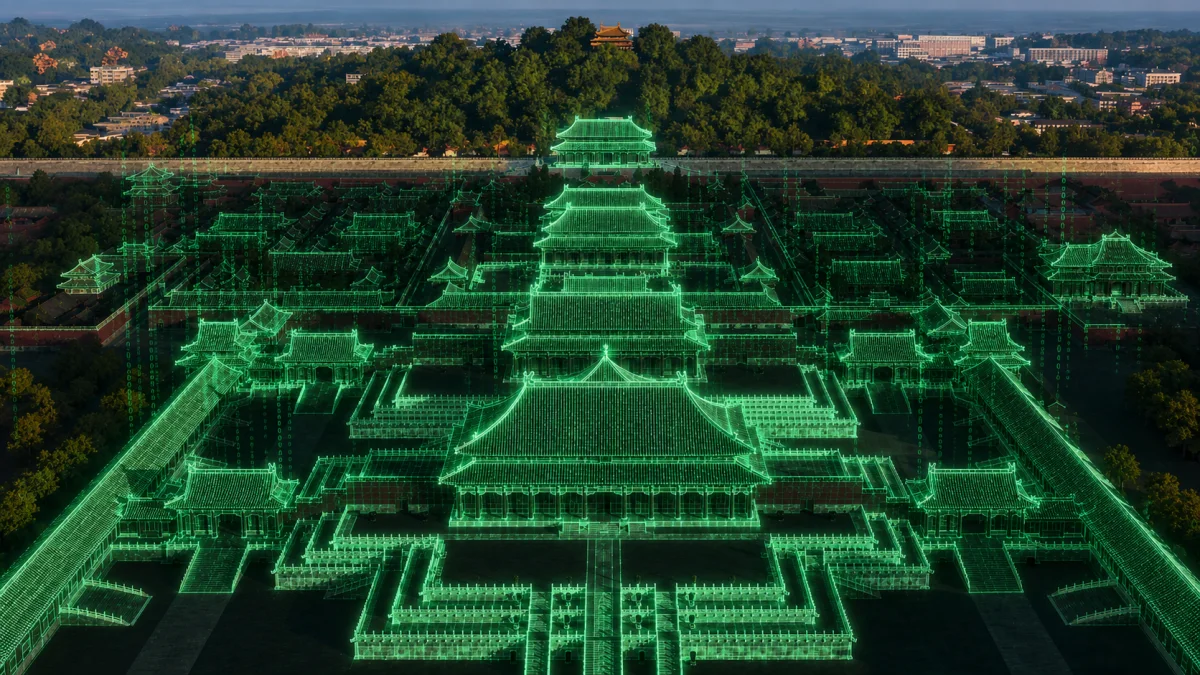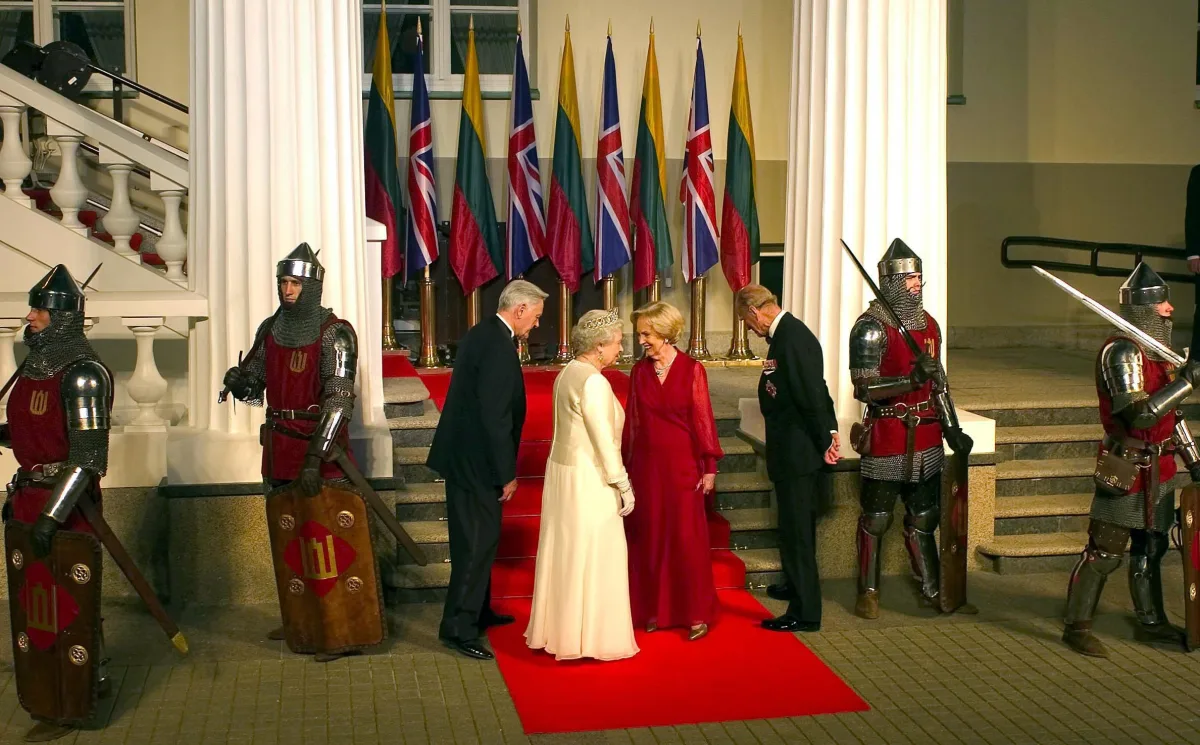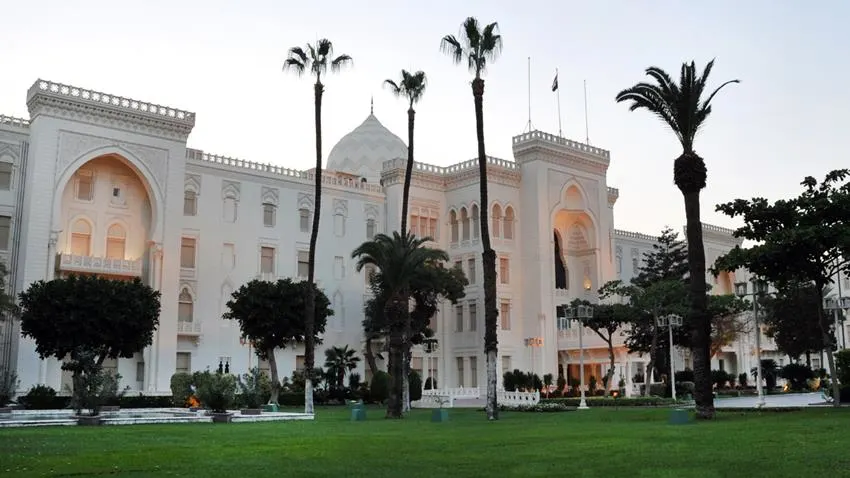
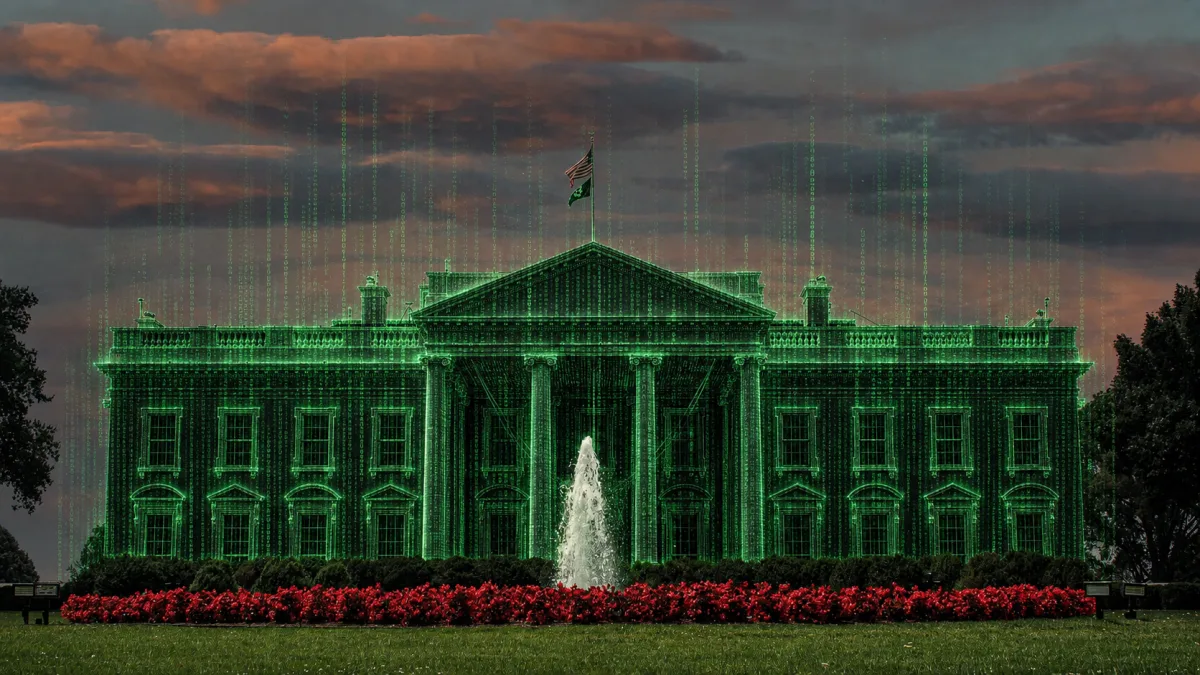
The Palaces of Heads of State and official residences are being digitized.
Sovereignty, formats, property, cyberattacks: who owns and protects the digital double of a palace?
No one has yet decided who owns this copy, where it should live, or who should defend it.
The first part of this investigation showed a palace that had become a database. There remained the question that no one asks: who owns this double?

What double really costs
The most instructive experience is not Chinese, it is French, and it is public. Since October 2022, the Center for National Monuments has been leading the CMN Digital program, funded by France 2030 and planned until October 2026. More than twelve digitization campaigns have been carried out on a heritage of one hundred and ten sites, from the Paleolithic cave to the 20th century villa.
In March 2025, the establishment published a white paper with a remarkably frank title: “The digital twin in heritage: fantasy or reality? “. His conclusion deserves to be quoted exactly: “The 3D Swiss army knife model with universal uses, in other words the “digital twin” perfect copy of a heritage object, therefore probably does not exist today. » Usage dictates the model, and not the other way around.
Orders of magnitude are just as useful. The digitization of the Font-de-Gaume cave is estimated between 36,000 and 107,000 euros. The Azay-le-Rideau castle alone produces 391 gigabytes divided into 37,000 files and 1,685 folders. A presidential palace, with its gardens, outbuildings and furniture, would be several times that.
A duplicate is therefore not a deliverable. It is a permanent burden: storage, migrations, updates, an operating budget where institutions have only planned an investment budget.
The more we entrust to him, the more he weighs
This load only makes sense in relation to what we would entrust to the model. Three horizons are emerging, and their maturity is very uneven.
The first is already within reach: preventive conservation, monitoring of decorations, management of energy, water and indoor climate. The second, after five or ten years, is that of operation: preparation of ceremonies, flow management, simulation of fire, flood or earthquake on the model rather than on the building, staff training. This is perhaps the most underestimated gain, because a double records adjustments and know-how that neither plans nor public contracts record. A steward leaves, the double remembers.
The third horizon changes the nature of the object. The model would become a legal and insurance document, capable of establishing the exact state of a building before and after a construction site, reception or disaster. It would become the support for an artificial intelligence of stewardship, drones and inspection robots in support. None of these functions are documented in an active official residence today. All are technically credible. And each one increases the value of the copy for those who would like to take it.
Aggregation, the risk that no one names
The danger is not the theft of a plan. He cares about what the model brings together. Taken in isolation, the temperature of a room, its occupancy rate, a cleaning schedule and an access log are harmless data. Crossed in the same system, they produce a presence map, habits, weak points.
This risk has a name and appears in the reference texts. The Gemini Principles, published in 2018 by the Center for Digital Built Britain, state that security takes precedence over openness and that each component must be clearly owned, governed and regulated. An international standard is even entirely dedicated to it: ISO 19650-5, published on June 10, 2020 and confirmed in 2025, defines an approach to information management called “attentive to security” for sensitive buildings. Twenty-eight pages that describe how to assess the sensitivity of an asset before organizing its modeling.
It is necessary to measure the asymmetry between the palate and its copy. A palace is protected by its mass, its walls, its distance and its guards. The model does not have any of these protections: it is transportable, identically duplicatable and modifiable without leaving a trace. You don’t rob a palace; you copy your duplicate in a few hours. And a distorted model would be more dangerous than a stolen model, because it would make the institution lie about its own building.
The British Library, a useful precedent
The usual objection is that these are assumptions. It has not held since October 2023. That year, the British Library suffered a ransomware attack accompanied by data exfiltration. The establishment published a public report on March 8, 2024, “Learning Lessons from the Cyber-Attack”, with rare transparency for an institution of this size.
We read that around six hundred gigabytes were exfiltrated and that services remained degraded for months. Above all, we read the causes: a historically complex and insufficiently segmented network topology, heterogeneous systems accumulated over decades, reinforced authentication absent on certain remote accesses.
This diagnosis describes quite precisely the IT state of most heritage institutions, including official residences. The lesson is not that we should give up the double. It is that a duplicate deposited on an infrastructure of this type multiplies the attack surface instead of reducing it.
Sovereignty, formats, ownership
Three questions then remain to be decided, and none is technical.
The first is accommodation. In France, the interministerial digital department indicated on March 26, 2026 that 70% of orders from the interministerial cloud market and 99% of State orders were for European suppliers, with the SecNumCloud qualification serving as a reference for sensitive data. An official residence which would entrust its double to an infrastructure subject to extraterritorial legislation would make a political decision, not an operating choice.
The second is duration. The report “3D Data Long-Term Preservation in Cultural Heritage”, published in December 2024 by Nicola Amico and Achille Felicetti as part of the European eArchiving initiative, recalls that the continuity of 3D data depends on regular migrations and open formats. The CMN white paper recommends, in the same spirit, requiring service providers to have several levels of detail in several formats. A duplicate that is only readable by software is a duplicate that expires.
The third is ownership, and it is the least explored. The CMN suggests “no longer considering the 3D model as an indivisible whole”: a point cloud would fall under the administrative document, while a textured model could constitute a protectable work. Applied to a state residence, this distinction decides what is communicable, what is transferable and what must never leave.
The function that doesn’t exist yet
The simplest and unanswered question remains. In a presidency or a royal house, who holds double?
Today, no one. It does not entirely come under the management, which manages the building without a mandate over the data. Nor from the security service, which protects physical access and networks, not documentary heritage. Nor the curator, who is responsible for the collections and not the equipment. Nor from the IT department, which hosts without arbitrating what must be modeled.
The first consequence of the digital twin will therefore not be technical. It will be organizational: it will be necessary to create a function which does not yet exist, somewhere between the archivist, the engineer and the security officer. The institutions which will create it first will not be the most modern. They will be the ones who will have understood that the double of a palace is kept with the same seriousness as the palace itself, and that it is lost much more quickly.
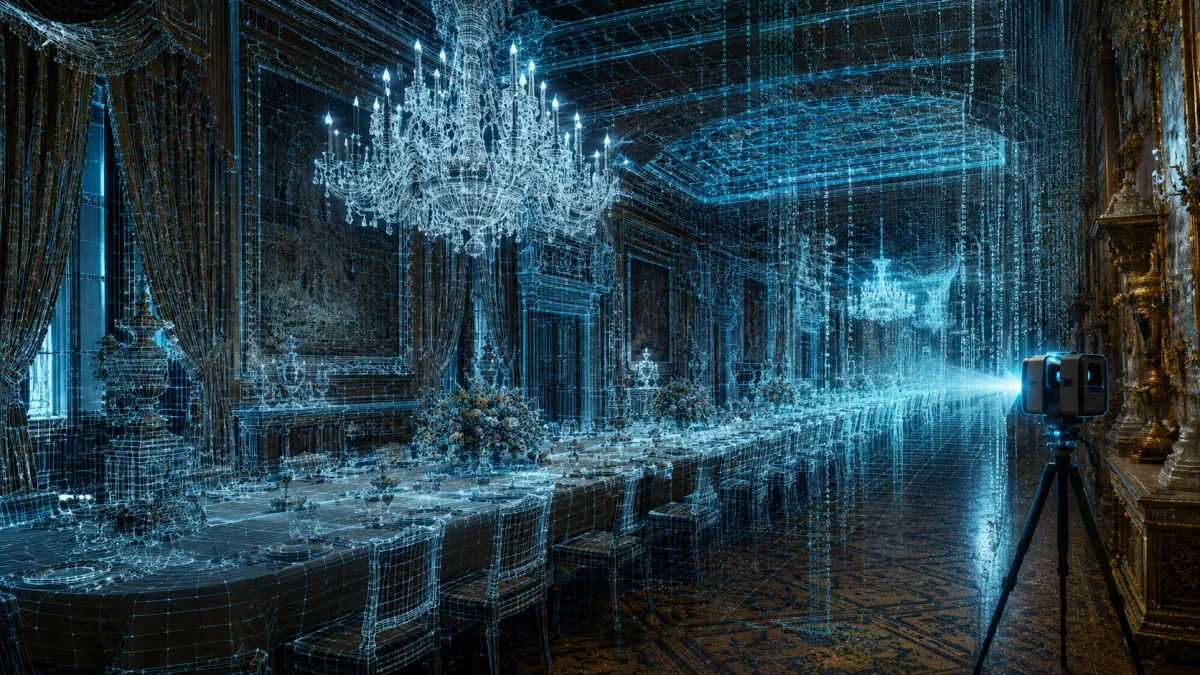
Royalty-free source photographs of the White House and a lounge in the Royal Palace of Madrid, with visual compositions © Intendance Palace. Screenshot of a 3D reconstruction of the Azay-le-Rideau castle, taken from the white paper The digital twin in heritage: fantasy or reality?, Center des monuments nationaux, March 2025: © Mira - CMN, reproduced with permission.
The third attribution is confirmed by the legend of the white paper: the view presented corresponds to 3D reconstruction nº 11, credited “© Mira - CMN