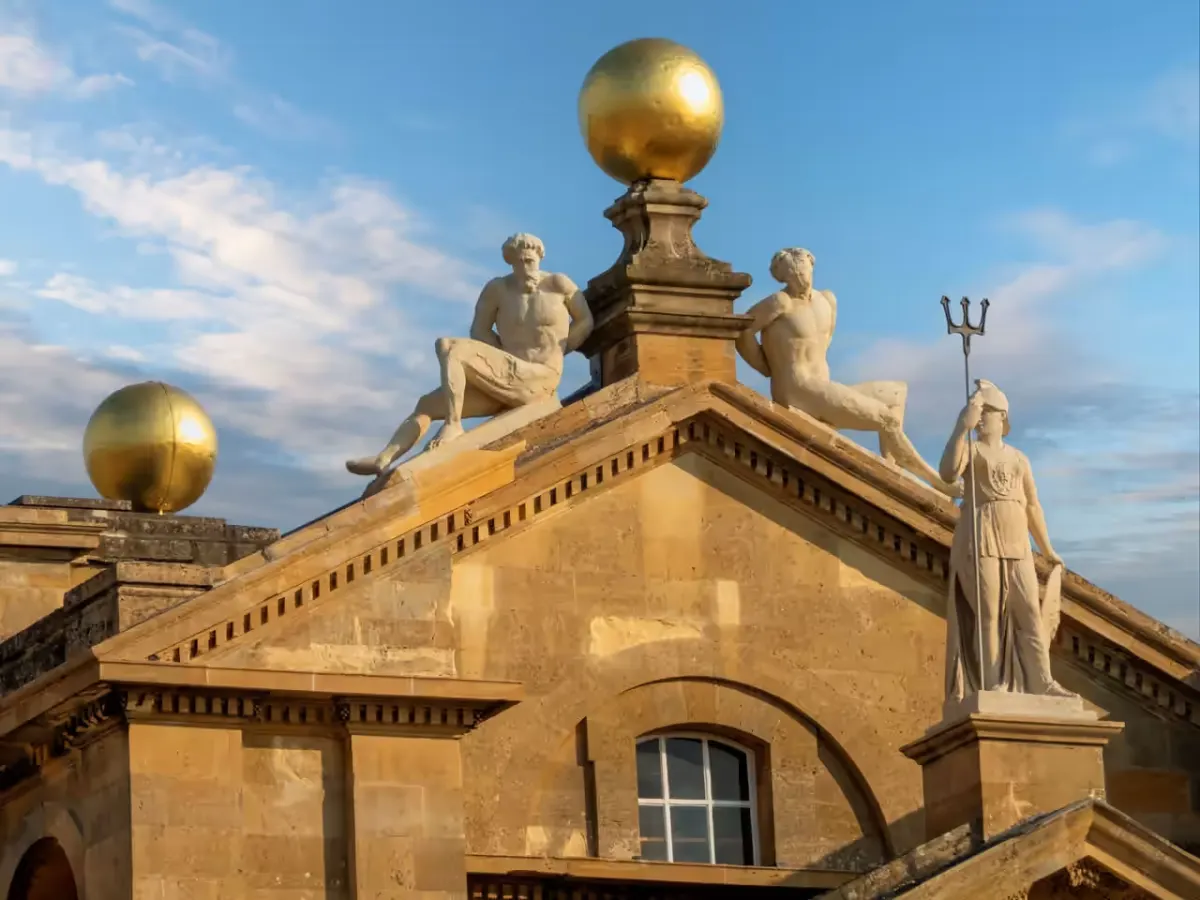
A palace offered after a victory
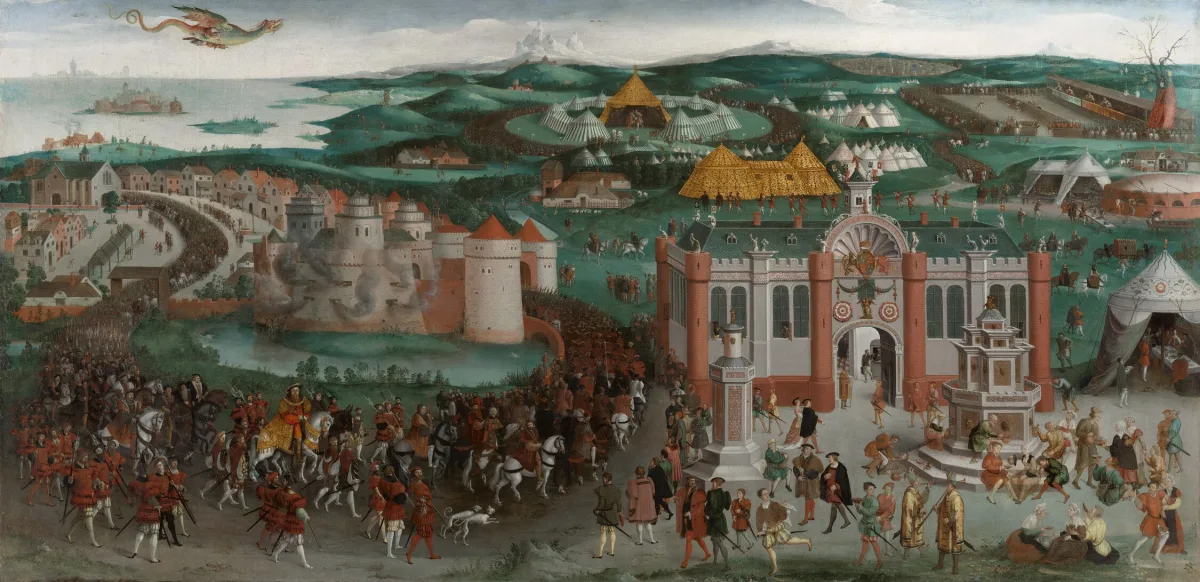
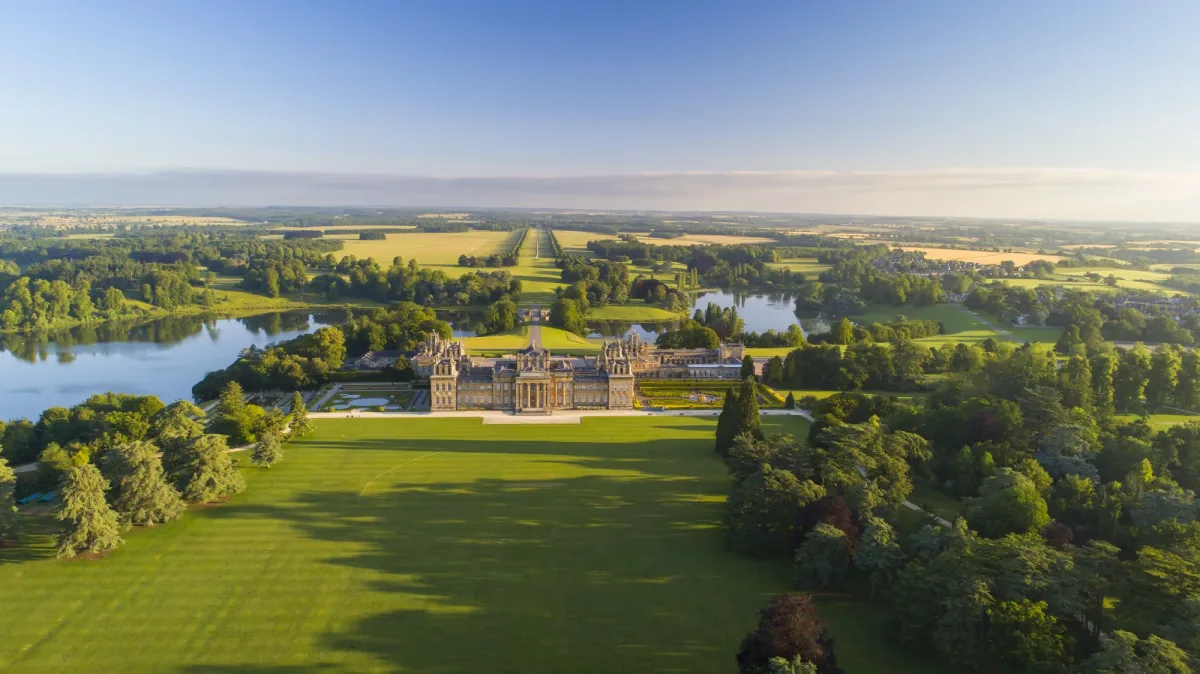
To understand this project, you must first know what Blenheim is. The palace is located in Woodstock, Oxfordshire, a few miles from Oxford. It was built for John Churchill, 1st Duke of Marlborough, after his victory over the armies of Louis XIV on 13 August 1704 during the War of the Spanish Succession. The battle took place near the Bavarian village of Blindheim, which the English called Blenheim, after which the palace was named. Queen Anne presented the Duke with the royal estate of Woodstock. The architect John Vanbrugh built the residence there between 1705 and 1722.
Blenheim is one of the largest houses in England.
It is also one of the rare ones to bear the name of palace without being a royal or episcopal residence. The Dukes of Marlborough still live there, and Winston Churchill was born there in 1874. The palace and its park, designed by the landscaper Capability Brown, have been listed as a UNESCO World Heritage Site since 1987.
It is finally a house that must earn its living. It receives about a million visitors a year, and ticket money pays for much of its upkeep. The palace opened its doors to the public in 1950 precisely to finance roof repairs.
The roof was leaking
The problems date back to the 1880s. The eighth duke, who was short of money, sold the library’s books and much of the lead in the roofs. We replaced it with slate, which was cheaper. But the slate meant that the slope of the roofs had to be changed, and the water began to drain poorly.
The repairs made from 1950 lasted several decades, then they reached the end of their lifespan. When crews opened the roofs, they found slipping slates, crumbling stones and rotting lumber. Nearly an acre of roof space, or approximately 4,000 m², had only four downspouts to drain it. During heavy rains, which became more and more frequent, the gutters overflowed and the water passed into the attic, just above the large rooms.
This is where the real risk lay, as these attics cover two of the most important painted ceilings in the palace. In the Great Hall, the entrance room, that of Sir James Thornhill had fine cracks, water marks and mold. In the Saloon, the state dining room, Louis Laguerre’s paintings on the Battle of Blenheim had suffered leaks. They had also been clogged by three centuries of smoke from chimneys and candles, by the humidity of visitors and their wet coats. In some places, the paint is only a few inches from the roof structure.
Keep the house open during the work
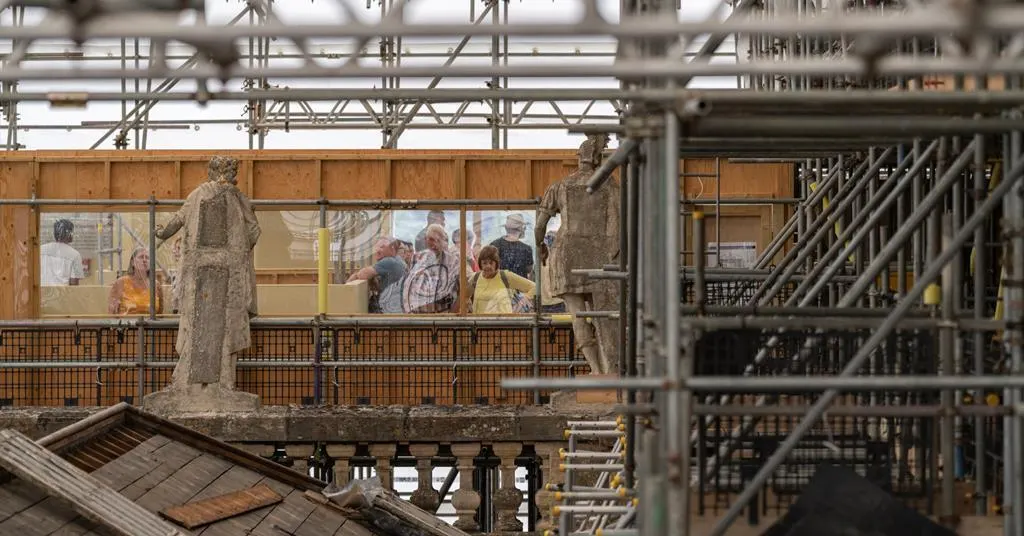
To work under cover, the Allen & Foxworthy company first set up a giant scaffolding: around 50 kilometers of tubes and 70,000 fittings. It took six months to edit and 1.7 million pounds. A large one-acre tarp covered the entire thing, which allowed construction to continue during one of the wettest winters on record. The water falling on this temporary roof was collected in tanks, so as not to overload the drains, then used to water the gardens.
For the teams in the field, the difficulty was mainly organizational. Blenheim welcomes the public every day, rents out its salons and hosts many weddings. The palace did not close a single day during the work, and only a few event prices were lowered a little. Built Heritage Manager Kelly O’Driscoll put it simply: “Brides don’t like scaffolding. » With the architect, she therefore planned in advance the periods when the scaffolding would be covered and those when it would not.
The dismantling was prepared with the same care. A tunnel was installed in the Great Hall to safely remove the tarpaulins and tubes over several weeks. Throughout the work, a life-size reproduction of Thornhill’s ceiling hung from the scaffolding.
Visitors on the roofs
The estate chose to show the construction site rather than hide it. On May 1, 2025, a platform installed in the scaffolding and accessible by stairs opened to the public. From up there you could see the Great Court, Great Vanbrugh Bridge, Victory Column and the Oxfordshire countryside. In one year, around 50,000 people went up there. Receptions were also held on the roof after closing, and many local residents returned several times to see the progress of the work.

What the craftsmen repaired
On the roofs, we tried to keep as many original materials as possible. The existing lead was melted, then poured back into sand molds, an old technique, with details revised so that it better withstands temperature variations. Thousands of slates were checked, and only those that were damaged were changed. The stone in good condition was laser cleaned, which preserved rare lichens. Tons of degraded stone were cut out and replaced.

The stonemasons redid the erased details of the Corinthian capitals of the north portico. A local craftsman spent several weeks re-gilding, with 23.5 carat gold, the two spheres which cover the top of the roof. On the south portico, the marble bust of Louis XIV has found its place. The first duke had it installed there in memory of his victory over the king of France. The marble used for its restoration comes from Italy.

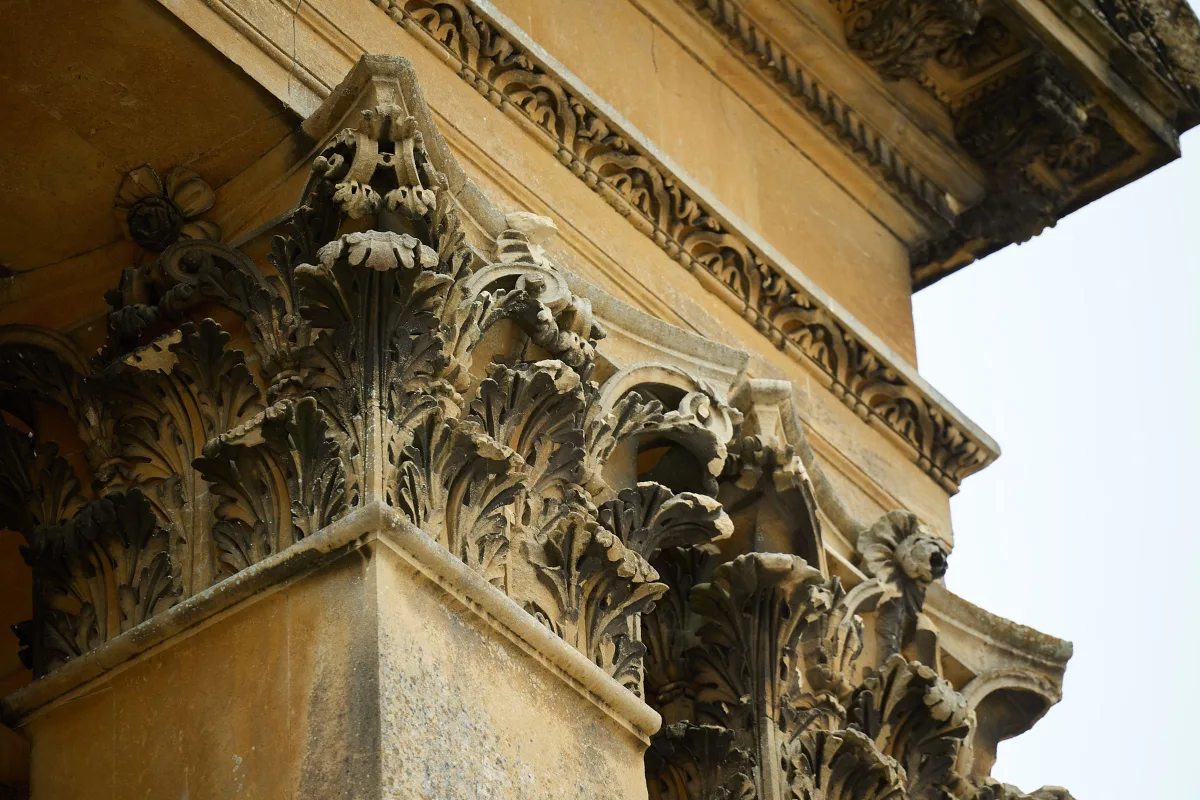
The construction site also had its unforeseen events. Edward Lewis, the project architect at Donald Insall Associates, was stuck on a cherry picker for a while. It had broken down under the weight of around 200 kilos of pieces of sculpture that he had just picked up.
The palace was finally adapted to the climate. Gutter capacity has been increased by more than 300%. The attics were insulated, better ventilated and partitioned against fire, and protection against lightning was improved. The team also created a digital copy of the palace, called a “digital twin.” It will make it possible to monitor the condition of the building and identify problems before they get worse.

The roof first
Among Blenheim’s maintenance principles, there is a very simple one: “Roof First”. As long as the roof is in good condition, everything under it is protected.
The estate paid for two-thirds of the work itself. He received support from the National Lottery Heritage Fund and relied on foundations and donors for the rest. The proceeds from the visits were spent directly on the construction site. The next step is already planned: in 2027, the built heritage team will take care of the park.

SOURCES AND CREDITS
Documentary sources
- UNESCO, World Heritage Centre, “Blenheim Palace” (property no. 425): https://whc.unesco.org/en/list/425
- UNESCO, decision 11 COM VII.A, inscription of Blenheim Palace, 1987: https://whc.unesco.org/en/decisions/3747
- Blenheim Palace, “The Roof Restoration Project”: https://www.blenheimpalace.com/restoration/palace-roof-project/
- Blenheim Palace, “The Glow Up”: https://www.blenheimpalace.com/whats-on/events/the-glow-up/
- Blenheim Palace, “Rooftop View”: https://www.blenheimpalace.com/whats-on/events/rooftop-view/
- Blenheim Palace, “Roof light” (“Roof First” principle): https://www.blenheimpalace.com/restoration/projects/roof-light.html
- Experience Oxfordshire, “Blenheim Palace gears up to reveal its “Glow Up” following £12m two-year restoration”, August 7, 2026: https://www.experienceoxfordshire.org/blenheim-palace-gears-up-to-reveal-its-glow-up-following-12m-two-year-restoration/
- Experience Oxfordshire, “Blenheim Palace celebrates 75th anniversary of public opening”: https://experienceoxfordshire.org/?p=181337
- The Art Newspaper, Maev Kennedy, “Gods, emperors and eagles restored in Blenheim Palace roof-rescue mission”, April 7, 2026: https://www.theartnewspaper.com/2026/04/07/gods-emperors-and-eagles-restored-in-blenheim-palace-roof-rescue-mission
- Business Mondays, Jon Perks, “Blenheim Palace completes landmark £12m restoration”, November 20, 2026: https://businessmondays.co.uk/blenheim-palace-completes-landmark-12m-restoration-safeguarding-300-years-of-history/
- Building, Thomas Lane, “Fixing the roof while the sun is shining”: https://www.building.co.uk/buildings/fixing-the-roof-while-the-sun-is-shining-making-blenheim-palace-fit-for-the-next-300-years/5141635.article
- ScaffMag, “Blenheim Palace Scaffolding Works Featured on ITV News”, March 2025: https://scaffmag.com/2025/03/blenheim-palace-scaffolding-works-featured-on-itv-news
Photo credits (order of appearance)
- Photo 1: restored roof, Blenheim Palace,
- Photo 2: visitors on the scaffolding, Damian Griffiths / Donald Insall Associates,
- Photo 3: bust of Louis XIV under restoration, Damian Griffiths / Donald Insall Associates,
- Photo 4: ceiling of the Saloon by Louis Laguerre, Blenheim Palace,