Only eleven countries and the Holy See officially recognise Taiwan. Everywhere else, the island has no embassy. So it sent something else: its chefs, its restaurants, and a milk tea filled with black pearls. A diplomacy sipped through a straw.
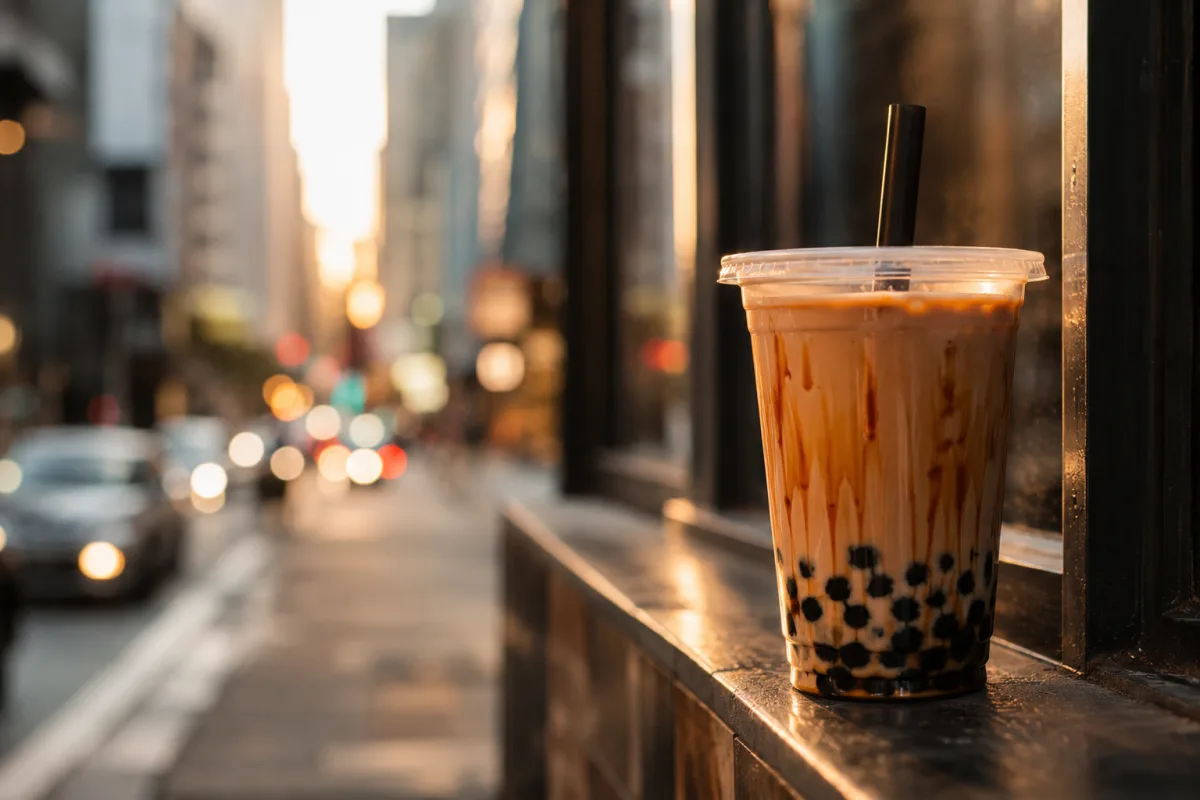
A clear cup, sealed with a plastic film. A wide straw, cut on the slant. At the bottom, black tapioca pearls that rise one by one, sweet and chewy. Bubble tea was born in Taiwan in the 1980s. Today it is drunk in Paris, London, Sydney and Los Angeles. Behind this cup lies a question of diplomacy.
An Island Without Embassies
Taiwan has no seat at the UN. In May 2026, the island has only twelve diplomatic allies left: eleven states and the Holy See. In the rest of the world, no embassy, no state dinner, no treaty signed in due form. Beijing regards the island as part of its territory, and over the years the list of its official partners has kept growing shorter.
When the official doors are closed, others must be found. Cuisine is one of them.
2010: The State Goes into the Kitchen
In 2010, President Ma Ying-jeou made exporting Taiwanese cuisine a political priority. The government launched a plan christened “Gourmet Taiwan”, presented abroad under the name “All in Good Taste: Savor the Flavors of Taiwan”. It was allocated 34.2 million dollars over four years, under the aegis of the Ministry of Economic Affairs. It was soon nicknamed “dim sum diplomacy”.
The programme funded food festivals abroad. It sent Taiwanese chefs to international schools and competitions. It helped restaurants set up beyond the island.
One point must be made in fairness: this plan was also, and perhaps first of all, an economic stimulus plan, meant to create jobs and brands. But when a country has almost no other shop window, the line between commerce and diplomacy becomes very thin.
Paul Rockower, an American scholar of public diplomacy, was then in Taipei as a visiting fellow at the Taiwan Foundation for Democracy. He summed up the idea in the British press: Taiwan had understood that a country is best made known through the kitchen table. His example is not some grand banquet dish. It is a simple sea-salt coffee, which is enough, he says, to awaken curiosity about a culture.
When the official doors are closed, the kitchen remains.
Bubble Tea, an Ambassador Without a Passport
The 2010 plan bet on restaurants and chefs. The greatest ambassador came from elsewhere: a street drink, carried first by Taiwanese entrepreneurs, then adopted far beyond their community. With no flag and no speeches, bubble tea did what no consulate could do: it planted the name of Taiwan in the daily lives of millions of people.
But a single shop window is also a weakness. In 2025, two researchers, Andrew Yen Chang and Ho-Chun Herbert Chang, studied more than 100,000 Instagram posts devoted to bubble tea between 2020 and 2024. Their first finding: the drink crowds out every other image of Taiwanese cuisine. Their second finding is more troubling. According to them, posts that mention Taiwan are roughly twelve times less visible than the others, and activity drops sharply after the inauguration of President Lai Ching-te in May 2024.
The study has not yet been validated by other researchers. But it raises a new question: what becomes of shop-window diplomacy when the shop window belongs to a platform?
An embassy can close. A cup keeps circulating.
A Diplomacy of Necessity
Other countries practise gastrodiplomacy: Thailand, South Korea, Malaysia, Peru. For them, cuisine is one tool among others, alongside embassies, summits and treaties. For Taiwan, it is one of the few tools still open.
That is what makes this case unique. Here, cuisine does not complement diplomacy: it partly replaces it. It speaks to people rather than to governments, on a shopping street rather than in a palace. It signs nothing. But it brings a name into being.
What the cup carries, in the end, is not only sweet tea. It is a presence in the world, served without protocol, but not without strategy.
Also in our pages: Culinary Diplomacy: When the Plate Plays Politics.
FAQ
Why is gastrodiplomacy so important for Taiwan? Because the island has official diplomatic relations with only twelve partners. Cuisine lets it make itself known where it has no embassy.
When did Taiwanese gastrodiplomacy begin? In 2010, with a public plan funded at 34.2 million dollars over four years, under the presidency of Ma Ying-jeou.
Was bubble tea part of that plan? The plan focused mainly on restaurants, chefs and festivals. Bubble tea’s global success owes much to private entrepreneurs, but the drink has become the most visible symbol of Taiwanese cuisine.
Sources
- Paul S. Rockower, “Projecting Taiwan: Taiwan’s Public Diplomacy Outreach”, Issues & Studies, vol. 47, no. 1, March 2011, pp. 107-152.
- Paul S. Rockower, “Recipes for Gastrodiplomacy”, Place Branding and Public Diplomacy, vol. 8, no. 3, 2012.
- Paul S. Rockower, “A Guide to Gastrodiplomacy”, Routledge Handbook of Public Diplomacy, 2020.
- USC Center on Public Diplomacy, “Eight Great Gastrodiplomacy Nations”.
- Martin Mandl, “Taiwan with a Side of New Public Diplomacy”, Taiwan Insight, 21 June 2021.
- “Taiwan launches gastro-diplomacy drive”, reprint of a British press article, 9 August 2010.
- Andrew Yen Chang and Ho-Chun Herbert Chang, “Food as Soft Power: Taiwanese Gastrodiplomacy on Social Media and Algorithmic Suppression”, arXiv, November 2025 (preprint).
- Leilani Collins Chen and Adrienne Wu, “Taiwanese Identity and Culinary Diplomacy”, Global Taiwan Institute, November 2023.
- Reuters, “Factbox: Taiwan’s 12 Remaining Diplomatic Allies”, 2 May 2026.
- Ministry of Foreign Affairs of the Republic of China (Taiwan), list of diplomatic allies.
- USC Center on Public Diplomacy, profile of Paul Rockower.
With the contribution of Paul S. Rockower.