A State Dinner in the East Room
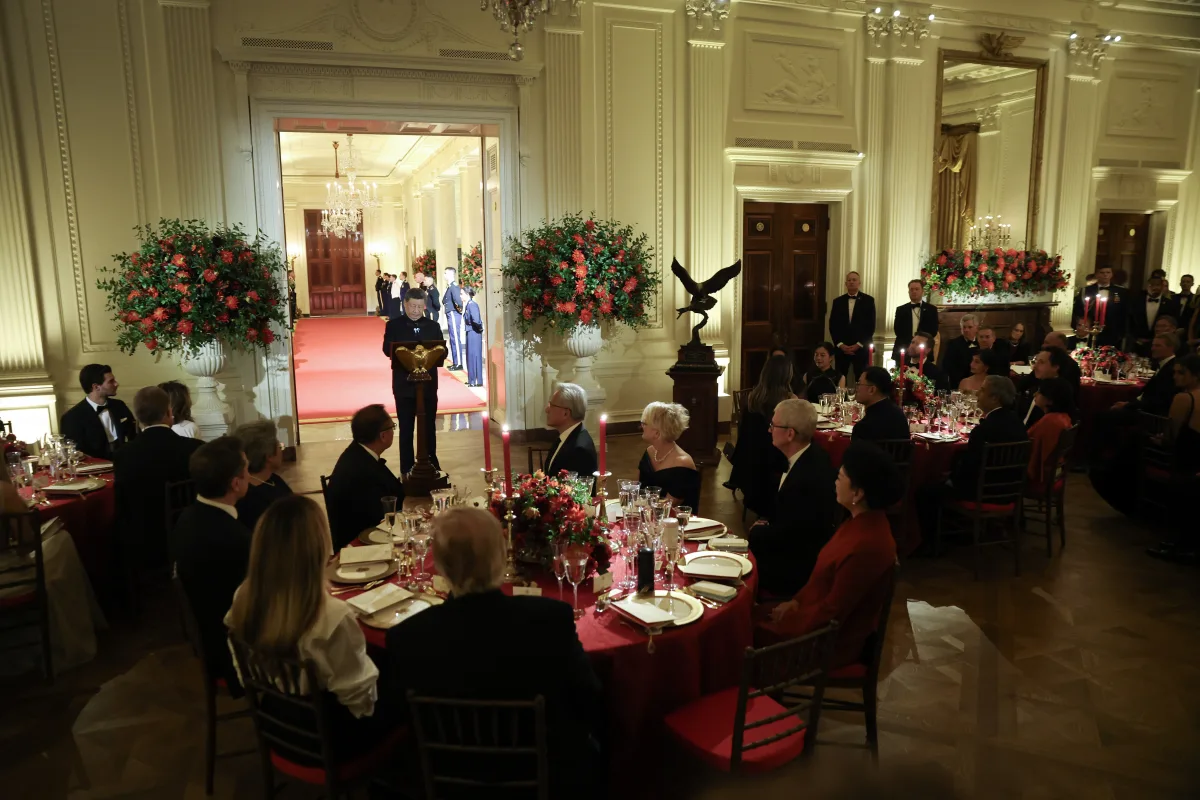
Donald Trump would undoubtedly have preferred to receive Xi Jinping in his future ballroom. It is still under construction. The state dinner offered to the Chinese president and his wife, Peng Liyuan, was therefore held in the East Room, the largest reception room in the White House.
Around 145 guests were seated there.
The visit had particular importance. Xi Jinping had not been received on a state visit to Washington since 2015 and was returning Donald Trump’s visit to Beijing a few months earlier.
Two state visits in less than six months: the two countries clearly had a lot to say to each other.
The arrival
At the North Portico, the ceremonial is that of special occasions: red carpet, photographers, handshakes and official photo of the two presidential couples on the steps of the White House.
Outside the protocol perimeter, the atmosphere is different. Demonstrators hostile to Beijing are heard even during the official photographs.
This is also what a state visit is: two realities that sometimes coexist a few dozen meters from each other.
Before dinner, look at the table
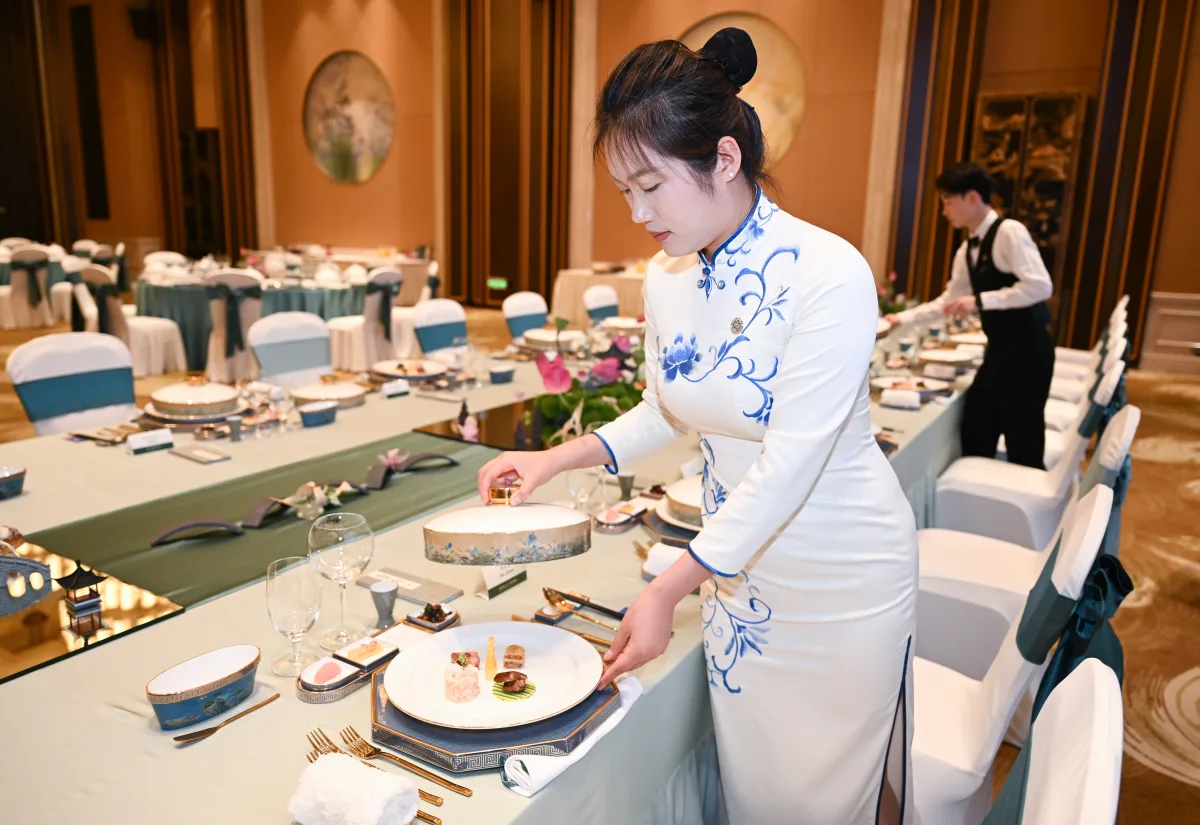
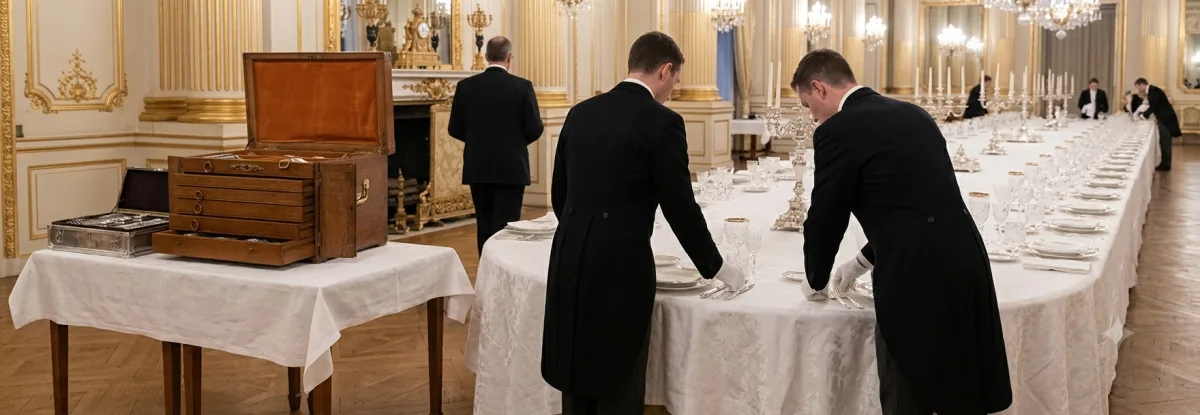
For a steward, dinner begins well before the guests arrive.
The table already gives a lot of information.
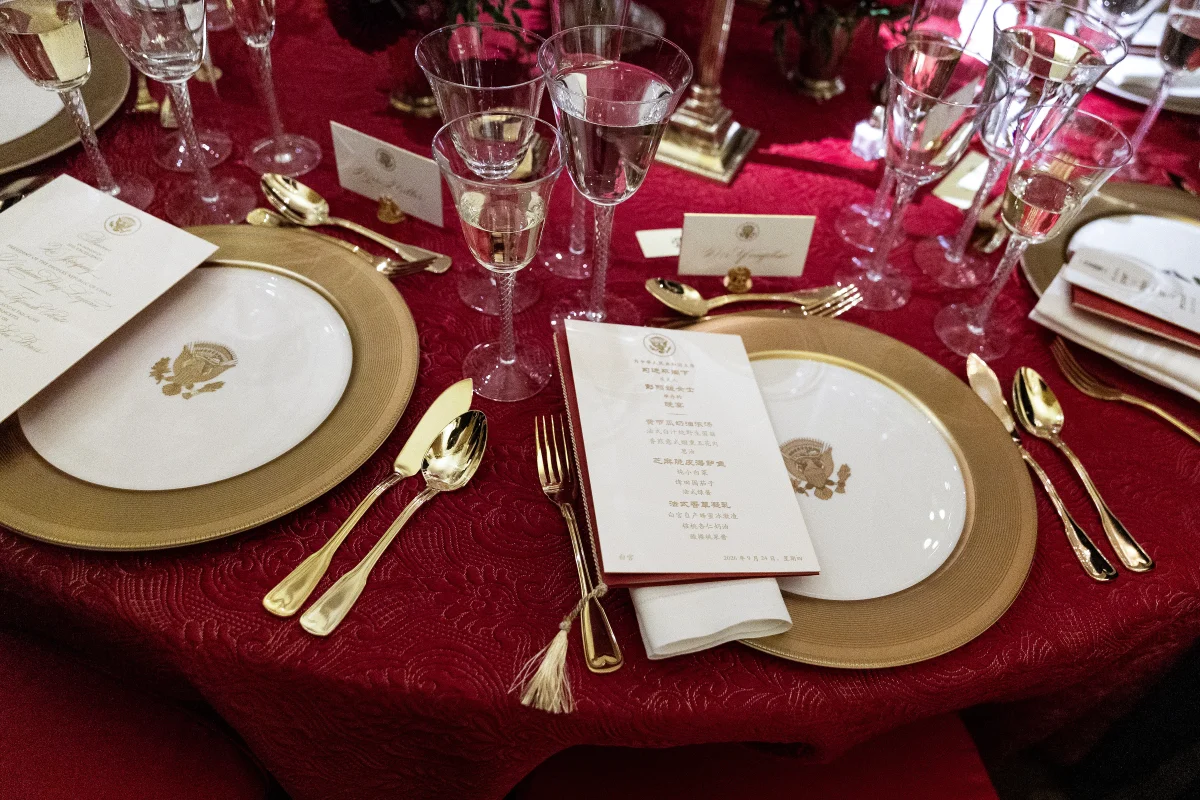
Red is everywhere: tablecloths, candles, flowers. The White House presented it as a tribute to a color deeply associated with Chinese culture.
But looking closer at the photographs, other details attract attention.
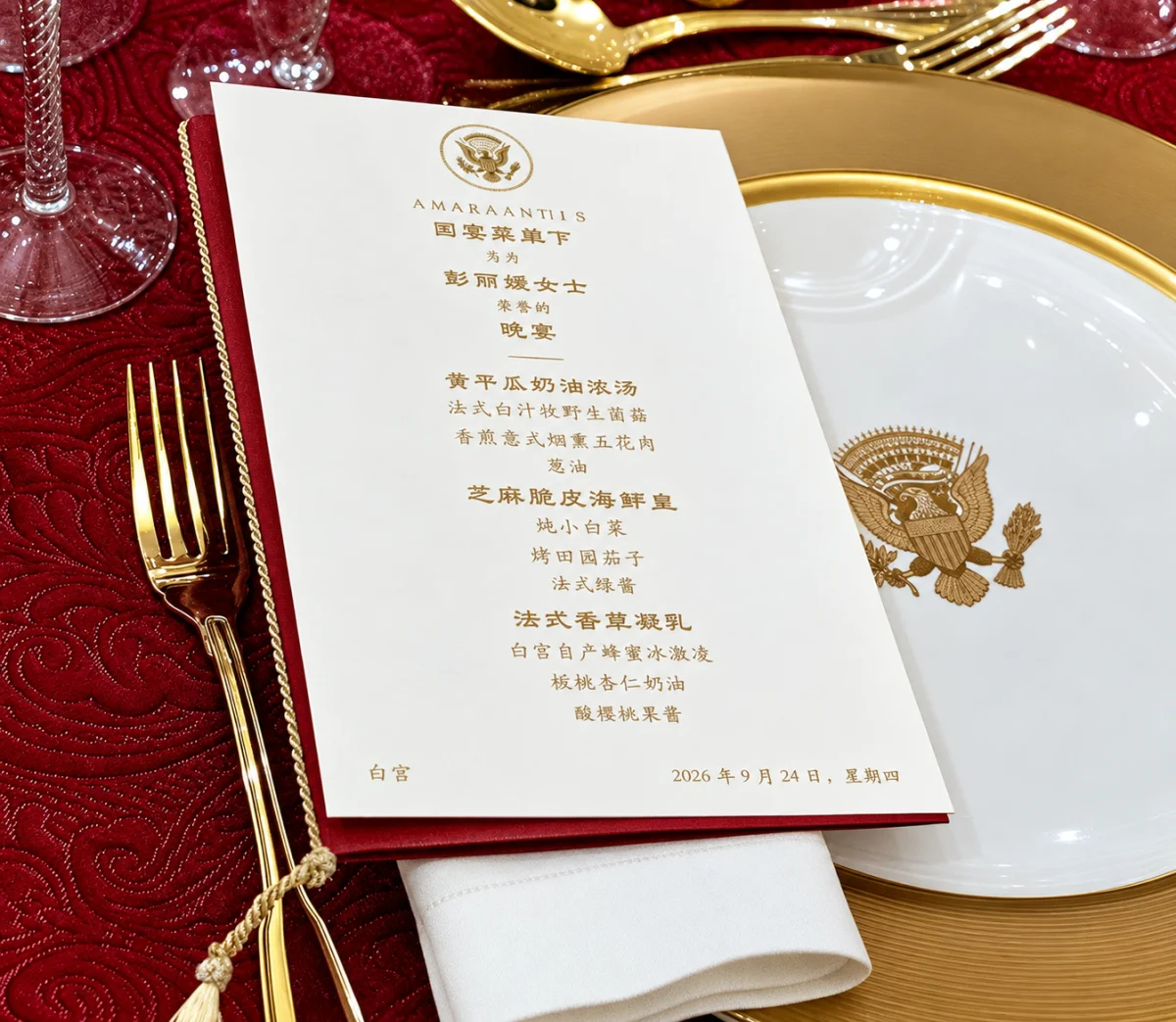
The tablecloth is not just red. It features a quilted scrollwork pattern that catches the candlelight very well. In front of each guest, a large gold fluted tray holds a white plate bearing the presidential seal in gold.
The cutlery is in vermeil, in the threaded model. Their arrangement already allows us to guess the construction of the meal: soup spoon, flat-bladed fish knife, dessert cutlery placed above the plate. Nothing spectacular, but a perfectly readable table.
The glasses, with twisted legs, are reminiscent of ancient crystals. They were filled before the guests entered.
The woven linen napkin is folded into a rectangle. The calligraphed menu is placed on top, held in place by a cord ending in a gold tassel. The place cards are written in pen.
It is a fairly classic table in its organization, but very elaborate in the materials.
Centerpieces are kept low, allowing guests to see and talk to each other without having to walk around the flowers. Dahlias, ranunculus, deep reds, coral, burgundy: the palette remains in the register chosen for the evening.
Around the room, large white arrangements include cactus dahlias and orange berries.
Some will see it as a reminder of chrysanthemum, very present in Chinese culture. However, there is no evidence to suggest that this reference was intentional.
Another detail deserves attention.
The White House had announced the use of the Reagan service, this porcelain with a large red rim chosen by Nancy Reagan in 1981. However, in the photographs of the table before the dinner, it is mainly the gold that we notice.
The Reagan service was able to intervene during the meal. But at the time the room was photographed, the American table was clearly more gold than red.
The toast: a memory from 1972
Dinner opens with a Californian sparkling wine from Schramsberg.
The choice is not trivial.
In February 1972, during Richard Nixon’s historic trip to China, a wine from this house was served in Beijing during the famous toast with Zhou Enlai.
However, one clarification must be made: it was not exactly the same vintage. In 1972, it was a Blanc de Blancs. 1969. In 2026, the White House chose a Blanc de Noirs.
The historical reference is therefore real, but it is due to the estate more than to the bottle itself.
And it’s undoubtedly more interesting this way: we don’t reproduce 1972, we discreetly refer to it.
An American menu… very French in its construction
The menu was presented in English and Chinese.
The Chinese version is particularly interesting to observe.
The term 法式, “French style”, appears several times: for the wild mushrooms, for the green sauce and for the vanilla cream. Pancetta is described as “Italian-style” smoked pork.
It’s a detail, but it says something about the construction of the meal.
The products are essentially American: yellow squash, sea bass, eggplant from the White House garden, walnuts, morello cherries, honey from the hives of the presidential residence.
Some elements directly refer to Asia: spring onion oil, sesame, braised bok choy.
On the other hand, the culinary vocabulary and techniques remain very French: velouté, fricassee, creamy, frangipane.
This is not a particularity of this evening alone. French cuisine continues to occupy an important place in the technical repertoire of large official Western dinners, even when no French dish strictly speaking is served.
No guest chef has been announced for this dinner. It was different in 2015: during Xi Jinping’s previous state visit to Washington, under Barack Obama, chef Anita Lo participated in preparing the meal.
A detail could also surprise the Chinese guests. In Beijing, the Mid-Autumn Festival had already started and Xi Jinping himself mentioned it in his toast. However, no mooncake appears to have appeared on the menu.
It’s not necessarily a message. But for a meal constructed with so many cultural references, the absence is noticeable.
Two speeches, two ways of telling the story
Donald Trump speaks first. He discusses the differences between the two political systems but emphasizes the duration of relations between the American and Chinese people.
Xi Jinping also chooses to talk about history.
It recalls ping-pong diplomacy, the redwoods offered to China after Nixon’s trip and even evokes George Washington, a lover of Chinese porcelain.
The reference is well chosen for a state dinner: talking about Chinese porcelain in one of the most ceremonial rooms of the White House serves as a reminder that relations between the two countries are not limited to the tensions of the moment.
Music also accompanies the evening, with tenor Christopher Macchio and several American military groups, including the Marine Band, “The President’s Own”.
The American gift
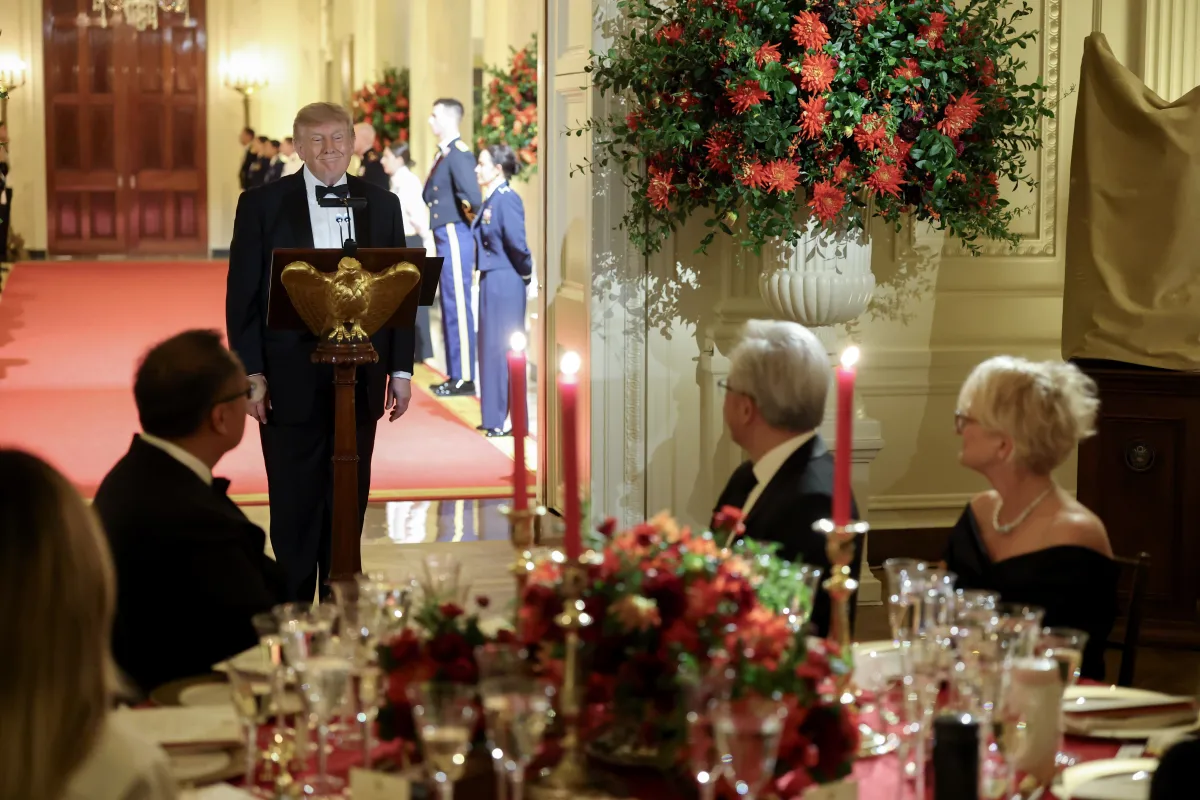
During Donald Trump’s speech, an object covered in a veil waits near the lectern.
It is then revealed: a bald eagle, wings open on a branch. The American president specifies that the gift was designed with Melania Trump and wishes Xi Jinping to find a nice place for it in Beijing.
The choice of the eagle is obviously not discreet. It is one of the most immediately identifiable symbols of the United States.
What is interesting is its repetition in the setting.
We find the eagle on the desk, on the plates, on the menus and on the place cards. At the end of the dinner, it also becomes an item given to the Chinese president.
The decoration paid homage to China through color. However, American symbols had not disappeared.
At the head table
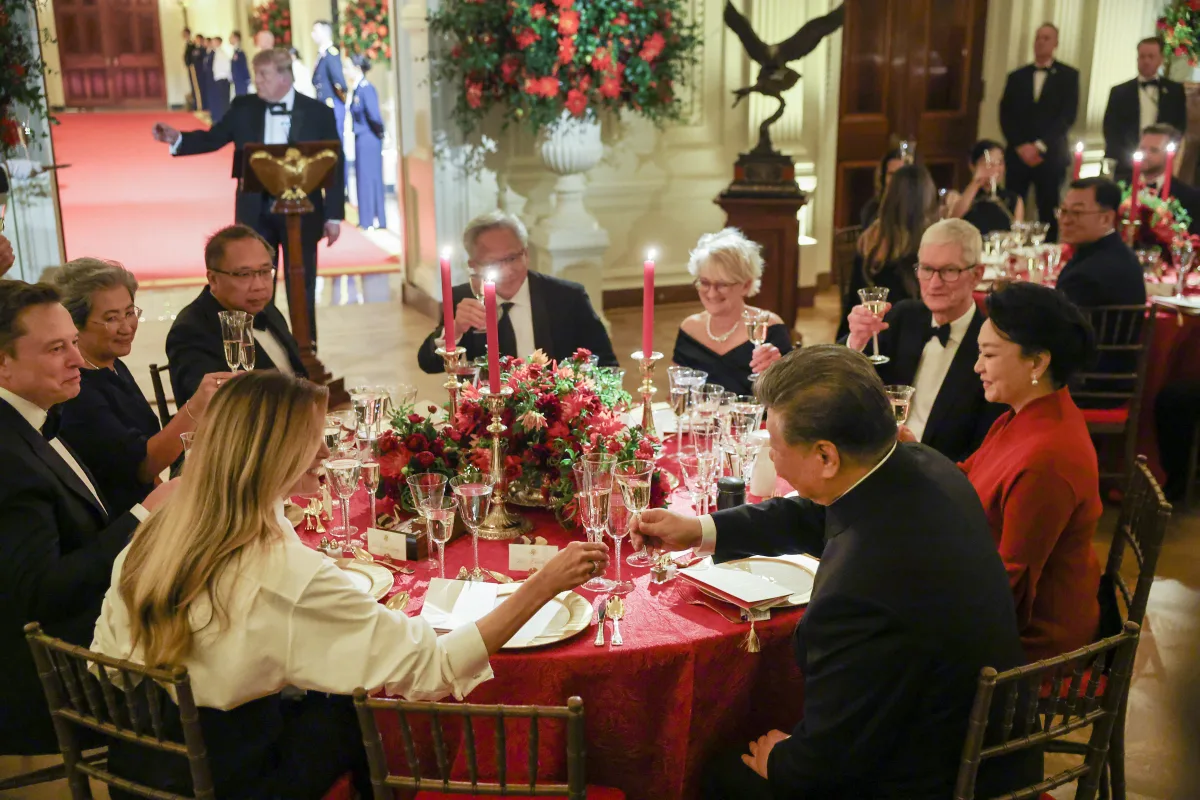
The placement of the guests tells another part of the evening.
Melania Trump sits between Xi Jinping and Elon Musk. Peng Liyuan is near Tim Cook. Nvidia boss Jensen Huang and AMD’s Lisa Su are also among the guests.
Melania Trump’s outfit is also worth a look: rather than an evening dress, she chose a tuxedo, accompanied by a white blouse with a large bow and black brocade pants decorated with peonies.
The Chinese reference is there, but in a fairly subtle way.
Also in the room are Jeff Bezos, Mark Zuckerberg, Sam Altman, Sundar Pichai, Satya Nadella, Jamie Dimon, Larry Fink and Bernard Arnault.
The composition of the room reveals an evolution of state dinners.
Technology, artificial intelligence and finance now occupy a considerable place in this type of reception. The big personalities of the show were much less present that evening.
In 2011, during the visit of President Hu Jintao, the evening included a large part of culture, including a performance by pianist Lang Lang at the White House. Fifteen years later, the scene has changed: among the most notable guests are mainly the leaders of technology, artificial intelligence and finance. The symbol is interesting: cultural figures have not disappeared, but economic and technological power now occupies a much more visible place at the state table.
Another notable element: several leaders of large Chinese groups, notably BYD, Xiaomi and CATL, had been announced or discussed before the visit. They were ultimately not among the guests, the Chinese delegation present at the dinner being essentially government.
Here again, we must avoid making an absence say too many things. But at a state dinner, the guest list always deserves as much attention as the menu.
After dinner, visit to the construction site
The evening ends in a rather unusual way.
Donald Trump invites some of his guests to go through a curtain at the back of the East Room to discover the construction site of the future White House ballroom.
He already evokes a “Great Hall of the United States”.
Xi Jinping, for his part, did not publicly present his gift to the American president during the dinner. A Chinese present is nevertheless visible in the East Room.
The most notable Chinese announcements are elsewhere: two giant pandas intended for the United States and the invitation to 100,000 American students to come and study in China.
Two very different ways of practicing the diplomatic gift.
What I remember from this table
This dinner was not based on revolutionary scenography. And that’s precisely what makes it interesting.
The White House used very classic codes: official china, silver gilt, candles, flowers, large table service. She added enough Chinese references to honor the guest without transforming the East Room into a themed setting.
Red made the link with China. The gold and the eagles were an immediate reminder of where we were.
In the kitchen, the same logic appears: American products, some Chinese touches, but a largely French technical grammar.
Finally, the guest list perhaps tells the story of the 2026 state dinner better than anything else. Around the table, the bosses of technology and artificial intelligence had taken a place previously occupied more readily by artists and major figures of culture.
This is probably where this evening becomes truly interesting for the steward.
A state table is never just a beautiful table. You have to look at who is sitting there, what you serve them, the objects you take out of storage and the references you choose to slip into the decor.
And sometimes just look at what’s missing.
Sources
Official sources
- White House, Office of the First Lady: menu, decor and dinner program, September 24 2026
- White House, Office of the First Lady: State Visit Schedule, September 21 2026
- SCIO, State Council Information Office (China): full text of Xi Jinping’s toast
- Xinhua, via People’s Daily: Chinese report of the banquet
- White House (Obama archives): China State Dinner press kit, 2015
Heritage and history
- White House Historical Association: The Reagan Service
- UPI Archives: “First lady pays $210,000 for new china”, 1981
- White House Historical Association: Chinese state visits to the White House
- Schramsberg Vineyards: the toast of 1972
- Schramsberg Vineyards: history of the estate
Press
- Associated Press: Menu, fashion and dinner guests
- The New York Times: full guest list
- The Washington Post: a menu between France and China
- The Washington Post: the outfits of the two First Ladies
- Yahoo News: Placement at the head table
- Yahoo Lifestyle: the French anchor of Trump-era state dinners
- CNN: Chinese bosses expected and absent
- The Hill: Giant Pandas and Student Visa
- The Washington Times: the gift and guest list
- Reuters (French): demonstrators, toasts and visit to the construction site
- East Wing Magazine: outfits and program of the visit
- Outlook India: AP photographs, including the Chinese present
Iconographic sources
Photographs taken during the state dinner offered to Chinese President Xi Jinping at the White House, Washington, September 24, 2026.
- Setting up the table in the East Room. Kevin Dietsch/Getty Images - Xi Jinping toasting with Melania Trump during Donald Trump’s speech. Kevin Dietsch/Getty Images - Donald Trump speaking during the state dinner. Kevin Dietsch/Getty Images - Xi Jinping delivering his speech in the East Room. Kevin Dietsch/Getty Images
© 2026 Getty Images. Editorial use.