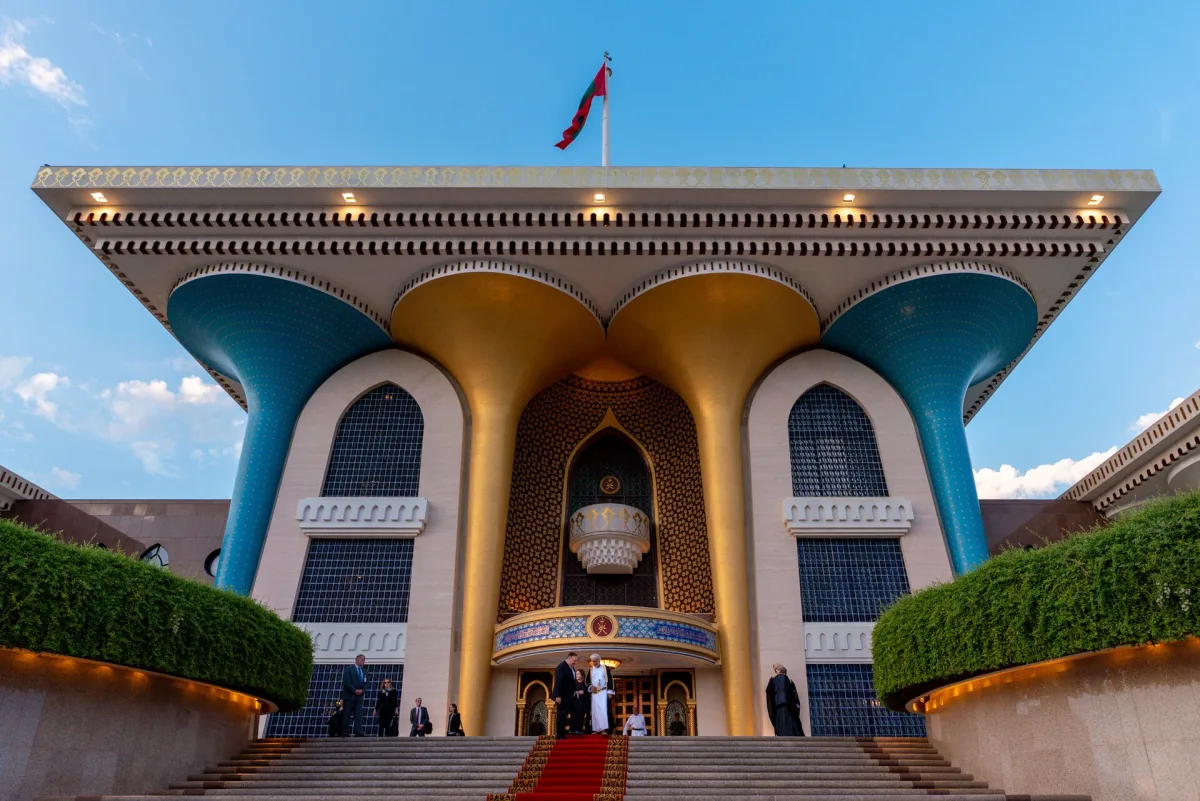
In Muscat, the ceremonial palace of Al Alam was not conceived to be lived in, but to receive. And what is exchanged there of any importance is not spoken: it is poured, offered and breathed in. A journey into a sensory diplomacy, where coffee, the date and incense make up the whole welcome of heads of state.

One imagines a state audience made of speeches, handshakes and communiqués. In Oman, the essential happens elsewhere, and without a word. Before a single word is spoken, the host has already said everything: through the coffee poured from an ewer, through the date held out with the right hand, through the curl of incense that scents the room and the guests’ clothes. And this scene is played out, in Muscat, in a place built for it alone: the ceremonial palace of Al Alam, which is not the sovereign’s dwelling but his theatre of welcome. Here, hospitality does not accompany protocol: it is the protocol, made entirely of gestures, of flavours and of scents.
A journey into a sensory diplomacy.

A palace reserved for official receptions
Al Alam - “the flag” - occupies the tip of old Muscat, facing the harbour, there where the sea once brought the emissaries. The building one sees today dates from 1972: a façade blazing with gold and blue, borne by tall columns that flare open like a corolla, set against the mountain and guarded, on either side, by the forts of Al Jalali and Al Mirani, inherited from the sixteenth-century Portuguese presence.
The essential point rests on a rare distinction: Al Alam is not the sultan’s residence. It is a ceremonial palace, reserved for official receptions, for the welcome of heads of state and foreign delegations, for the presentation of letters of credence. The sovereign does not sleep there; he receives there. The place is a built threshold, an architecture wholly given over to the moment when the other is shown in. Nothing about it is domestic; everything is arranged for the encounter. And it is precisely because the palace is pure theatre of welcome that what unfolds there deserves our attention.
The kahwa, the first gesture of welcome
The encounter begins with coffee, and coffee here is not a drink: it is a preamble. Omani kahwa, lightly roasted, is scented with cardamom and saffron, sometimes with rose water; it is poured from a long-spouted ewer, the dallah, into small handleless cups, the finjan. Every detail of the service carries a meaning.
One pours little - only a few sips - and one pours from high up, to crown the cup with a little foam. One serves with the right hand, beginning with the eldest or most eminent guest, then descending the hierarchy of those present. The coffee always comes with the date, Khalas or Fardh, whose sweetness answers the bitterness of the cup. And when a guest has drunk enough, he does not say so: he gently shakes the cup between his fingers, and the service stops. This whole ballet - who pours, for whom first, with which hand, how many times - tells without a word of rank, of respect and of measure. In Oman, an audience begins inside a cup.

Incense, the Omani signature
Then comes the scent, and with it the invisible signature of Omani hospitality. Oman was, in antiquity, the great land of incense: Dhofar, in the south, has for millennia produced luban, the resin that fed the incense road and made the region’s fortune - a heritage today inscribed by UNESCO under the name “Land of Frankincense”. What the caravans once sold to Rome and to India still perfumes today’s receptions.
In the majlis, the reception space, incense is burned on a brazier, the mabkhara, and passed around among the guests. The smoke is not a decoration: it is a sign of honour. It purifies the air, it speaks of the care given to the guest, it wraps each person in one and the same scent of welcome. The censer is passed from hand to hand so that everyone lets the smoke soak into their clothes and their hair. To receive the incense, in Oman, is to be honoured; and the gesture dispenses with all speech: it is enough to make the visitor feel that he is welcome. Where the coffee opens the audience, the incense holds its atmosphere.

Scents brought back by the sea routes
These flavours and these scents were not born of a single terroir: they come from the ocean. For centuries, Oman was a maritime power, linked to East Africa, to India, to Persia, and as far as Zanzibar, long placed under its authority. From these routes came back the very scents of hospitality: the cardamom, the saffron, the rose water that lift the coffee. The Omani welcome tray is, in its way, the map of a former empire of the seas.
This origin explains the very particular tonality of Omani protocol: sober, yet cosmopolitan; restrained, yet rich. One does not seek to dazzle by excess here, but to honour by rightness. Generosity expresses itself in measured gestures, never in displays. Down to the khanjar, the curved dagger worn at the belt during official ceremonies, everything works toward one and the same idea: dignity is shown through bearing, not through pomp.
A sensory art of hosting
One must beware of exoticising this scene. Omani sensory protocol is no picturesque folklore: it is a ceremonial of state as sophisticated as that of the great Western courts, simply written in another alphabet. Where the West codes power through the precedence of seats, the order of toasts and the length of speeches, Oman codes it through the hand that pours, the order of service and the smoke that circulates.
It is in this that the subject is profoundly a matter of stewardship. Behind the apparent simplicity of a cup and a censer hides a choreography regulated to the last gesture, handed down from generation to generation, and performed in a palace designed for it. To host, here, is not a preliminary to diplomacy: it is its very language. And this language has the rare advantage of dispensing with translation - a foreign head of state does not need to understand Arabic to grasp that he is being honoured.