
In 1984, the year of its independence, Brunei entrusts a Filipino architect with the most delicate mission imaginable: to give form to the power of a state only just born. The result is the largest residential palace in the world, and the masterpiece of a man who, all his life, had learned to make concrete float.
One looks at the Istana Nurul Iman as one looks at a record: the largest residential palace on the planet, a profusion of gilded domes, an excess worthy of an Oriental tale. That is to miss what matters. This palace is not a heaping-up of splendours: it is an argument, written by a single hand. On the eve of its independence, a tiny but ancient sultanate needed to give itself a face, and it entrusted the task to a foreigner, the Filipino Leandro Locsin, a modernist and a Catholic, of whom the impossible was asked: to translate into concrete the legitimacy of a monarchy entering History. A state palace is never a décor: it is a doctrine made habitable, and this one was written by the hand of a poet.
Portrait of the architect who gave a kingdom its silhouette.
On 1 January 1984, Brunei ceases to be a British protectorate and becomes a fully sovereign sultanate. That same month, the palace is ready. The coincidence is anything but chance: one does not accidentally deliver a two-hundred-thousand-square-metre edifice on the day a state is born. The palace is the act of independence, as much as the flag and the anthem. What remains is to understand what it says, and for that, one must look at the man who drew it.
A Poet of Concrete Summoned to Brunei
Leandro Valencia Locsin was no decorator of courts. He was one of the greatest architects of Southeast Asia, the man his country calls “the poet of concrete.” Named National Artist of the Philippines in 1990, he had covered Manila with buildings that became emblems, foremost among them the Cultural Center of the Philippines, a vessel of concrete whose marble façade seems to float twelve metres above the ground. His signature lay in a mastered contradiction: the duality of the light and the heavy, the floating and the massive.
The choice of this man to build the palace of a Malay Muslim sultanate was not self-evident, and that is what makes it fascinating. Locsin held a precise idea of architecture: it had to be, he said, the product of two great currents, the Eastern and the Western, fused into an object of profound harmony. All his life he had sought to wed the modernity that came from America (his influences ran to Eero Saarinen and Paul Rudolph) to the traditional forms of his archipelago: the dominant roof, the broad eaves, the massive supports inherited from the native house. One could dream of nothing better for a country that wished, precisely, to be at once modern and true to itself. In entrusting him with the Istana Nurul Iman, Brunei was not commissioning a building: it was commissioning a synthesis. This palace would become, of all his work, his largest single-piece achievement.
Domes, Malay Roofs, and Concrete: Locsin’s Synthesis
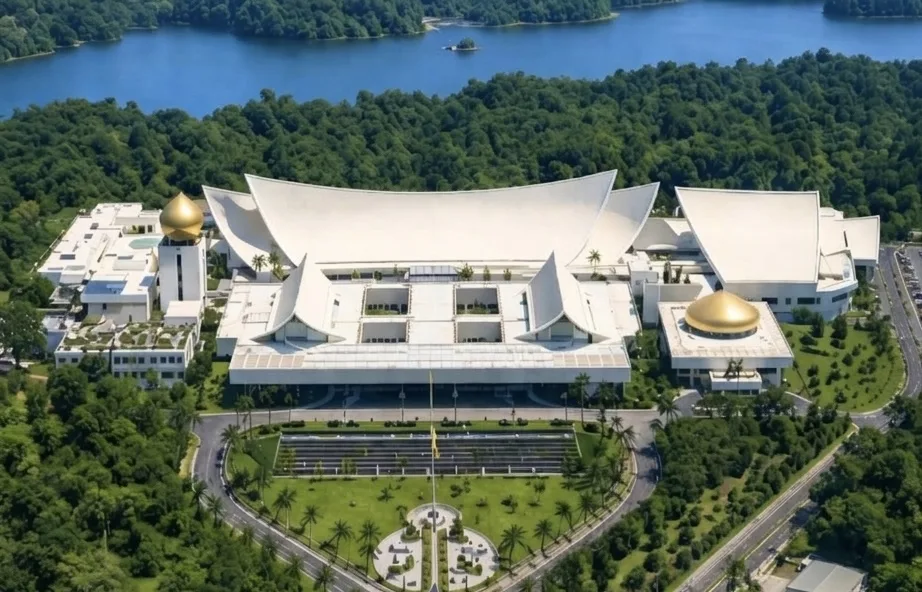
Up close, the Istana Nurul Iman ceases to be a gilded accumulation and becomes a reasoned assembly. Three architectural registers are layered upon one another, each drawn from a precise source. The gilded domes belong to the vocabulary of Islamic architecture, whose curve and gleam they take up. The roofs, steeply pitched and broadly eaved, derive from Malay vernacular architecture, that of the tropical dwellings conceived for shade and driving rain. And beneath these crownings, the volumes themselves, horizontal masses, clean lines, disciplined concrete, belong to the most contemporary modernism. Dome, roof, and mass: three traditions, a single edifice.
This assembly is no pastiche. It proceeds from Locsin’s very method, which spent a career fusing Western forms and Eastern legacies into a coherent whole. Here he does not juxtapose his borrowings, he articulates them: the verticality of the domes set against the horizontality of the roofs, the severity of the concrete softened by the ample sweep of the eaves, the mass lightened by plays of shadow and by the plinths that lift it. The edifice holds together as a demonstration of balance among three worlds that, elsewhere, ignore one another.
There remains the political reach of this alloy. In the very year the palace was delivered, Brunei raised into state doctrine the Melayu Islam Beraja, the “Malay Islamic Monarchy,” which binds together Malay identity, the Muslim faith, and the monarchic institution. The edifice’s three registers cover exactly its three terms: the roof for Malayness, the dome for Islam, modern monumentality for the sovereign state the monarch embodies. Palace and doctrine, born the same year, proceed from a single programme, one formulated in principles, the other executed in concrete and gold. Herein lies the intelligence of the commission: to give a nascent ideology not an emblem of circumstance, but a built form, durable, inhabited by the very man it legitimises.
Making the Mass Float
Then comes the finest paradox of the whole affair, the one that makes the architect so pertinent to our subject. The most massive palace in the world was entrusted to the man who had spent his career fighting mass. Locsin, master of weightlessness, who made colossal blocks appear light, found himself handed two hundred thousand square metres to hold upright without their crushing anything.

His whole art consisted precisely in this: raising volumes on sculptural plinths so they seem to hover, hollowing deep shadows beneath the overhangs to lighten the masses, throwing out cantilevers that defy the eye. On the wooded hills along the bank of the Brunei River, the Istana works the same magic on an unprecedented scale: its golden roofs appear to rest on light more than on stone, and its silhouette, despite its vastness, keeps something airborne when seen from the river. This is where the difference between a vast building and a work of art is measured: anyone could build big; it took Locsin to build big and graceful. The poet won his hardest wager: to make light that which, by nature, had to carry the full weight of a state.
The Day the Palace Shakes Hands
A palace is judged not only by its proportions, but by what it does. And the Istana Nurul Iman, a fortress ordinarily closed, performs once a year the most spectacular gesture of hospitality imaginable. During Hari Raya Aidilfitri, the feast that closes the month of fasting, the palace opens its doors for three days and receives some one hundred and ten thousand visitors. They enter by the thousands; they are fed; the sovereign greets the men in person, the queen and the women of the royal household welcome the women visitors, and the children leave with small green envelopes slipped with money.
This scene tells everything about the palace’s function, and it vindicates the architect. For the Istana Nurul Iman was conceived to receive: its banquet hall can seat up to five thousand guests, its mosque some fifteen hundred faithful, and its volumes are cut to absorb the crowd without ever jostling it. Locsin had not only built a symbol; he had built a machine for receiving, able to pass, in a single day, from intimate residence to the largest popular reception in the kingdom. Stewardship here is not the stewardship of delegations: it is that of an entire people led into the home of its sovereign.
A Single Roof for the Whole State
Finally, one must take the measure of what this palace gathers under a single roof. The Istana Nurul Iman is not merely a residence: it houses the office of the Prime Minister (a function held by the sultan himself), the seat of government, the audience halls where heads of state and ambassadors are received, a throne room for great ceremonies, and its own mosque. Under one roof, the sovereign sleeps, prays, governs, and receives the world.
It is a rare choice, and Locsin served it with logic: since everything had to coexist, the edifice had to be vast enough and articulated enough that the private and the official, the sacred and the diplomatic, would never interfere with one another. Where other states scatter their functions, a palace to live in, another to govern from, a third to pray in, Brunei gathered everything together and entrusted a single architect with holding this improbable ensemble in place. The palace is not only the sultan’s house: it is the very body of the Bruneian state, drawn in a single stroke.