November 2020. A Chinese state newspaper celebrates a “China-led” international standard for the kimchi industry. In Seoul, it is read as an annexation, and the internet catches fire. Yet this is not the start of the war. It is already the second round.
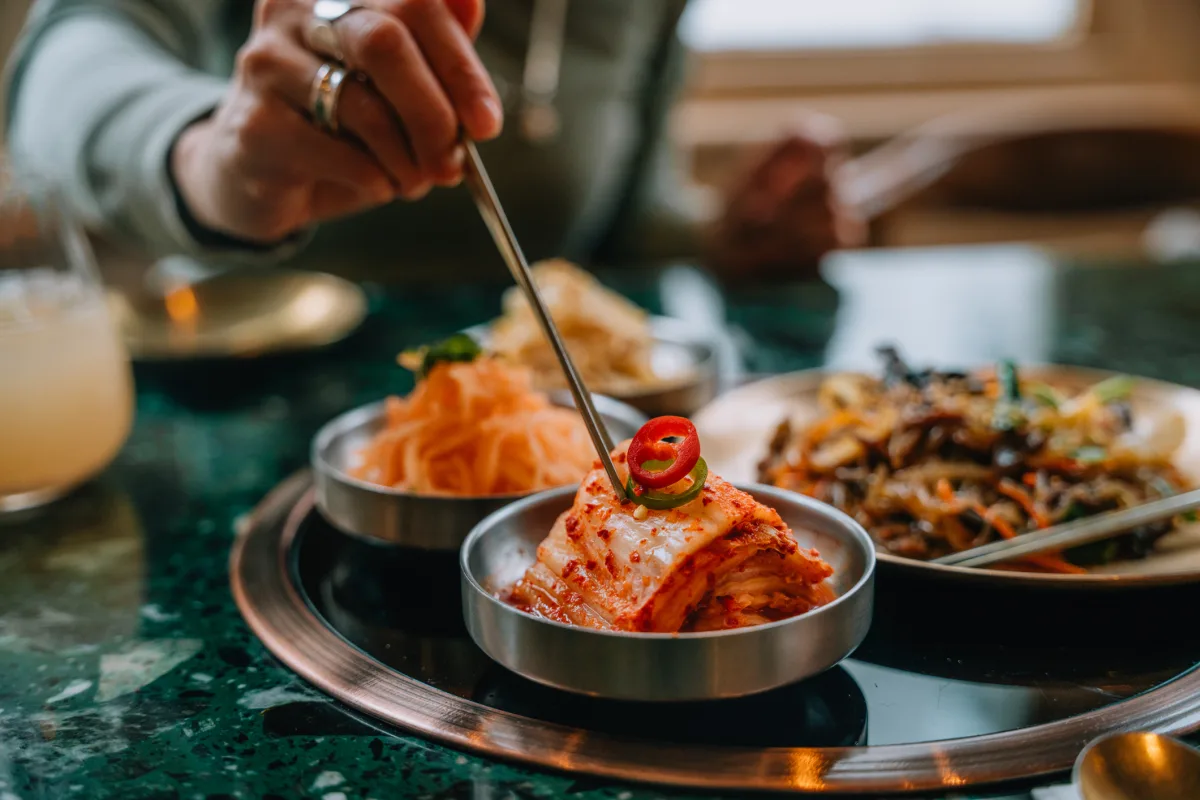
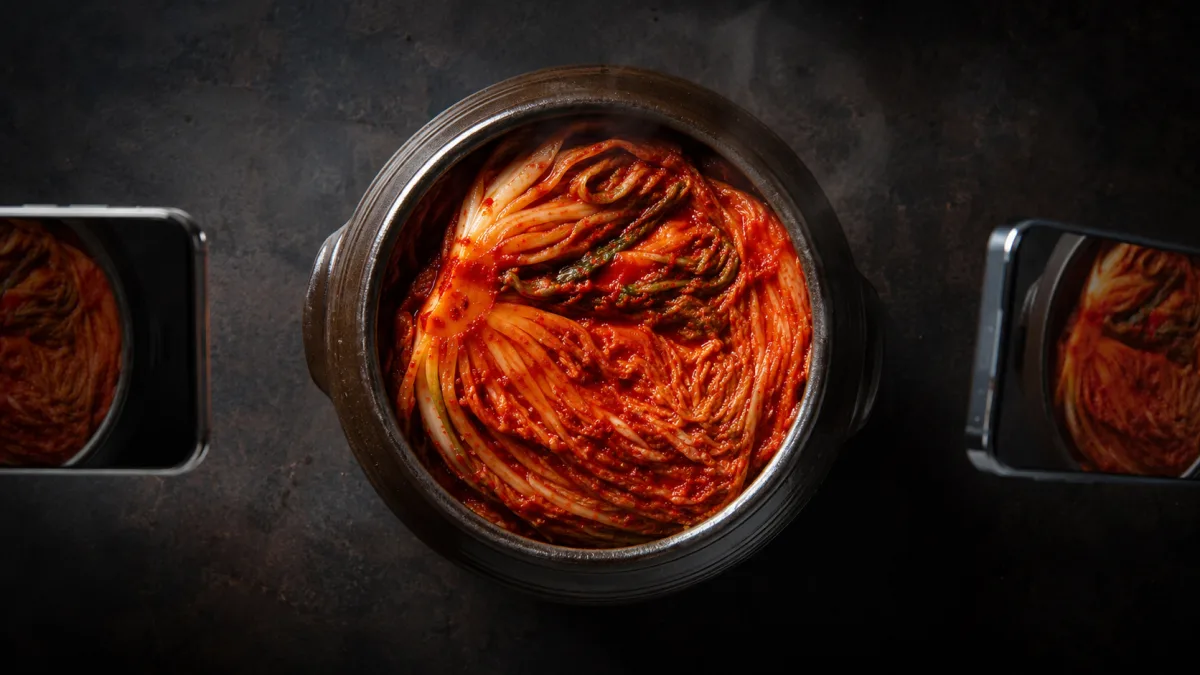
A cabbage cut into quarters, massaged with a scarlet paste of chilli (gochugaru), garlic, ginger and fish brine, then left to be forgotten in an earthenware jar. Kimchi (김치) is that tangy miracle: crunchy, hot, alive in the literal sense, since the bacteria are still at work in it. In Korea it reaches the table before the menu does, in a small dish that is refilled without anyone asking. Every autumn, kimjang gathers families and neighbours around the same basins, to last the whole winter. It is hard to imagine anything more everyday, more intimate, more bound up with identity.
Round One: The War of the Jars
It all begins quietly, in the trade figures. Chinese kimchi costs far less, and Korean restaurants start buying it. Since 2006, Korea has imported more kimchi than it exports. Between 2007 and 2011, its purchases of Chinese kimchi increased at least tenfold.
In the other direction, the door closes. In 2010, Korea was still selling 378,000 dollars’ worth of kimchi to China. By 2012, only 15,000 remained, then almost nothing: Chinese rules designed to protect local producers block the Korean dish.
In 2013, Seoul attempts a first counter-attack through vocabulary. The Korean Ministry of Agriculture proposes a Chinese name specific to kimchi, so that it is no longer confused with pao cai (泡菜), the brined vegetables of Sichuan. The name is so badly received in China that it vanishes at once. The same year, Seoul wins a symbolic victory: UNESCO inscribes kimjang as intangible cultural heritage of humanity.
Round Two: The War of Words
November 2020. China obtains an ISO standard for pao cai. The text says so in black and white: it does not apply to kimchi. But the Global Times speaks of a “China-led” standard for the entire kimchi industry. Now, in Chinese, a single word, pao cai, had until then served to name both. The misunderstanding was in the dictionary.
Each camp brings out its arguments. Korean internet users point out that kimchi has had its own standard since 2001, set by the Codex Alimentarius of the FAO and the WHO, a public body more credible in their eyes than the ISO, a private organisation. On the Chinese side, many reply that kimchi owes part of its history to pao cai, and that most of the kimchi eaten in Korea is made in China anyway.
Seoul then draws the weapon of the name, for good this time. In July 2021, the Korean Ministry of Culture makes xinqi (辛奇), “spicy and unique”, the official Chinese name for kimchi. Some 4,000 characters are said to have been studied before the choice was made. The stated aim: to distinguish Korean kimchi clearly from Chinese pao cai.
When two countries can no longer agree on the name of a dish, the battle has already begun.
Round Three: The War of the Screens
Meanwhile, the fight has moved from offices to phones. In January 2021, Li Ziqi, China’s star of food video, films the making of a chilli-spiced cabbage labelled Chinese cuisine. Korean comments rain down. The same month, the Korean YouTuber Hamzy likes a comment accusing China of appropriating kimchi. Her Chinese subscribers boycott her, and the Chinese company distributing her videos drops her. Shortly afterwards, she shoots a new kimchi video, this time with the Korean Ministry of Agriculture. The state has entered the arena.
The fire never really goes out. In 2024, a single subtitle is enough: in a Netflix show, Koreans make kimchi, and the Chinese translation calls it la bai cai, “spicy cabbage”. Hashtags, response videos, memes: each camp mobilises its internet users like troops, and the algorithm hands out the ammunition.
This is no longer a scholars’ quarrel. It is an influence war fought in the open.
So who is right? Both, and neither. Pao cai and kimchi are two distinct traditions of fermented vegetables, cousins but separated by ingredients, chilli and method. Nobody invented the idea of preserving a cabbage in brine. UNESCO settles nothing: after the South’s kimjang in 2013, it inscribed the North’s kimchi tradition in 2015. Neither exclusivity nor ownership. (Also in our pages: South Korea: Cuisine as an Affair of State.)
While the internet users fight, trade has made its choice. According to an official Korean survey, imported kimchi accounts for 36% of the country’s consumption, and more than half of what restaurants and canteens serve. Almost all of it comes from China, notably from Pingdu, in Shandong, now a major export base. The Chinese media see it as a fine opportunity for cooperation. The little red dish set before a diner in Seoul has often crossed the Yellow Sea.
In the end, this war is not about cabbage. It is about a country that has become a cultural power, from cinema to K-pop, and defends its dish like a flag. It is about an immense neighbour that refuses to have an ancient know-how contested. And about a market that, for its part, has no homeland. The fermentation goes on working in the jar, perfectly indifferent to notifications.
Sources
Primary sources
- UNESCO, “Kimjang, making and sharing kimchi in the Republic of Korea”, inscribed in 2013. North Korean kimchi tradition inscribed in 2015.
- ISO, standard on pao cai, 2020, which explicitly excludes kimchi.
South Korea
- Korea JoongAng Daily, “Seoul pushes xinqi as Chinese translation of kimchi”.
- The Korea Herald, “Food firms flustered over resurgent kimchi feud”, April 2022.
- The Korea Herald, “The world is eating more Korean kimchi, but Korea is importing more of it from China”, 24 November 2025.
- The Asia Business Daily, record kimchi imports and the aT survey, October 2025.
China
- Global Times, “Paocai or kimchi? They share similarities but differ”, January 2021.
- Global Times, Li Ziqi’s video reignites the controversy, January 2021.
- China News Service, “Over 99.9% of South Korea’s imported kimchi comes from China”, 31 October 2025.
International
- International Monetary Fund, “Kimchi: No Longer Solely Korea’s“, Finance & Development, June 2014.
- Reuters, “South Koreans, Chinese clash on social media over kimchi”, 30 November 2020.
- CNN, “Xinqi? Why kimchi is getting a new Chinese name”, August 2021.
- NextShark, “People in China dismiss South Korea’s push for new Chinese name for kimchi”, December 2021.
- Mothership, “Korean YouTuber, who got cancelled in China for saying kimchi is Korean, partners with govt”, January 2021.
- CBC News, “Netflix show reignites debate about what to call kimchi”, July 2024.
- The Guardian, “Kimchi, made in China: how South Korea’s national dish is being priced out at home”, December 2025.
Picture credits: original images composed by artificial intelligence for “Gastronomic Conflicts”. They are visual interpretations, not documentary photographs.