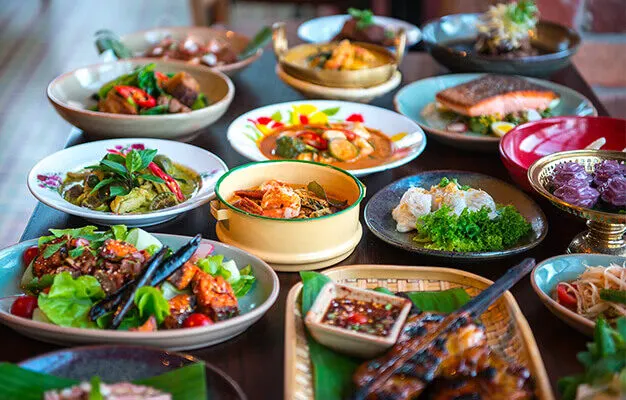
In 2002, Thailand took an unprecedented decision: to finance, with public money, the opening of Thai restaurants throughout the world. The goal is not just to feed people, but to improve the country’s image, sell its products and attract tourists. It was in this year that the word “gastrodiplomacy” was born. After the founding gesture of Talleyrand in the 19th century, here is the modern founding act, a model that the whole world will soon copy.
Two centuries after the Congress of Vienna, the history of diplomatic cuisine changed a second time. But the scenery has changed. We are no longer in a European negotiating room, we are in Bangkok, and the main character is not an aristocrat. He is a businessman who became head of government.

In 2001, Thaksin Shinawatra became Prime Minister of Thailand. A telecommunications billionaire, he runs the country as he ran his businesses, thinking first of all about brand image. However, at the beginning of the 2000s, Thailand’s image abroad was fragile. The country is only just emerging from the serious financial crisis that hit Asia in 1997, and its international reputation remains too often associated with sex tourism. Thaksin is looking for a positive way to talk about his country. He finds it in a wealth that Thailand already has, and that the world already loves: its cuisine.
A simple idea: each restaurant is an embassy
The Thai government’s reasoning is remarkably clear. A Thai restaurant abroad is not just a business. It is also a showcase for the country’s products, as he buys fish sauce, curry or lemongrass imported from Thailand. And it’s a tourist magnet, because anyone who loves a dish dreams of one day visiting the country where it comes from. Authorities even calculate a rule: for every one million people who dine at a Thai restaurant abroad, about one hundred thousand will eventually come to Thailand.
To turn this idea into reality, the state is putting money on the table. The program, called “Global Thai,” receives a budget of around $15 million per year. Above all, a state-owned bank offers loans of up to three million dollars to entrepreneurs who want to open a Thai restaurant abroad. In short, the country pays its citizens to cook around the world. An article in the British magazine The Economist, in February 2002, described this strategy and invented for the occasion a word with a great future: “gastro-diplomacy”.
Thai SELECT, a label to guarantee authenticity

Opening restaurants is not enough, they still need to be good and faithful to the country’s true cuisine. Thailand therefore created an official label in 2003: “Thai SELECT”. To obtain it, a restaurant must meet specific rules. It must be open at least five days a week, employ state-trained Thai cooks, use ingredients from Thailand, and offer traditional service and ambiance. This label is both a guarantee of quality, a sales tool for Thai products and an image tool.
Behind this system lies an impressive organization. Several ministries and agencies work together: commerce, foreign affairs, the public bank, the tourist office and even the national airline. This machine has a rare quality: it has survived all changes of power, including coups d’état, without ever stopping. Where other countries start from scratch with each new government, Thailand has held its course for more than twenty years.
Spectacular results
The numbers tell a story of success. In 2001, there were approximately 5,500 Thai restaurants worldwide. In 2025, there will be nearly 18,900, almost three and a half times as many. Tourism has grown significantly since the program launched, with nearly one in three new visitors citing food as a reason for their trip. Thailand is today one of the largest food exporters on the planet.
But the real success lies elsewhere. It can be summed up in a few names: pad thai, tom yum soup, green curry, mango sticky rice. These dishes have become world references, just like Italian pizza or Japanese sushi. Thailand has managed to associate its name with positive images: warmth, welcome, pleasure. In 2024, it was among the very top countries in the world ranking of soft power, this ability to seduce rather than constrain. For a country of its size, this is a considerable image victory.

What cooking can do, and what it can’t
However, we must remain honest, as the report that inspired this series invites us to do. Thai cuisine has transformed the country’s image, but it has not transformed its diplomacy. No serious study shows that a Thai restaurant abroad has changed a government’s decision. Paul Rockower, the researcher who popularized the word “gastrodiplomacy”, himself recognizes that these effects are very difficult to measure.
Other experts ask more awkward questions. This “authentic Thai cuisine” sold around the world is partly an invention: it highlights the dishes of the capital and leaves the cuisines of the regions in the shadows. And the obligation to import ingredients from Thailand mainly benefits large exporters. The success is therefore real, but we need to know what it is: a triumph of image and commerce, not an instrument that would replace classic diplomacy.
A model copied all over the world
Perhaps the best proof of Thai success is imitation. After 2002, many countries launched their own programs on the same model: Malaysia, South Korea, Peru, Taiwan, then Indonesia. They all used the Bangkok recipe: a public budget, quantified objectives, an official label, chefs sent abroad.
This is where Vienna and Bangkok meet. Talleyrand understood, by intuition, that the table is an instrument of power. Thailand has made it a method: a plan, a budget, rules. Between the cook of 1814 and the program of 2002, the same idea crosses two centuries and two continents. A country that knows how to make its cuisine loved makes itself loved. And no army can achieve that.